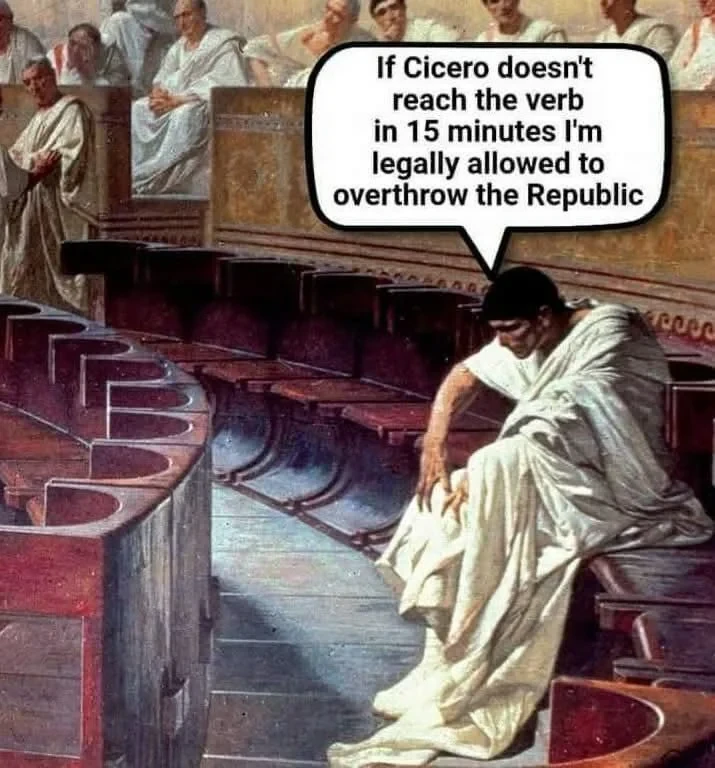
It was normal in Latin for the verb to go at the end, or near the end, of a sentence. Latin relies heavily on context and matching up word endings for meaning, rather than word order, I believe. Since word order was largely recommended rather than mandatory, Latin poetry could get very 'flexible'.
Cicero's nested statements were considered ornate and eloquent rather than tedious - one assumes assisted by verbal delivery. Very likely there is an element of classism here, though, as Roman society was immensely classist - by showing an elaborate ability to construct sentences that are extensive, wordplay-heavy, embellished, and yet still grammatically correct, Cicero displays higher learning, which was valued as a marker of social class.
Apparently, when Cicero was in his 20s and seeking an advanced rhetoric teacher to hone his style, he was instructed by said teacher in simplifying his rhetoric - a process Cicero seems to think worked and was core to his (then-current) style. One shudders to think of how elaborate pre-correction Cicero might have gotten!
By contrast, Julius Caesar is noted to have had a very simple and clear, yet pleasing, style of writing/speech, and both Cicero and Caesar - despite being on opposite political sides - expressed admiration for the other's literary/rhetorical ability, with Caesar regarding Cicero as the master of Latin literary rhetoric, and Cicero regarding Caesar's writings as so pure (stylistically) and clear that there could simply be no improving on them.