this part is about the early adoption hypothesis, and relies on one (!) table about the internet usage in Europe from 2000 to 2007
https://www.researchgate.net/figure/Internet-usage-in-Europe-2000-2007_tbl9_4891139
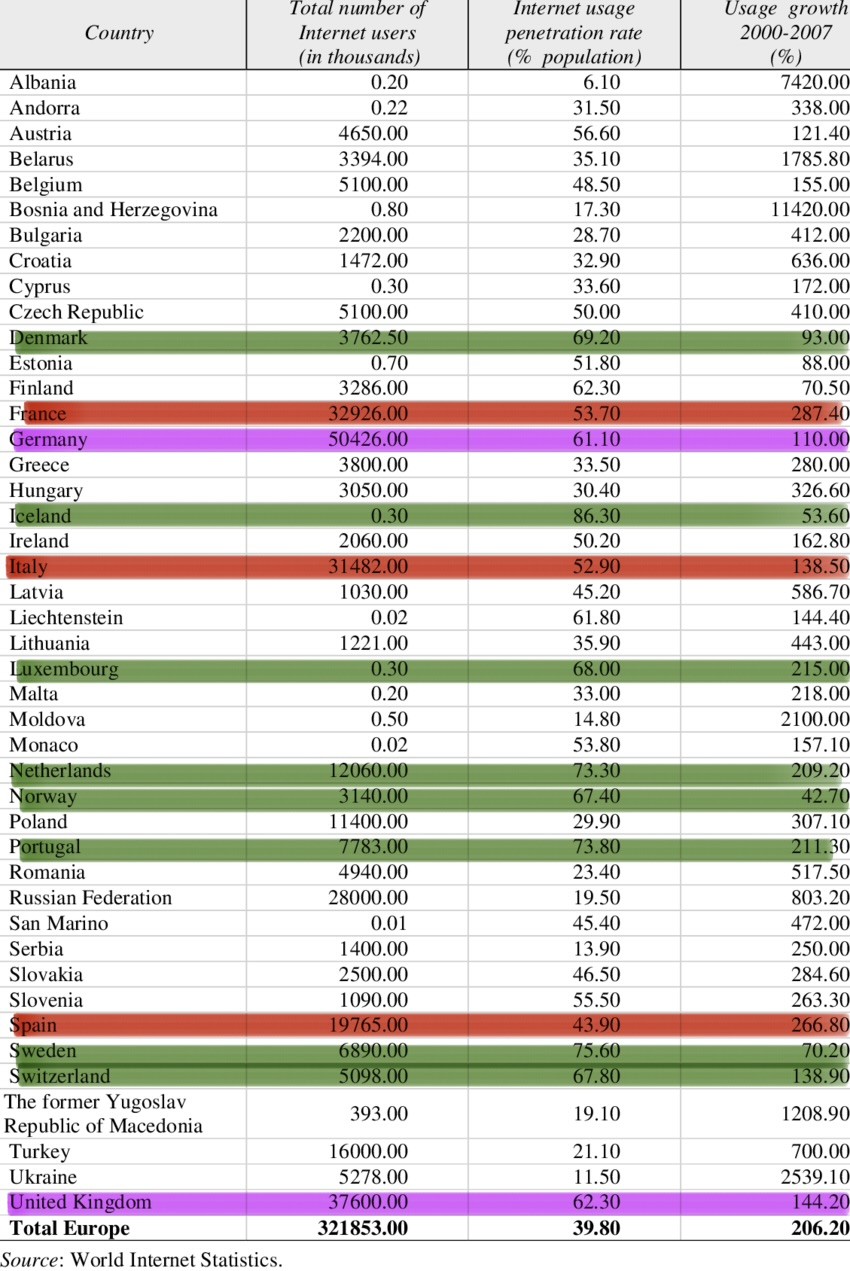
we can distinguish a few groups:
- relatively wealthy countries with high percentages of internet adoption but with a small population size which translates into relative small proportions (green)
- relatively less wealthy countries with lower percentages but with bigger population size which makes for bigger proportions (red)
- relatively wealthy countries with high percentages with a big population size which translates into big proportions (violet)
as we can see from the statistics, Germany is sporting the biggest total amount of internet users relative to the other European countries.
another relevant aspect is the percentage of growth, and Germany has one of the lowest growth rate compared to other countries while having a high percentage of users, which implies an early adoption of internet users.
linear regression could probably be used to find the relation between wealth and internet usage.
the case of Portugal is really interesting though, as it’s a less wealthy country but sporting a high percentage of internet users. Maybe there was some government subsidies?