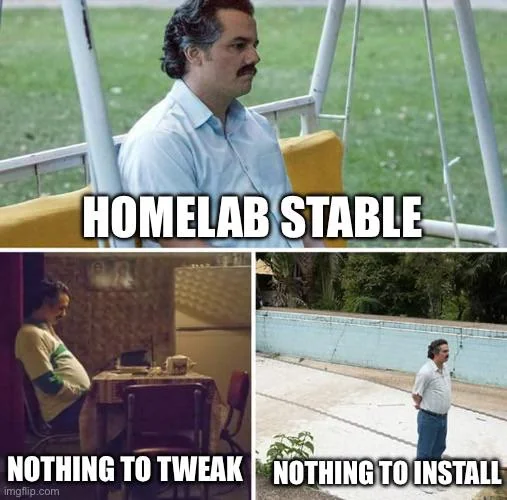
▲ 1343 ▼ Your logging is probably down (media.piefed.social) submitted 7 months ago by Ek-Hou-Van-Braai@piefed.social to c/selfhosted@lemmy.world 173 comments fedilink hide all child comments 😆 4
[–] epicshepich@programming.dev 15 points 7 months ago (14 children) And then try turning on SELinux! permalink fedilink source parent hideshow 14 child comments replies: [–] olafurp@lemmy.world 8 points 7 months ago (7 children) I set my homelab up on Bazzite immutable with podman and SELinux. It took a while to work everything out and have it boot up into a valid state hahaha permalink fedilink source parent hideshow 7 child comments replies: [–] epicshepich@programming.dev 6 points 7 months ago (6 children) Any reason you chose Bazzite for your homelab distro? First I've heard of someone doing that! permalink fedilink source parent hideshow 6 child comments replies: [–] olafurp@lemmy.world 2 points 7 months ago (2 children) At the start I just wanted a desktop machine that runs Steam through sunshine/moonlight so hardware support and gaming stuff such was very important. My homelab used to run on my laptop when it could all fit within a couple 100s of GB and I was the only user but moving it was tricky. Since I'm a programmer I'm not afraid of this stuff so I just spent the hours to figure out one problem at a time. I ended up figuring out adding HDD whitelist in SELinux, make it accessible in podman, manually edit fstab because tools didn't work, systemd service for startup, logging in automatically where I already forgot everything and would have not had to do any of this on a bog standard Ubuntu server. permalink fedilink source parent hideshow 2 child comments replies: [–] epicshepich@programming.dev 2 points 7 months ago* (1 child) Respect! I too often take it for granted that it's a privilege for my gaming rig and my homelab server to be separate boxes. My server is Almalinux, my laptop is Mint, and my gaming rig is Nobara. But if I had to consolidate everything in to one machine, I'd pick Nobara. permalink fedilink source parent hideshow 1 child comment replies: [–] olafurp@lemmy.world 2 points 7 months ago I came to the same conclusion, Nobara for would have been best. permalink fedilink source parent [–] Alaknar@sopuli.xyz 1 point 7 months ago (2 children) Wouldn't an immutable OS be overall a pretty good idea for a stable server? permalink fedilink source parent hideshow 2 child comments replies: [–] olafurp@lemmy.world 1 point 7 months ago Good for stability, bad for flexibility for when the homelab grows more complex. permalink fedilink source parent [–] epicshepich@programming.dev 1 point 7 months ago I honestly don't know a ton about immutable distros other than that they let you front-load some difficulty in getting things set up in exchange for making it harder to break. I was just surprised that the distro of choice was Bazzite, since its target audience seems to be gamers. permalink fedilink source parent [–] erev@lemmy.world 4 points 7 months ago (5 children) It's not that difficult to get SELinux working with podman quadlets, especially if you run things rootless. I have a kerberized service account for each application I host and my quadlets are configured to run under those. I very rarely encounter applications that simoky can't be run rootless but I usually can find an adequate alternative. I think right now the only thing that runs as root is one of the talk or collabora containers in my nextcloud stack. No selinux issues either. permalink fedilink source parent hideshow 5 child comments replies: [–] epicshepich@programming.dev 1 point 7 months ago (4 children) I use podman-compose with system accounts and I don't have a ton of issues. The biggest one is that I can't seem to get bluetooth and pip working on Home Assistant at the same time. Most of the servers I manage have SELinux and it works fine as long as I use :z/:Z with bind mounts. A few years ago, I set up a VPS for my friend's business; at the time, I didn't know how to work with SELinux so I just turned it off. I tried to flip it back on, and it somehow bricked the system. We had to restore from a backup. Since then, I've been afraid to enable it on my flagship homelab server. permalink fedilink source parent hideshow 4 child comments replies: [–] WhyJiffie@sh.itjust.works 1 point 7 months ago (3 children) are you sure it really bricked it? when turning it on, on next boot it needs to go over all the files and retag them or something like that, and it can take a significant amount of time permalink fedilink source parent hideshow 3 child comments replies: [–] epicshepich@programming.dev 1 point 7 months ago (2 children) Honestly, I don't know what happened, but it was unreachable via SSH and the web console. There shouldn't have been a ton of files to tag since it was an Almalinux system that started with SELinux enabled, and all we added was a container app or two. permalink fedilink source parent hideshow 2 child comments replies: [–] WhyJiffie@sh.itjust.works 2 points 7 months ago (1 child) that started with SELinux enabled that does not matter, it needs to go over all of them. I don't know how long it takes with SSD, but with HDD it can take a half an hour or more, with a mostly base system. and the kernel starts doing this very early, when not even systemd or other processes are running, so no ssh, but web console should have been working to see what its doing permalink fedilink source parent hideshow 1 child comment replies: [–] epicshepich@programming.dev 1 point 7 months ago Good to know! I do hope to eventually re-enable SELinux on my flagship server, so I'll keep this in mind. As for my friend's server, I think he migrated to Alpine a while back. permalink fedilink source parent
[–] olafurp@lemmy.world 8 points 7 months ago (7 children) I set my homelab up on Bazzite immutable with podman and SELinux. It took a while to work everything out and have it boot up into a valid state hahaha permalink fedilink source parent hideshow 7 child comments replies: [–] epicshepich@programming.dev 6 points 7 months ago (6 children) Any reason you chose Bazzite for your homelab distro? First I've heard of someone doing that! permalink fedilink source parent hideshow 6 child comments replies: [–] olafurp@lemmy.world 2 points 7 months ago (2 children) At the start I just wanted a desktop machine that runs Steam through sunshine/moonlight so hardware support and gaming stuff such was very important. My homelab used to run on my laptop when it could all fit within a couple 100s of GB and I was the only user but moving it was tricky. Since I'm a programmer I'm not afraid of this stuff so I just spent the hours to figure out one problem at a time. I ended up figuring out adding HDD whitelist in SELinux, make it accessible in podman, manually edit fstab because tools didn't work, systemd service for startup, logging in automatically where I already forgot everything and would have not had to do any of this on a bog standard Ubuntu server. permalink fedilink source parent hideshow 2 child comments replies: [–] epicshepich@programming.dev 2 points 7 months ago* (1 child) Respect! I too often take it for granted that it's a privilege for my gaming rig and my homelab server to be separate boxes. My server is Almalinux, my laptop is Mint, and my gaming rig is Nobara. But if I had to consolidate everything in to one machine, I'd pick Nobara. permalink fedilink source parent hideshow 1 child comment replies: [–] olafurp@lemmy.world 2 points 7 months ago I came to the same conclusion, Nobara for would have been best. permalink fedilink source parent [–] Alaknar@sopuli.xyz 1 point 7 months ago (2 children) Wouldn't an immutable OS be overall a pretty good idea for a stable server? permalink fedilink source parent hideshow 2 child comments replies: [–] olafurp@lemmy.world 1 point 7 months ago Good for stability, bad for flexibility for when the homelab grows more complex. permalink fedilink source parent [–] epicshepich@programming.dev 1 point 7 months ago I honestly don't know a ton about immutable distros other than that they let you front-load some difficulty in getting things set up in exchange for making it harder to break. I was just surprised that the distro of choice was Bazzite, since its target audience seems to be gamers. permalink fedilink source parent
[–] epicshepich@programming.dev 6 points 7 months ago (6 children) Any reason you chose Bazzite for your homelab distro? First I've heard of someone doing that! permalink fedilink source parent hideshow 6 child comments replies: [–] olafurp@lemmy.world 2 points 7 months ago (2 children) At the start I just wanted a desktop machine that runs Steam through sunshine/moonlight so hardware support and gaming stuff such was very important. My homelab used to run on my laptop when it could all fit within a couple 100s of GB and I was the only user but moving it was tricky. Since I'm a programmer I'm not afraid of this stuff so I just spent the hours to figure out one problem at a time. I ended up figuring out adding HDD whitelist in SELinux, make it accessible in podman, manually edit fstab because tools didn't work, systemd service for startup, logging in automatically where I already forgot everything and would have not had to do any of this on a bog standard Ubuntu server. permalink fedilink source parent hideshow 2 child comments replies: [–] epicshepich@programming.dev 2 points 7 months ago* (1 child) Respect! I too often take it for granted that it's a privilege for my gaming rig and my homelab server to be separate boxes. My server is Almalinux, my laptop is Mint, and my gaming rig is Nobara. But if I had to consolidate everything in to one machine, I'd pick Nobara. permalink fedilink source parent hideshow 1 child comment replies: [–] olafurp@lemmy.world 2 points 7 months ago I came to the same conclusion, Nobara for would have been best. permalink fedilink source parent [–] Alaknar@sopuli.xyz 1 point 7 months ago (2 children) Wouldn't an immutable OS be overall a pretty good idea for a stable server? permalink fedilink source parent hideshow 2 child comments replies: [–] olafurp@lemmy.world 1 point 7 months ago Good for stability, bad for flexibility for when the homelab grows more complex. permalink fedilink source parent [–] epicshepich@programming.dev 1 point 7 months ago I honestly don't know a ton about immutable distros other than that they let you front-load some difficulty in getting things set up in exchange for making it harder to break. I was just surprised that the distro of choice was Bazzite, since its target audience seems to be gamers. permalink fedilink source parent
[–] olafurp@lemmy.world 2 points 7 months ago (2 children) At the start I just wanted a desktop machine that runs Steam through sunshine/moonlight so hardware support and gaming stuff such was very important. My homelab used to run on my laptop when it could all fit within a couple 100s of GB and I was the only user but moving it was tricky. Since I'm a programmer I'm not afraid of this stuff so I just spent the hours to figure out one problem at a time. I ended up figuring out adding HDD whitelist in SELinux, make it accessible in podman, manually edit fstab because tools didn't work, systemd service for startup, logging in automatically where I already forgot everything and would have not had to do any of this on a bog standard Ubuntu server. permalink fedilink source parent hideshow 2 child comments replies: [–] epicshepich@programming.dev 2 points 7 months ago* (1 child) Respect! I too often take it for granted that it's a privilege for my gaming rig and my homelab server to be separate boxes. My server is Almalinux, my laptop is Mint, and my gaming rig is Nobara. But if I had to consolidate everything in to one machine, I'd pick Nobara. permalink fedilink source parent hideshow 1 child comment replies: [–] olafurp@lemmy.world 2 points 7 months ago I came to the same conclusion, Nobara for would have been best. permalink fedilink source parent
[–] epicshepich@programming.dev 2 points 7 months ago* (1 child) Respect! I too often take it for granted that it's a privilege for my gaming rig and my homelab server to be separate boxes. My server is Almalinux, my laptop is Mint, and my gaming rig is Nobara. But if I had to consolidate everything in to one machine, I'd pick Nobara. permalink fedilink source parent hideshow 1 child comment replies: [–] olafurp@lemmy.world 2 points 7 months ago I came to the same conclusion, Nobara for would have been best. permalink fedilink source parent
[–] olafurp@lemmy.world 2 points 7 months ago I came to the same conclusion, Nobara for would have been best. permalink fedilink source parent
[–] Alaknar@sopuli.xyz 1 point 7 months ago (2 children) Wouldn't an immutable OS be overall a pretty good idea for a stable server? permalink fedilink source parent hideshow 2 child comments replies: [–] olafurp@lemmy.world 1 point 7 months ago Good for stability, bad for flexibility for when the homelab grows more complex. permalink fedilink source parent [–] epicshepich@programming.dev 1 point 7 months ago I honestly don't know a ton about immutable distros other than that they let you front-load some difficulty in getting things set up in exchange for making it harder to break. I was just surprised that the distro of choice was Bazzite, since its target audience seems to be gamers. permalink fedilink source parent
[–] olafurp@lemmy.world 1 point 7 months ago Good for stability, bad for flexibility for when the homelab grows more complex. permalink fedilink source parent
[–] epicshepich@programming.dev 1 point 7 months ago I honestly don't know a ton about immutable distros other than that they let you front-load some difficulty in getting things set up in exchange for making it harder to break. I was just surprised that the distro of choice was Bazzite, since its target audience seems to be gamers. permalink fedilink source parent
[–] erev@lemmy.world 4 points 7 months ago (5 children) It's not that difficult to get SELinux working with podman quadlets, especially if you run things rootless. I have a kerberized service account for each application I host and my quadlets are configured to run under those. I very rarely encounter applications that simoky can't be run rootless but I usually can find an adequate alternative. I think right now the only thing that runs as root is one of the talk or collabora containers in my nextcloud stack. No selinux issues either. permalink fedilink source parent hideshow 5 child comments replies: [–] epicshepich@programming.dev 1 point 7 months ago (4 children) I use podman-compose with system accounts and I don't have a ton of issues. The biggest one is that I can't seem to get bluetooth and pip working on Home Assistant at the same time. Most of the servers I manage have SELinux and it works fine as long as I use :z/:Z with bind mounts. A few years ago, I set up a VPS for my friend's business; at the time, I didn't know how to work with SELinux so I just turned it off. I tried to flip it back on, and it somehow bricked the system. We had to restore from a backup. Since then, I've been afraid to enable it on my flagship homelab server. permalink fedilink source parent hideshow 4 child comments replies: [–] WhyJiffie@sh.itjust.works 1 point 7 months ago (3 children) are you sure it really bricked it? when turning it on, on next boot it needs to go over all the files and retag them or something like that, and it can take a significant amount of time permalink fedilink source parent hideshow 3 child comments replies: [–] epicshepich@programming.dev 1 point 7 months ago (2 children) Honestly, I don't know what happened, but it was unreachable via SSH and the web console. There shouldn't have been a ton of files to tag since it was an Almalinux system that started with SELinux enabled, and all we added was a container app or two. permalink fedilink source parent hideshow 2 child comments replies: [–] WhyJiffie@sh.itjust.works 2 points 7 months ago (1 child) that started with SELinux enabled that does not matter, it needs to go over all of them. I don't know how long it takes with SSD, but with HDD it can take a half an hour or more, with a mostly base system. and the kernel starts doing this very early, when not even systemd or other processes are running, so no ssh, but web console should have been working to see what its doing permalink fedilink source parent hideshow 1 child comment replies: [–] epicshepich@programming.dev 1 point 7 months ago Good to know! I do hope to eventually re-enable SELinux on my flagship server, so I'll keep this in mind. As for my friend's server, I think he migrated to Alpine a while back. permalink fedilink source parent
[–] epicshepich@programming.dev 1 point 7 months ago (4 children) I use podman-compose with system accounts and I don't have a ton of issues. The biggest one is that I can't seem to get bluetooth and pip working on Home Assistant at the same time. Most of the servers I manage have SELinux and it works fine as long as I use :z/:Z with bind mounts. A few years ago, I set up a VPS for my friend's business; at the time, I didn't know how to work with SELinux so I just turned it off. I tried to flip it back on, and it somehow bricked the system. We had to restore from a backup. Since then, I've been afraid to enable it on my flagship homelab server. permalink fedilink source parent hideshow 4 child comments replies: [–] WhyJiffie@sh.itjust.works 1 point 7 months ago (3 children) are you sure it really bricked it? when turning it on, on next boot it needs to go over all the files and retag them or something like that, and it can take a significant amount of time permalink fedilink source parent hideshow 3 child comments replies: [–] epicshepich@programming.dev 1 point 7 months ago (2 children) Honestly, I don't know what happened, but it was unreachable via SSH and the web console. There shouldn't have been a ton of files to tag since it was an Almalinux system that started with SELinux enabled, and all we added was a container app or two. permalink fedilink source parent hideshow 2 child comments replies: [–] WhyJiffie@sh.itjust.works 2 points 7 months ago (1 child) that started with SELinux enabled that does not matter, it needs to go over all of them. I don't know how long it takes with SSD, but with HDD it can take a half an hour or more, with a mostly base system. and the kernel starts doing this very early, when not even systemd or other processes are running, so no ssh, but web console should have been working to see what its doing permalink fedilink source parent hideshow 1 child comment replies: [–] epicshepich@programming.dev 1 point 7 months ago Good to know! I do hope to eventually re-enable SELinux on my flagship server, so I'll keep this in mind. As for my friend's server, I think he migrated to Alpine a while back. permalink fedilink source parent
[–] WhyJiffie@sh.itjust.works 1 point 7 months ago (3 children) are you sure it really bricked it? when turning it on, on next boot it needs to go over all the files and retag them or something like that, and it can take a significant amount of time permalink fedilink source parent hideshow 3 child comments replies: [–] epicshepich@programming.dev 1 point 7 months ago (2 children) Honestly, I don't know what happened, but it was unreachable via SSH and the web console. There shouldn't have been a ton of files to tag since it was an Almalinux system that started with SELinux enabled, and all we added was a container app or two. permalink fedilink source parent hideshow 2 child comments replies: [–] WhyJiffie@sh.itjust.works 2 points 7 months ago (1 child) that started with SELinux enabled that does not matter, it needs to go over all of them. I don't know how long it takes with SSD, but with HDD it can take a half an hour or more, with a mostly base system. and the kernel starts doing this very early, when not even systemd or other processes are running, so no ssh, but web console should have been working to see what its doing permalink fedilink source parent hideshow 1 child comment replies: [–] epicshepich@programming.dev 1 point 7 months ago Good to know! I do hope to eventually re-enable SELinux on my flagship server, so I'll keep this in mind. As for my friend's server, I think he migrated to Alpine a while back. permalink fedilink source parent
[–] epicshepich@programming.dev 1 point 7 months ago (2 children) Honestly, I don't know what happened, but it was unreachable via SSH and the web console. There shouldn't have been a ton of files to tag since it was an Almalinux system that started with SELinux enabled, and all we added was a container app or two. permalink fedilink source parent hideshow 2 child comments replies: [–] WhyJiffie@sh.itjust.works 2 points 7 months ago (1 child) that started with SELinux enabled that does not matter, it needs to go over all of them. I don't know how long it takes with SSD, but with HDD it can take a half an hour or more, with a mostly base system. and the kernel starts doing this very early, when not even systemd or other processes are running, so no ssh, but web console should have been working to see what its doing permalink fedilink source parent hideshow 1 child comment replies: [–] epicshepich@programming.dev 1 point 7 months ago Good to know! I do hope to eventually re-enable SELinux on my flagship server, so I'll keep this in mind. As for my friend's server, I think he migrated to Alpine a while back. permalink fedilink source parent
[–] WhyJiffie@sh.itjust.works 2 points 7 months ago (1 child) that started with SELinux enabled that does not matter, it needs to go over all of them. I don't know how long it takes with SSD, but with HDD it can take a half an hour or more, with a mostly base system. and the kernel starts doing this very early, when not even systemd or other processes are running, so no ssh, but web console should have been working to see what its doing permalink fedilink source parent hideshow 1 child comment replies: [–] epicshepich@programming.dev 1 point 7 months ago Good to know! I do hope to eventually re-enable SELinux on my flagship server, so I'll keep this in mind. As for my friend's server, I think he migrated to Alpine a while back. permalink fedilink source parent
[–] epicshepich@programming.dev 1 point 7 months ago Good to know! I do hope to eventually re-enable SELinux on my flagship server, so I'll keep this in mind. As for my friend's server, I think he migrated to Alpine a while back. permalink fedilink source parent