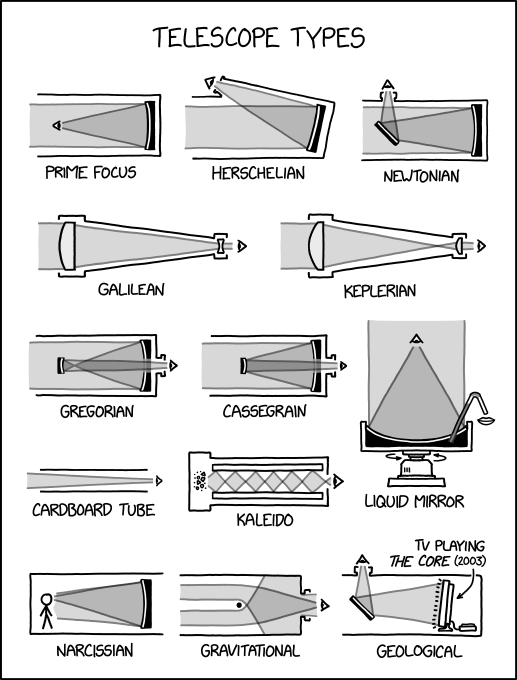
xkcd #3182: Telescope Types

Title text:

I'm trying to buy a gravitational lens for my camera, but I can't tell if the manufacturers are listing comoving focal length or proper focal length.

Transcript:

Transcript will show once it’s been added to explainxkcd.com

Source: https://xkcd.com/3182/
explainxkcd for #3182

I'm trying to buy a gravitational lens for my camera, but I can't tell if the manufacturers are listing comoving focal length or proper focal length.
you are viewing a single comment's thread
view the rest of the comments
[–] 4 points 10 months ago (4 children)

Anyone want to tell me how the telescopes where the mirror is in the middle of the aperture sometimes still show the image without a big dot/wires holding the mirror in what you see? It's smack in the middle you'd think it would block the view.

  • source
  • hideshow 4 child comments
  • [–] 11 points 10 months ago* (last edited 10 months ago) (1 child)

    The wire will cause the entire image to become a little bit darker.

    in a telescope light travels in many paths from start to finish. so a single wire will have a very soft shadow, which stretches over the entire image. This works because the wire is well within the focal length. If the wire was exactly at the focal length, it's shadow would be sharp, but the farther away it is from the focal length, the softer the shadow will become.

    edit: when the object is exactly at the center of the image, then I think it will still cast a sharp shadow, because all the light-paths that go through the center, stay close to the center. Not sure though

  • source
  • parent
  • hideshow 1 child comment
  • [–] 3 points 10 months ago

    It will only affect it materially if they cross where the light is converged / infocus. So if you put a big piece of paper where the wires are, the image will be blurred. So if you look at the wires from the focal point, they are also blurred enough to be able to see what's behind them

  • source
  • parent
  • [–] 2 points 10 months ago

    Like others have mentioned, the spider (the wires) and the secondary do shadow some light that would otherwise reach the primary. It also results in some artifacts due to diffraction; the view ends up convolved with the Fourier transform of the aperture. This is why on Hubble images, you see cross shaped stars, as that's the shape of the Fourier transform of its 4-strut spider.

  • source
  • parent