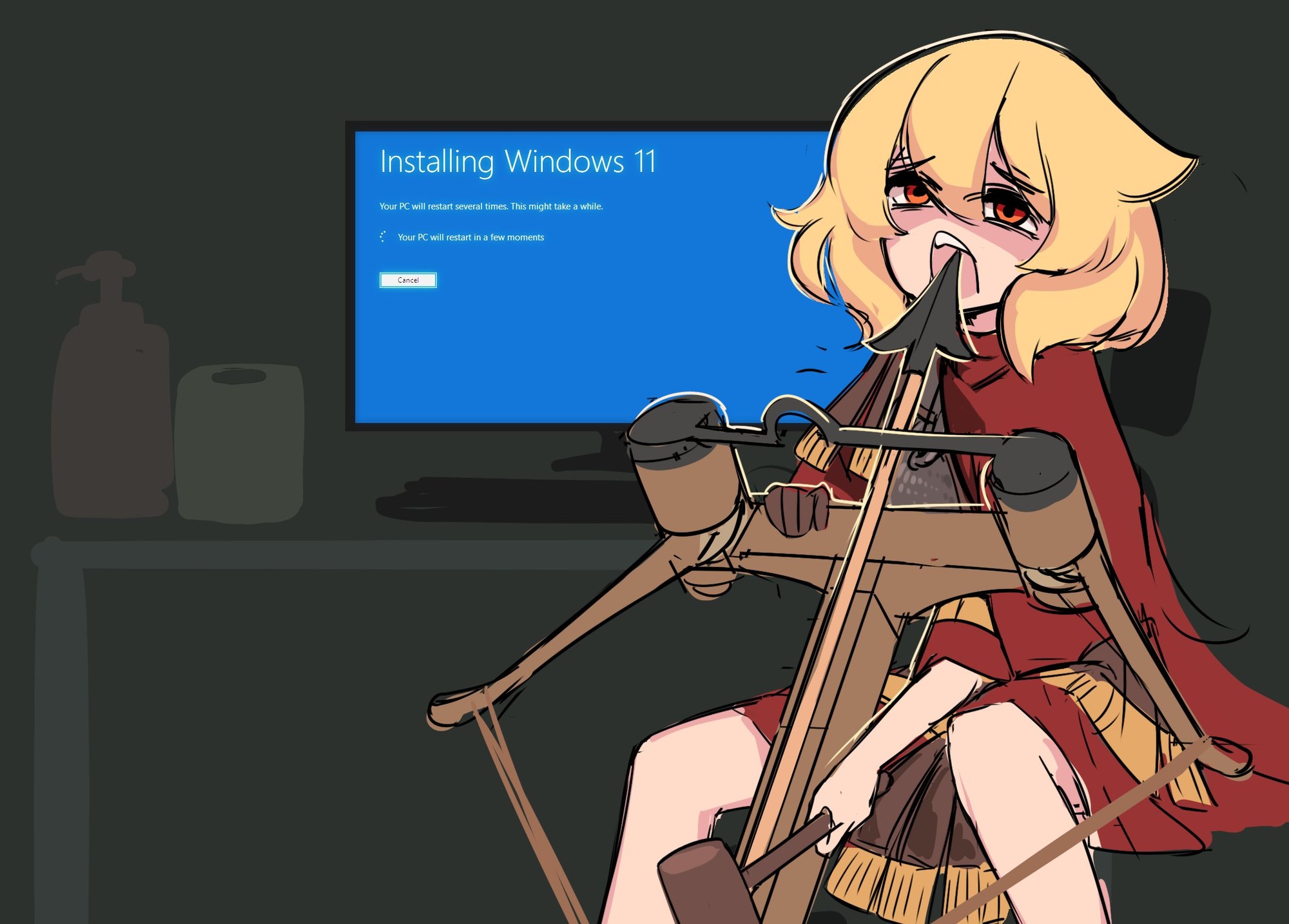
▲ 291 ▼ I upgraded to windows 11 by accidentally pressing spacebar on startup (piefedimages.s3.eu-central-003.backblazeb2.com) submitted 10 months ago by FenrirIII@lemmy.world to c/iiiiiiitttttttttttt@programming.dev 33 comments fedilink hide all child comments cross-posted from: https://piefed.zip/c/centuriichan/p/817029/i-upgraded-to-windows-11-by-accidentally-pressing-spacebar-on-startup
[–] BigTrout75@lemmy.world 19 points 10 months ago (17 children) What was the plan? Run Windows 10 unpatched? permalink fedilink source hideshow 17 child comments replies: [–] Creat@discuss.tchncs.de 15 points 10 months ago* (2 children) ESU runs until Oct '26. So those that can't or don't want to leave windows have that option. permalink fedilink source parent hideshow 2 child comments replies: [–] real_squids@sopuli.xyz 3 points 10 months ago iot will get patches til 2032. by then i think most people will be sick of windows enough to switch permalink fedilink source parent load more comments (1 reply) [–] Blackmist@feddit.uk 17 points 10 months ago That's my plan. We're not raw dogging the internet any more, like when the Blaster virus went around and we all had to learn what firewalls and ports were. These days the main attack vector is going to be the browser or social engineering. The OS isn't going to save you from either. permalink fedilink source parent [–] __ghost__@lemmy.ml 6 points 10 months ago (5 children) That's my plan permalink fedilink source parent hideshow 5 child comments replies: [+] Cevilia@lemmy.blahaj.zone 4 points 10 months ago (4 children) [deleted] permalink fedilink source parent hideshow 4 child comments replies: [–] __ghost__@lemmy.ml 5 points 10 months ago (3 children) Yeah I will. Only really keeping it around for a few niche games, my daily driver is centos permalink fedilink source parent hideshow 3 child comments replies: [–] entwine@programming.dev 1 point 10 months ago (1 child) I'm curious how you ended up on CentOS, especially for a desktop/laptop? That distro effectively died when IBM bought Red Hat, but even before that it was afaik mostly used for server deployments due to RHEL compatibility. permalink fedilink source parent hideshow 1 child comment replies: [–] __ghost__@lemmy.ml 1 point 10 months ago* You're on the money with compatibility. At work I have equipment with accompanied proprietary software designed to run on RHEL. All hosts on my network run it, about 60% desktop and the rest blades A bit niche. I wanted to be comfortable with the system both as a user and as an admin so I daily drive it. Not the best user experience, but I've learned how to work around most issues people encounter with it and it's helped a lot My preference outside of that would be really mixed. My spare time is dedicated to virtualization and containers so I'm mostly using a hypervisor like proxmox. As a desktop interface I'd probably choose something with gnome. Fedora is good, I've used it in the past and liked it permalink fedilink source parent load more comments (1 reply) [–] finitebanjo@lemmy.world 5 points 10 months ago* (5 children) My 10 LTSC runs out in 2027 without extended support. It's been my main driver for years. I also don't have this issue of accidentally upgrading. Though if it did I wouldn't notice because I always hibernate to avoid waiting an hour for startup. permalink fedilink source parent hideshow 5 child comments replies: [–] TonyTonyChopper@mander.xyz 5 points 10 months ago (2 children) hibernate In my experience on a modern SSD there is no difference in startup time between hibernate and normal boot. 10-20 seconds from hitting the power button. permalink fedilink source parent hideshow 2 child comments replies: [–] finitebanjo@lemmy.world -1 points 10 months ago (1 child) You're wrong because There is no difference between a regular startup and waking from hibernate, it cannot really be compard as two separate things in the first place, the RAM was stored in memory before shutdown. Type of drive does not make any difference. Maybe you were confusing it with Sleep? Windows runs some fuckery all the time during a normal startup. I've seen both Windows 10 and 7 take upwards of an hour to boot. This is avoided via hibernate. permalink fedilink source parent hideshow 1 child comment replies: [–] TonyTonyChopper@mander.xyz 2 points 10 months ago nope permalink fedilink source parent [–] kazerniel@lemmy.world 0 points 10 months ago* (1 child) I always hibernate to avoid waiting an hour for startup. I'm sorry but wtf, I've been a Windows user all my life, often on old, shitty PCs, but startup never took more than a couple minutes at worst. Sounds like something is really wrong with your PC O.o permalink fedilink source parent hideshow 1 child comment replies: [–] finitebanjo@lemmy.world 1 point 10 months ago* It's been wrong with all of my Windows PCs for over a decade, It doesn't seem specific to any software on them, so I say it's a windows general issue. I've even run memory diagnostics from a bootable USB, no issues. I've verified the same machines can boot Linux fast and perfectly fine. I've even seen memes about it, it's a really common problem. permalink fedilink source parent [–] mrgoosmoos@lemmy.ca 3 points 10 months ago that is legitimately a better option than using Windows 11 permalink fedilink source parent
[–] Creat@discuss.tchncs.de 15 points 10 months ago* (2 children) ESU runs until Oct '26. So those that can't or don't want to leave windows have that option. permalink fedilink source parent hideshow 2 child comments replies: [–] real_squids@sopuli.xyz 3 points 10 months ago iot will get patches til 2032. by then i think most people will be sick of windows enough to switch permalink fedilink source parent load more comments (1 reply)
[–] real_squids@sopuli.xyz 3 points 10 months ago iot will get patches til 2032. by then i think most people will be sick of windows enough to switch permalink fedilink source parent
[–] Blackmist@feddit.uk 17 points 10 months ago That's my plan. We're not raw dogging the internet any more, like when the Blaster virus went around and we all had to learn what firewalls and ports were. These days the main attack vector is going to be the browser or social engineering. The OS isn't going to save you from either. permalink fedilink source parent
[–] __ghost__@lemmy.ml 6 points 10 months ago (5 children) That's my plan permalink fedilink source parent hideshow 5 child comments replies: [+] Cevilia@lemmy.blahaj.zone 4 points 10 months ago (4 children) [deleted] permalink fedilink source parent hideshow 4 child comments replies: [–] __ghost__@lemmy.ml 5 points 10 months ago (3 children) Yeah I will. Only really keeping it around for a few niche games, my daily driver is centos permalink fedilink source parent hideshow 3 child comments replies: [–] entwine@programming.dev 1 point 10 months ago (1 child) I'm curious how you ended up on CentOS, especially for a desktop/laptop? That distro effectively died when IBM bought Red Hat, but even before that it was afaik mostly used for server deployments due to RHEL compatibility. permalink fedilink source parent hideshow 1 child comment replies: [–] __ghost__@lemmy.ml 1 point 10 months ago* You're on the money with compatibility. At work I have equipment with accompanied proprietary software designed to run on RHEL. All hosts on my network run it, about 60% desktop and the rest blades A bit niche. I wanted to be comfortable with the system both as a user and as an admin so I daily drive it. Not the best user experience, but I've learned how to work around most issues people encounter with it and it's helped a lot My preference outside of that would be really mixed. My spare time is dedicated to virtualization and containers so I'm mostly using a hypervisor like proxmox. As a desktop interface I'd probably choose something with gnome. Fedora is good, I've used it in the past and liked it permalink fedilink source parent load more comments (1 reply)
[+] Cevilia@lemmy.blahaj.zone 4 points 10 months ago (4 children) [deleted] permalink fedilink source parent hideshow 4 child comments replies: [–] __ghost__@lemmy.ml 5 points 10 months ago (3 children) Yeah I will. Only really keeping it around for a few niche games, my daily driver is centos permalink fedilink source parent hideshow 3 child comments replies: [–] entwine@programming.dev 1 point 10 months ago (1 child) I'm curious how you ended up on CentOS, especially for a desktop/laptop? That distro effectively died when IBM bought Red Hat, but even before that it was afaik mostly used for server deployments due to RHEL compatibility. permalink fedilink source parent hideshow 1 child comment replies: [–] __ghost__@lemmy.ml 1 point 10 months ago* You're on the money with compatibility. At work I have equipment with accompanied proprietary software designed to run on RHEL. All hosts on my network run it, about 60% desktop and the rest blades A bit niche. I wanted to be comfortable with the system both as a user and as an admin so I daily drive it. Not the best user experience, but I've learned how to work around most issues people encounter with it and it's helped a lot My preference outside of that would be really mixed. My spare time is dedicated to virtualization and containers so I'm mostly using a hypervisor like proxmox. As a desktop interface I'd probably choose something with gnome. Fedora is good, I've used it in the past and liked it permalink fedilink source parent load more comments (1 reply)
[–] __ghost__@lemmy.ml 5 points 10 months ago (3 children) Yeah I will. Only really keeping it around for a few niche games, my daily driver is centos permalink fedilink source parent hideshow 3 child comments replies: [–] entwine@programming.dev 1 point 10 months ago (1 child) I'm curious how you ended up on CentOS, especially for a desktop/laptop? That distro effectively died when IBM bought Red Hat, but even before that it was afaik mostly used for server deployments due to RHEL compatibility. permalink fedilink source parent hideshow 1 child comment replies: [–] __ghost__@lemmy.ml 1 point 10 months ago* You're on the money with compatibility. At work I have equipment with accompanied proprietary software designed to run on RHEL. All hosts on my network run it, about 60% desktop and the rest blades A bit niche. I wanted to be comfortable with the system both as a user and as an admin so I daily drive it. Not the best user experience, but I've learned how to work around most issues people encounter with it and it's helped a lot My preference outside of that would be really mixed. My spare time is dedicated to virtualization and containers so I'm mostly using a hypervisor like proxmox. As a desktop interface I'd probably choose something with gnome. Fedora is good, I've used it in the past and liked it permalink fedilink source parent load more comments (1 reply)
[–] entwine@programming.dev 1 point 10 months ago (1 child) I'm curious how you ended up on CentOS, especially for a desktop/laptop? That distro effectively died when IBM bought Red Hat, but even before that it was afaik mostly used for server deployments due to RHEL compatibility. permalink fedilink source parent hideshow 1 child comment replies: [–] __ghost__@lemmy.ml 1 point 10 months ago* You're on the money with compatibility. At work I have equipment with accompanied proprietary software designed to run on RHEL. All hosts on my network run it, about 60% desktop and the rest blades A bit niche. I wanted to be comfortable with the system both as a user and as an admin so I daily drive it. Not the best user experience, but I've learned how to work around most issues people encounter with it and it's helped a lot My preference outside of that would be really mixed. My spare time is dedicated to virtualization and containers so I'm mostly using a hypervisor like proxmox. As a desktop interface I'd probably choose something with gnome. Fedora is good, I've used it in the past and liked it permalink fedilink source parent
[–] __ghost__@lemmy.ml 1 point 10 months ago* You're on the money with compatibility. At work I have equipment with accompanied proprietary software designed to run on RHEL. All hosts on my network run it, about 60% desktop and the rest blades A bit niche. I wanted to be comfortable with the system both as a user and as an admin so I daily drive it. Not the best user experience, but I've learned how to work around most issues people encounter with it and it's helped a lot My preference outside of that would be really mixed. My spare time is dedicated to virtualization and containers so I'm mostly using a hypervisor like proxmox. As a desktop interface I'd probably choose something with gnome. Fedora is good, I've used it in the past and liked it permalink fedilink source parent
[–] finitebanjo@lemmy.world 5 points 10 months ago* (5 children) My 10 LTSC runs out in 2027 without extended support. It's been my main driver for years. I also don't have this issue of accidentally upgrading. Though if it did I wouldn't notice because I always hibernate to avoid waiting an hour for startup. permalink fedilink source parent hideshow 5 child comments replies: [–] TonyTonyChopper@mander.xyz 5 points 10 months ago (2 children) hibernate In my experience on a modern SSD there is no difference in startup time between hibernate and normal boot. 10-20 seconds from hitting the power button. permalink fedilink source parent hideshow 2 child comments replies: [–] finitebanjo@lemmy.world -1 points 10 months ago (1 child) You're wrong because There is no difference between a regular startup and waking from hibernate, it cannot really be compard as two separate things in the first place, the RAM was stored in memory before shutdown. Type of drive does not make any difference. Maybe you were confusing it with Sleep? Windows runs some fuckery all the time during a normal startup. I've seen both Windows 10 and 7 take upwards of an hour to boot. This is avoided via hibernate. permalink fedilink source parent hideshow 1 child comment replies: [–] TonyTonyChopper@mander.xyz 2 points 10 months ago nope permalink fedilink source parent [–] kazerniel@lemmy.world 0 points 10 months ago* (1 child) I always hibernate to avoid waiting an hour for startup. I'm sorry but wtf, I've been a Windows user all my life, often on old, shitty PCs, but startup never took more than a couple minutes at worst. Sounds like something is really wrong with your PC O.o permalink fedilink source parent hideshow 1 child comment replies: [–] finitebanjo@lemmy.world 1 point 10 months ago* It's been wrong with all of my Windows PCs for over a decade, It doesn't seem specific to any software on them, so I say it's a windows general issue. I've even run memory diagnostics from a bootable USB, no issues. I've verified the same machines can boot Linux fast and perfectly fine. I've even seen memes about it, it's a really common problem. permalink fedilink source parent
[–] TonyTonyChopper@mander.xyz 5 points 10 months ago (2 children) hibernate In my experience on a modern SSD there is no difference in startup time between hibernate and normal boot. 10-20 seconds from hitting the power button. permalink fedilink source parent hideshow 2 child comments replies: [–] finitebanjo@lemmy.world -1 points 10 months ago (1 child) You're wrong because There is no difference between a regular startup and waking from hibernate, it cannot really be compard as two separate things in the first place, the RAM was stored in memory before shutdown. Type of drive does not make any difference. Maybe you were confusing it with Sleep? Windows runs some fuckery all the time during a normal startup. I've seen both Windows 10 and 7 take upwards of an hour to boot. This is avoided via hibernate. permalink fedilink source parent hideshow 1 child comment replies: [–] TonyTonyChopper@mander.xyz 2 points 10 months ago nope permalink fedilink source parent
[–] finitebanjo@lemmy.world -1 points 10 months ago (1 child) You're wrong because There is no difference between a regular startup and waking from hibernate, it cannot really be compard as two separate things in the first place, the RAM was stored in memory before shutdown. Type of drive does not make any difference. Maybe you were confusing it with Sleep? Windows runs some fuckery all the time during a normal startup. I've seen both Windows 10 and 7 take upwards of an hour to boot. This is avoided via hibernate. permalink fedilink source parent hideshow 1 child comment replies: [–] TonyTonyChopper@mander.xyz 2 points 10 months ago nope permalink fedilink source parent
[–] kazerniel@lemmy.world 0 points 10 months ago* (1 child) I always hibernate to avoid waiting an hour for startup. I'm sorry but wtf, I've been a Windows user all my life, often on old, shitty PCs, but startup never took more than a couple minutes at worst. Sounds like something is really wrong with your PC O.o permalink fedilink source parent hideshow 1 child comment replies: [–] finitebanjo@lemmy.world 1 point 10 months ago* It's been wrong with all of my Windows PCs for over a decade, It doesn't seem specific to any software on them, so I say it's a windows general issue. I've even run memory diagnostics from a bootable USB, no issues. I've verified the same machines can boot Linux fast and perfectly fine. I've even seen memes about it, it's a really common problem. permalink fedilink source parent
[–] finitebanjo@lemmy.world 1 point 10 months ago* It's been wrong with all of my Windows PCs for over a decade, It doesn't seem specific to any software on them, so I say it's a windows general issue. I've even run memory diagnostics from a bootable USB, no issues. I've verified the same machines can boot Linux fast and perfectly fine. I've even seen memes about it, it's a really common problem. permalink fedilink source parent
[–] mrgoosmoos@lemmy.ca 3 points 10 months ago that is legitimately a better option than using Windows 11 permalink fedilink source parent