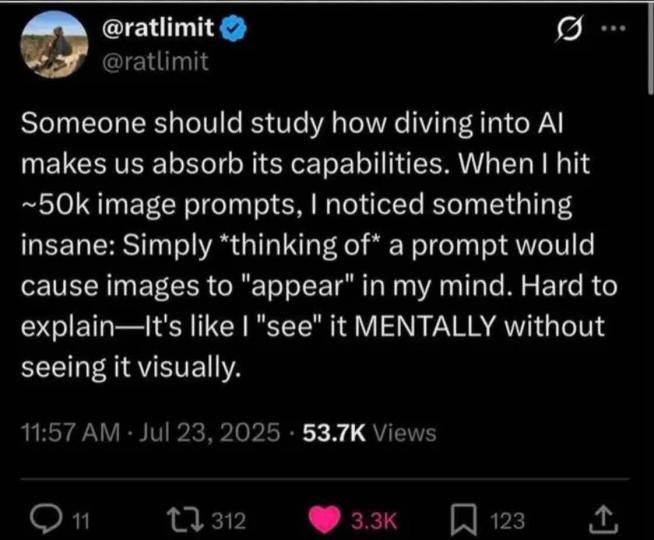
AI bro discovering imagination (piefedimages.s3.eu-central-003.backblazeb2.com)
 
Someone should study how diving into Al makes us absorb its capabilities. When I hit ~50k image prompts, I noticed something insane: Simply *thinking of* a prompt would cause images to "appear" in my mind. Hard to explain—It's like I "see" it MENTALLY without seeing it visually.
you are viewing a single comment's thread
view the rest of the comments
[–] 10 points 1 year ago (4 children)

How could you possibly read for fun if you can't picture what's happening?

Probably better than people who need to visualise stuff.

There's much more in books than just the visuals. There's the story, there's the characters' thoughts and personality, there's the author's style, and influences... they're infinitely more detailed and nuanced than film or TV.

Limiting them to the visual aspect seems like a disservice to both reader and author.

And, anyway, I know what's happening, it's written right there on the page, why would I need to visualise it?

And what if I imagined it a certain way, and later the author describes it differently than I imagined it, or adds some new detail that was missing in my mental image? Personally (if I experienced books like I do films) that kind of thing would completely pull me off from the story...

And what if the book is set somewhere alien to our senses? How do you visualise Flatland? Or the other universe in Asimov's The God's Themselves?

Frankly, needing to visualise books seems more like a handicap to me.

  • source
  • parent
  • hideshow 4 child comments
  • [–] 6 points 1 year ago (2 children)

    Interesting! However you seem to think effort is involved. For me, visualizations are automatic. If I find I'm not "seeing" the story, that means I'm tired and not really reading, just passing words through my brain pan with no understanding.

  • source
  • parent
  • hideshow 2 child comments
  • [–] 3 points 1 year ago

    No, I'm not taking about effort. I'm aware the brain does it automatically, and puts it in the same energy budget as the rest of the reading experience (though now I'm wondering if the brains of people with aphantasia consume less energy when reading).

    What I'm saying is that there's so many more layers to books than to film that being “forced” by your brain to see books in a visual way might produce a limited experience when compared to someone who can enjoy a book as, well, a book.

    More importantly, whatever you're visualising is made up by your brain... based on the author's descriptions, sure... but those descriptions might be incomplete until the very last page.

    If you're viewing the book like a film, you're necessarily making up details that can conflict with later descriptions by the author, which means you'd either have to change your visual representation (akin to a recast of an actor, which is often jarring) or ignore the author's description (I had a friend who, having read The Hobbit, somehow imagined Gollum as a sort of gelatinous blob; I suspect this is what might have been going on there). Again, this seems like it'd lead to a lesser experience than just experiencing the book like... a book.

  • source
  • parent
  • load more comments (1 reply)