[–] [S] 1 point 2 months ago*

It seems to me that this situation - an instance shutting down and community copies continuing to exist on other instances - has a potential frequency of a few times per year or more.

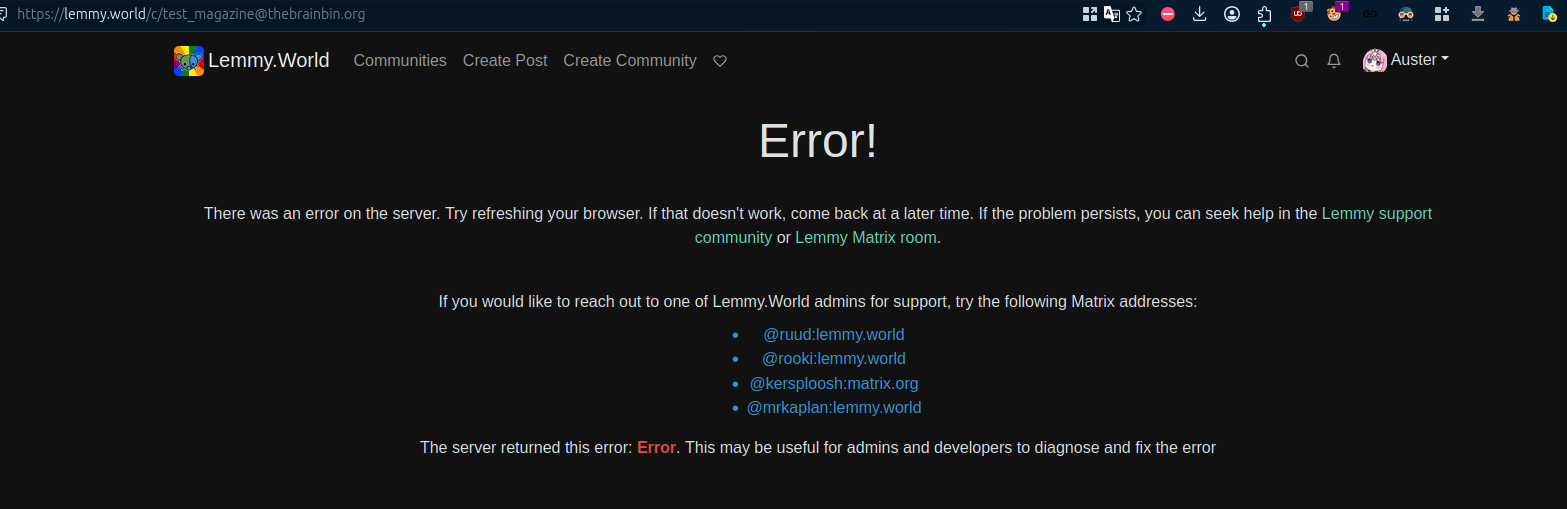
So, I wonder if there is no standard process, best practice, checklist, or any other recommendation by the development team of Lemmy?

Concretely:

if any stakeholder (user,...) discovers a zombie group copy, what shall he do?

Is there no measure to prevent the situation that users join zombie group copies again and again? Like the one I joined; it is still there. Each day other users could find it, be happy to join it and be frustrated by the resulting experiences.

  • source
  • parent
  • context
  • [–] 4 points 2 months ago (1 child)

    Since the instance itself is dead, federation won't work. Basically the way it works now is it needs to be removed from each individual instance.
    An admin could also decide to lock it instead of deleting it but there's like 3 posts in it.

  • source
  • [–] [S] 3 points 2 months ago (2 children)

    I tried and it says already created. I don't see it on any instance though so thought maybe there is a rules against it but I don't think there is as long as you make post and block out username?

  • source
  • parent
  • context
  • [–] 3 points 2 months ago (4 children)

    Lemmy is part of a larger ecosystem. Not a monolith to itself. There are plenty of communities targeting other communities like that. But seeing as what one person views as Lemmy could also be piefed, mbin, mastodon, miskey, etc. It doesn't have quite the appeal.

  • source
  • [–] 1 point 2 months ago (1 child)

    You should persist the auth token, rate limits are by IP. They also don't exclude successful logins currently. This is a limitation in Lemmy. We have currently configured it to allow 5 logins per IP per day, but if you're lucky you can exceed that, as the consumption is not synchronized between backends at this time.

  • source
  • parent
  • context
  • [–] [S] 1 point 2 months ago* (2 children)

    Hrm, well, now I'm noticing that I'm getting inconsistent results.

    I keep getting {"error":"rate_limit_error"} from the login endpoint, and I've made... maybe 10 requests to that endpoint over the course of the day? And I've had that block this user (like, my @TootSweet account) from being able to log in. But I really don't think I'm sending any noticeable amount more traffic than I would be without the bot testing.

    But sometimes I get past login and get a Cloudflare page back on another call. (In the unhappy path it tries to DM me, and it's tried that and failed.)

    Maybe I'm just not waiting long enough between requests? I had it set to wait 3 seconds between requests, but maybe I'll bump it up to 5.

    Thanks very much for your help so far. Sorry to throw more at you here. It seems the previous Cloudflare issue isn't what I'm running into any more at least.

  • source
  • parent
  • context
  • [–] 3 points 2 months ago (3 children)

    Then I don't know where you're seeing Cloudflare CAPTCHAs. There shouldn't be any on any of the API paths.

    I've checked both URLs you mentioned above and only saw a Python user agent getting blocked with a browser integrity check on one of them in our CF logs. I've now added a dedicated rule to skip browser integrity checks on all API paths.

  • source
  • parent
  • context
  • view more: ‹ prev next ›