1
posts
2
3
4
Tiled NavCam - NASA/JPL-Caltech

5
Raw colours Credit: NASA/JPL-Caltech

6
Distance 22.06 m (72.4 ft) Front NavCam (tiled) features the new workspace

7
8
9
10
11

12
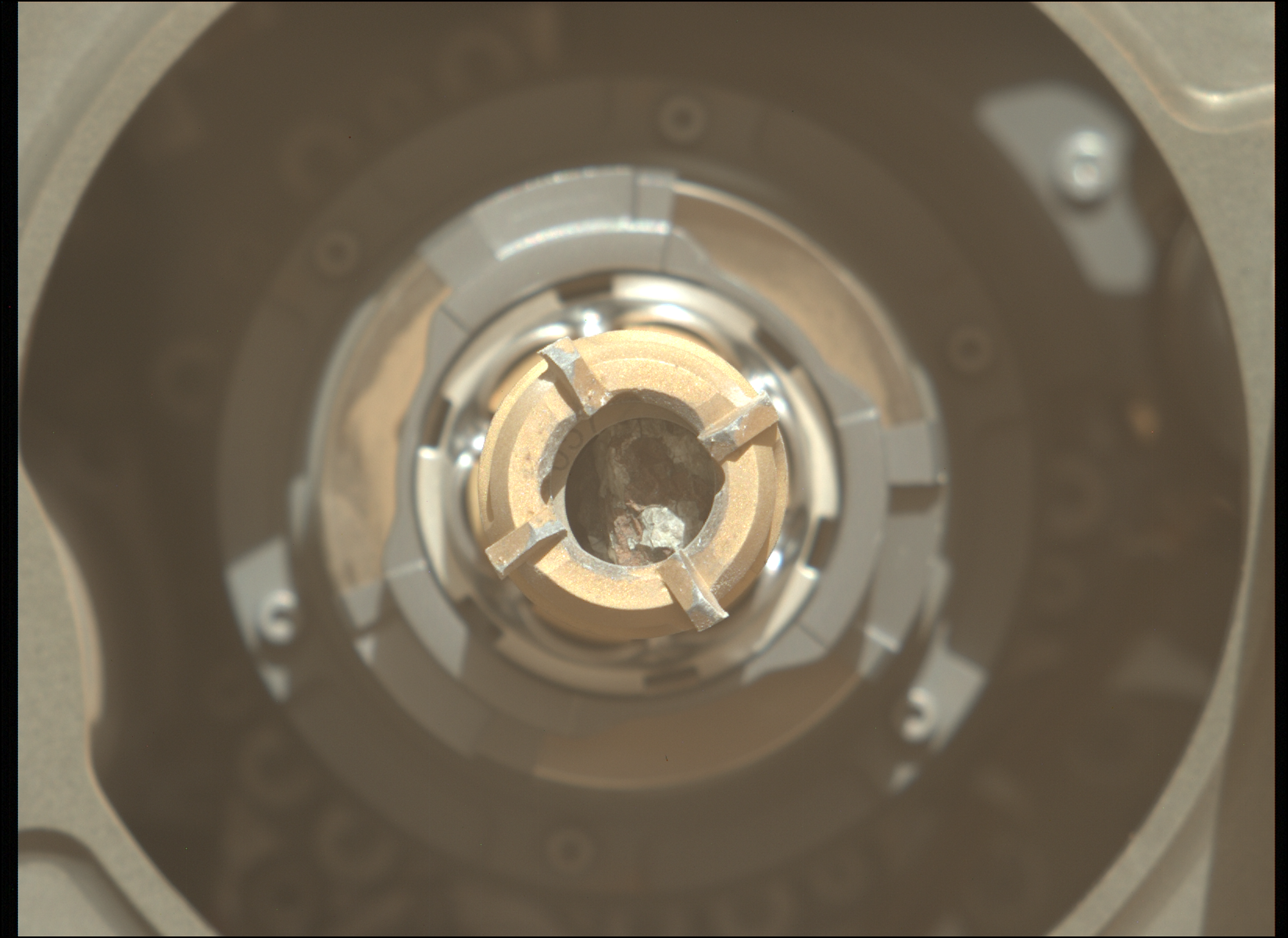
The core is still in the hole. They drove off today, did I miss it or are they abandoning any thought of retrieving it?
Credit: NASA\JPL

13
14
15
Awaiting the official details of the drive (distance etc) from JPL, but I'll add some of the post-drive images in the comments

16
17
18
19
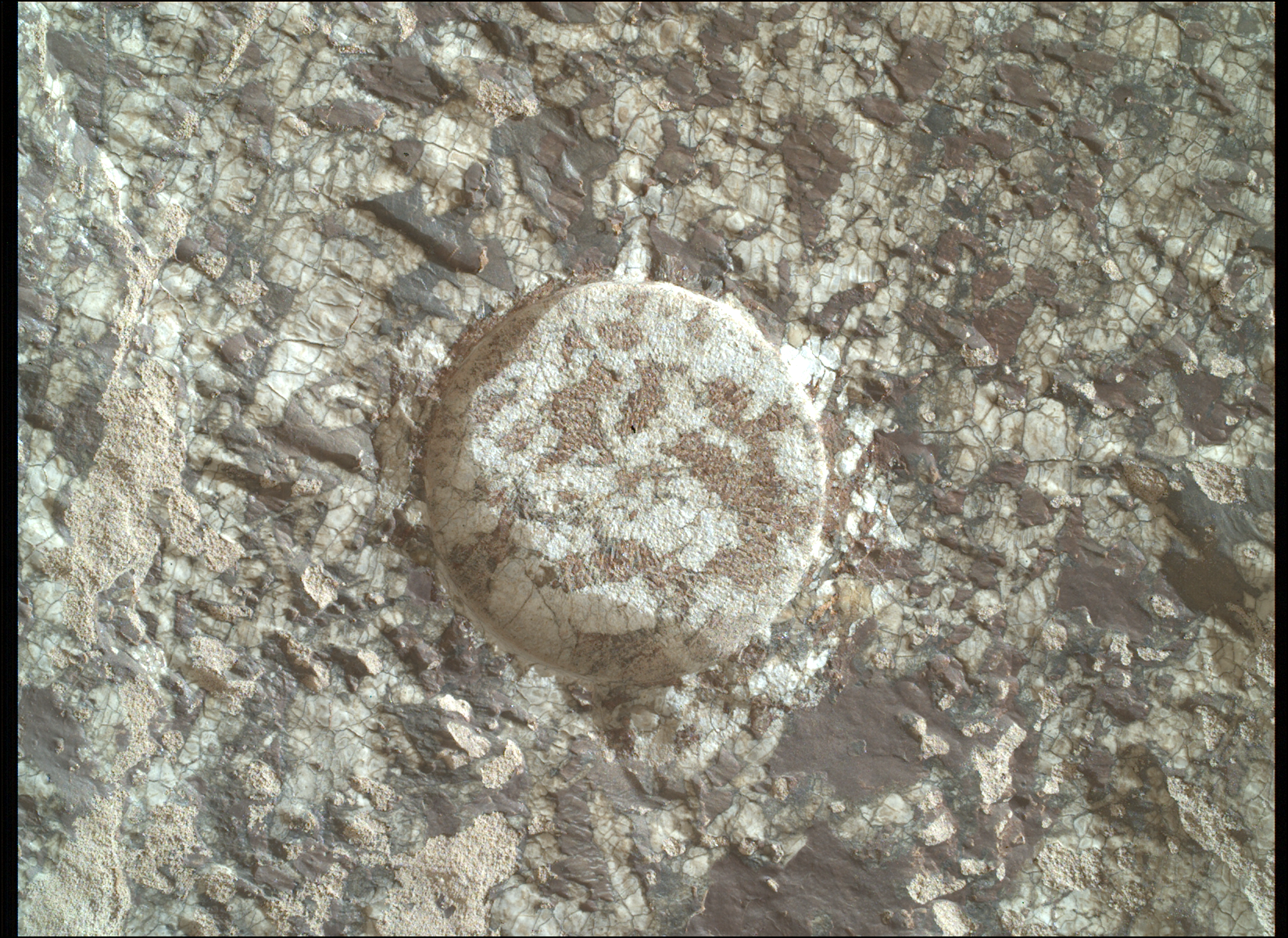
Perseverance used its SHERLOC WATSON camera on sol 1949 to take a close-up image of this light toned rock. The camera is mounted on the rover's robotic arm. Check the comments for a much closer image at the rock from the same camera acquired on the same sol

20
I see these images almost every day. What are they? Is that the sun and are they recording or sampling atmospheric conditions? In the past they were preceded by four images of star fields (if you download and zoom in.) What are those? (Image in comments). Are they related? Credit: NASA/JPL

21
22
Since the earliest weeks of the mission, the science team has been documenting an interesting type of feature found on many of the rocks Perseverance has encountered, dubbed the "purple coating". This has often been found on rocks that have been abraded by the rover (e.g. abrasion patches #2, left, and #18, right)...

... as well as natural, untouched surfaces. Some of these feature truly bizzare patterns:

The terrain being explored by Perseverance in Jezero Crater and Nili Planum is unique to date in our explorations of Mars, in that these coatings seem to be very widespread here. A much smaller number of rock coatings which may or may not be similar were found by Spirit and Opportunity, but Curiosity has notably found none. A 2025 paper by Garczynski et al. offers an explanation for these coatings - "indurated dust".
This "indurated" (solidified) coating forms may form in a series of steps:
- Windblown dust and very fine soil particles settle onto a rock
- Electrostatic charges may make the dust "clump" and stabilize on the rock surface
- Sand buries the stabilized dust
- Humidity beneath the sand increases under certain scenarios (e.g. frost formation events)
- The water reacts with iron and sulfur-bearing minerals in the deposited dust and soil, "cementing" it into a thin coating
This recent image captured by MastCam-Z shows a material very reminiscent of the purple coating on the rover's deck, near the base of the mast. If this material is related to the purple coating, it may have formed fairly recently. To my mind, the flat and homogeneous appearance of the material resembles the kind of thin layer you'd expect would form first.
Perseverance was parked for 46 sols (Earth dates 11 December 2025 to 28 January 2026) during solar conjunction, when the Sun prevented communication between Earth and Mars. Crucially, these dates correspond to late summer and early autumn in this region, when humidity is known to be high (as the longer, warmer days evaporate the north polar ice cap). Given the amount of fine regolith and dust that the wind has deposited onto the rover deck, and the relatively gentle slopes of the terrain we've been exploring in the last few months, it is conceivable that the loose material simply hasn't moved much recently, thus "sheltering" the deck, the same way sand can shelter the rocks where the coating has formed.
If correct, this observation of a coating on the body of Perseverance has interesting implications. It would mean that the coating can form quite quickly, and that this process is occurring today, not millions of years ago. Water actively altering the surface of Mars (and our rover) today is something we must observe closely, for many exciting reasons. If this process is active on an exposed and seemingly unsuitable surface like the rover deck, one wonders how widespread it is in the soil...

23
24

25
A ventifact is a wind carved rock
Mars Perseverance rover acquired this image using its Right Mastcam-Z camera set at full zoom (110mm).
Mastcam-Z is a pair of cameras located high on the rover's mast.
This image was acquired on July 22, 2026 (Sol 1927)

view more:
next ›