I started discovering it when I realize that I didn't really adhere to the traits of any male or female strongly. I flexed between the two at times but didn't really feel like either of them. I just am and am I is.
comments
comment on
When did you realize you were nonbinary?
comment on
Two-spirit — Wikipedia
I see. Thank you.
comment on
Two-spirit — Wikipedia
It's used to replace other terms that were/are being used, but the term itself was made by first nation people.
So, because the term was coined by people to refer to themselves, it's not really a colonial term, even if it's often used in place of other "colonial terms".
Also, the old terms used to describe the non-eurocentric gender/sexual roles often. had roots in words from the language of one of the first nations, they were just being applied to multiple groups from multiple languages, and sometimes the root they used was for something like a prostitute.
Like everything else, it's messy and complicated l, and basically any answer is at least a little bit wrong.
comment on
Two-spirit — Wikipedia
Interesting, thank you.
So it's a colonial term catch-all for “queer” today, without the granularity of the gender roles, if at all, few tribe members had within those tribe’s social agreements.
So def. a term that can be reappropriated by bigots, because it's unclaimed so many people. Though some claim it.
comment on
Two-spirit — Wikipedia
Starting with, I am not two-spirit, I just know some people who are.
So, here are some random points
At one point it was used to describe, in English, non-euro-centric gender roles that exist within many of the Canadian First Nation tribes. Previous words (often used by non-native people) to describe those roles would often just be slurs. It's one term to try to describe something in many different cultures. It is an English-Language term, not a traditional native one.
There are hundreds of recognised tribes in North America, with many different belief systems and cultures. Trying to lump them together as one is kinda like saying the ever country in Europe is the same. So, the term is kinda hard to pin down, and it also doesn't apply to every tribe.
It very-specifically does not mean that you have the spirit of a woman and the spirit of a man.
Its meaning has expanded, and I've seen it used catch-all for LGBTQ+ by native people, often as a way to reject the idea that they need to fit into euro-centric cultural boxes. I also know that some people refuse to use it, because they feel it's something that is sometimes pushed onto them by outside sources (aka, well-intentioned white people), or it doesn't really fit into the historic cultural beliefs of the tribe they are from, or they just don't want to use it.
(see also "Native American" vs "First Nations" vs "Indian")
Something important: It is not an identity you can have if you are not from one of the tribes who lands are within the current Canadian or United States boarders.
comment on
Sleep well dearies~
Good night, flustrat
comment on
Good nighty dearies~
Looks like Anya Forger from SPYxFAMILY, but she is almost never shown without her horn caps.
comment on
Sleepy Enby Hours
Could be temperature. I like it cold but the others in my home don't. I've tried taking some stuff for it before but didn't like the experience. It made my body feel sleepy while my mind was still wide awake.
comment on
Sleepy Enby Hours
[deleted]
comment on
Sleepy Enby Hours
I know the feeling. Mine seems to get worse certain times of year for some reason.
comment on
Sleepy Enby Hours
Eepy.
comment on
does sapphic imply that im a girl??
I don't think so. While I do agree it could cause some misunderstandings, I do not believe that being a girl is a necessary and sufficient condition for using the label sapphic.
Gender is complex, and it is my position that labels can describe in part, but can never exhaust, the human condition.
comment on
3rd person singular pronouns (Mid Eng)
In Middle English? Unsure I follow.
I’m looking for canonical accusatives & possessive case transformations. It’s looking as if “a” was only a Nominative pronoun: thus it may not have any. At all all.
comment on
3rd person singular pronouns (Mid Eng)
English Dialect Society
No accusatives or possessives either😔
 actual page 25, canonical 2.
comment on
3rd person singular pronouns (Mid Eng)
what are the verb conjugations to go with these pronouns? I think Wiktionary might have them...
comment on
3rd person singular pronouns (Mid Eng)
Thanks for the rabbit hole. Requesting those book from my local library.
comment on
3rd person singular pronouns (Mid Eng)
So, something like y/y/y’s: e.g.
I think y is very nice.
I met y recently.
Is this y’s dog?
Y told me that the house is y’s.
Y said y would rather do it yself.
comment on
3rd person singular pronouns (Mid Eng)
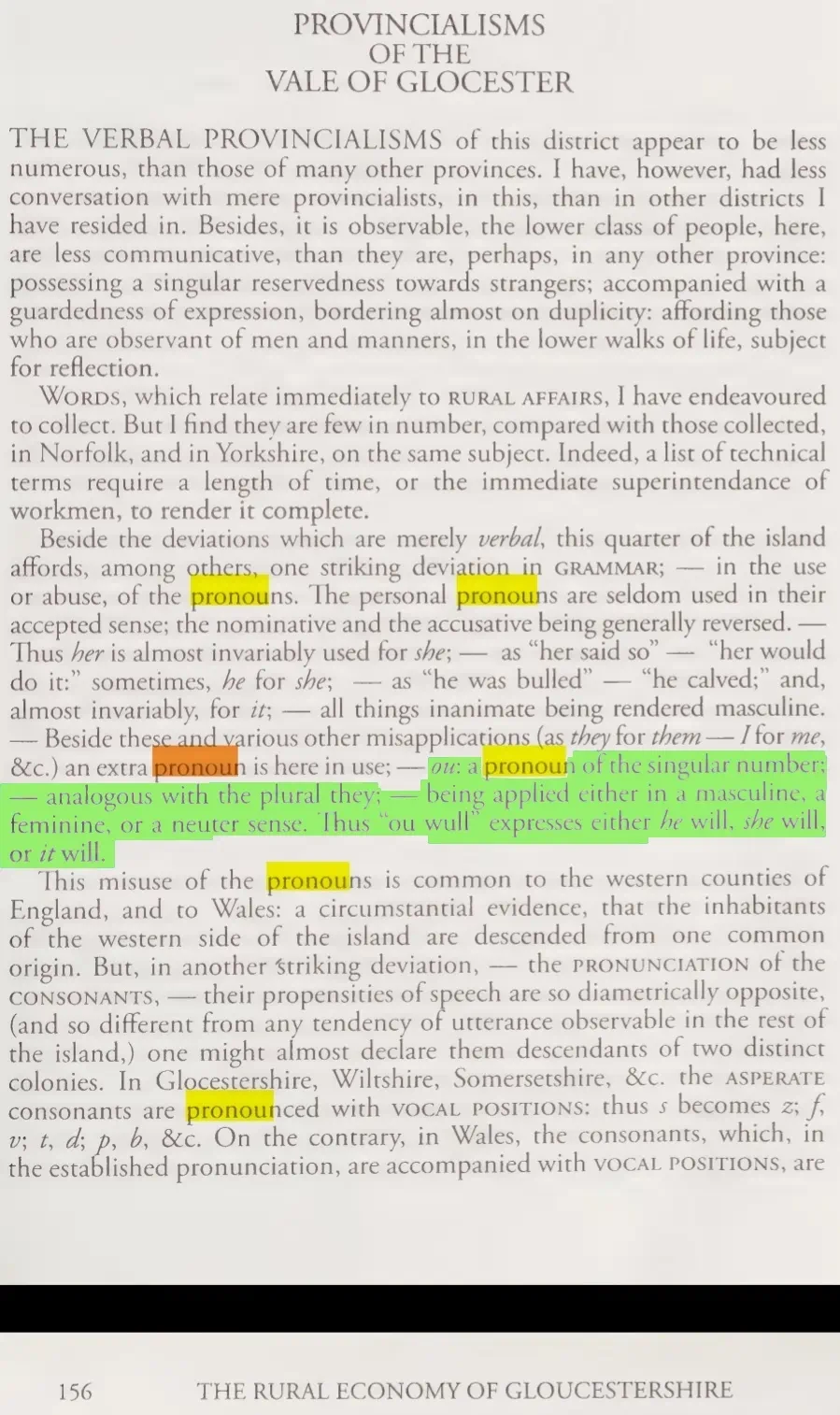
After reading the reference, page 155 ¶3, it doesn't note “a,” but “Ou” and used as singular “They.”
comment on
3rd person singular pronouns (Mid Eng)
French 'y' is like 'there' in English, roughly (IIRC; it's been decades). But, since English doesn't use it, it doesn't matter. Presumably, it would take a normal 's for possession. I don't know about accusative or dative.
comment on
3rd person singular pronouns (Mid Eng)
Spoilers for The Long Earth series
What about First Person Singular?
comment on
3rd person singular pronouns (Mid Eng)
So “e/em/es,” (4) or french “J’y” (6)? Does french “y” have accusative or possessive transformations, or is it combinational?
comment on
3rd person singular pronouns (Mid Eng)
📝
🔍 Marshall, W. [1789] 1873-74. Rural economy of Glocestershire. Reprinted as
Provincialisms of the vale of Gloucester. Publication of the English Dialect
Society, no. 2, 55-60. London: Truebner.
comment on
3rd person singular pronouns (Mid Eng)
I'm fine with singular they, personally, but as a cis-het guy, I'm not sure I'm the most qualified to be speaking on the subject, heh.
If something shorter was desired, maybe y (pronounced more like /i/) like french uses in another context that otherwise never stands alone in English and shouldn't really be homophonic with anything else meaningful when usage is considered.
comment on
3rd person singular pronouns (Mid Eng)
It's alright. I still want your input:
- a/am/as
- a/ar/ars
- ae/aer
- e/em/es
- they/them
- [insert your own]
comment on
3rd person singular pronouns (Mid Eng)
Ah, my brain read the first definition and totally forgot you put 3rd person in the title and failed to see the following definitions. Oops.
view more:
next ›