[–] 3 points 2 months ago (2 children)

Don't disparage someone for enjoying something you don't. It's about choice and allowing people to have the life they want to have.

Cut the sanctimonious attack on intelligence. I have a doctorate. I love going to museums alone. I have no desire to ever have kids. Ever.

But nothing makes me smile like being able to witness the purity of joy and awe as someone learning something new. Child or adult doesn't matter, but children show it more cleanly and plainly IME. I like helping and I like educating. Does that make me moribound? Because I get a dopamine hit when I spread knowledge and understanding?

Plainly speaking, you and I are total and complete biological failures. Life's only objective purpose is procreation - going back to self-replicating RNA molecules. The genes that perform best are the genes best at replicating themselves.

So before you go spouting off some slop about how someone has a "moribund" mind, maybe remember that we're the ones that are defective. But that's okay, because we are all more than our contribution to genetic diversity.

Act with more humility and kindness. Be confident in your own decisions, and maybe you'll act a little less like a shithead better-than-you-know-it-all.
  • source
  • parent
  • context
  • [–] 2 points 2 months ago*

    I'm not going to argue they're not dumb. But I think writing people off as dumb is a dead end. Trying to educate people in mass will never work, and honestly is scary. Re-education should chill everyone's blood.

    To me, it's that they don't have time to investigate further. They've adopted the R is good, and these talking points mean R mental model.

    And that's a problem that has scalable solutions. Four day work weeks. National holiday for voting. Increased paid time off for vacation and sick leave. Medicare for all.

    These all give people their time back. Time to think about things other than how they're feeding their kids this week.

  • source
  • parent
  • context
  • [–] 3 points 2 months ago (2 children)

    Fundamentally, I think trying to shortcut and use terms to consolidate and represent a complex idea is broken.

    If you have never encountered the concept or had it explained, then it's some black box. What does "I support DEI policies" mean at face value. How do you parse that sentence if you've never heard the acronym?

    "It means diversity, equity, and inclusion" doesn't clarify anything. Diversity of what, specifically? Who is being included in what? How do we measure equity?

    Especially for people who have been conditioned to think that you don't qualify for diversity if you're white.

    The lesson isn't that we need new terms to rotate through to stay ahead of media. The lesson is we need to speak to the actual fucking meat of the matter.

  • source
  • parent
  • context
  • [–] 14 points 3 months ago

    While I won't argue against the ignorance of the 50th percentile, I'd encourage you to consider that for many it may not be willful.

    By design, more and more people are forced to focus on their immediate needs. As more Americans than ever before live paycheck to paycheck with hardly a thousand dollars in savings, how can they justify spending time learning when they need to be at their second job so their kids don't go homeless?

    If you write people off as stupid then the problem is intractable. You can't cure stupid. But you can inform the ignorant.

  • source
  • parent
  • context
  • [–] 1 point 3 months ago* (1 child)

    No, your perspective is how we get climate science denial and vaccine skepticism and removal of fluoride from drinking water.

    People with no subject matter experience or practical knowledge of what "Science" actually is.

    I said trust scientists. Not a scientist. Scientists. Plural. Trust the literature reviews and meta analyses of multiple studies. Trust the scientists that have amassed DECADES of knowledge of an incredibly small and specialized area of interest.

    Instead, we get schmucks all up and down shitting on whatever study they want. The number of times I've seen papers dismissed simply on the population size alone for being "poor statistical power" without any discussion on effective and whether the study was actually appropriately powered or not.

    I bet you don't even really know what the drivers are for the reproducibility crisis and where real problems are.

  • source
  • parent
  • context
  • [–] 21 points 3 months ago (6 children)

    Scientists. Scientists are to say it's not having an impact on selection.

    I can guarantee you they've asked that already, and researched the topic extensively.

    Look, scientists are (semi) normal people with a wickedly intense interest. If someone is willing to devote 5+ years learning about how to study bird behavior to get their doctorate, do you think they're not going to be concerned about the bird's well being? When the entire point of the research and study of endangered species is conservation?

  • source
  • parent
  • context
  • [–] 19 points 4 months ago (2 children)

    I'm tired of hearing it's not that simple. No. It is. It's not easy, but it is quite simple.

    States should do it. When the legal challenges come, good. It doesn't fucking matter if it sticks or not.

    Maybe it'll slow them down. Maybe we just need to flood the zone like they do with nonstop, ridiculous, clearly illegal BULLSHIT.

    We shouldn't take action because it would invoke a constitutional crisis while recognizing we already have had them (and should have had MORE)?

    They're LITERALLY interfering with the machinery of our democracy, and we don't even have enough fucking conviction to TRY FUCKING WITH TAX REVENUE to stop them because 'it's not that simple.'

    They TRAFFICK AND RAPE CHILDREN but let's make sure we only do things we know will absolutely work. The kids can wait.

  • source
  • parent
  • context
  • [–] 4 points 4 months ago (1 child)

    It's honestly a super subtle difference and only structure heads like me care about it. It matters on the edges. My advisor gave sage advice that I think more people should take to heart. To paraphrase: every experiment has limitations and assumptions baked in assumptions. That doesn't mean their results are invalid/irrelevant, but you need to know what they are so you know when they are violated or don't apply.

    It's a spin on the "all models are wrong, but not all models are useful

    /pedagogical soapbox


    It's a great use of AI / machine learning tech. Incredible. Turns out biology reuses structure a LOT. Structure is function in biology, and there are a LOT of shared, essential functions in Biology. Their models are actually incredibly accurate at predicting the individual atom placement for side chains (the bit of an amino acid that makes it unique from other amino acids). Side chains do chemistry for proteins, so this is highly salient for research broadly. It's just far from being a "solved problem" like they would have you believe.

    The main thing to keep in mind, is that alphafold is not predicting structures based on first principles (that is to say, based on the underlying physics and laws of nature). It uses sequence similarity between proteins with solved structures to make probable guesses as to the structure and how it folds. Solely based off current experimental data-driven structure models.

    This works surprisingly well even for proteins that don't have much actually in common with the amino acid sequence of the protein. But because structure is function, we can still trace and track the divergences in sequence over time while still being confident the overall shape is the same.

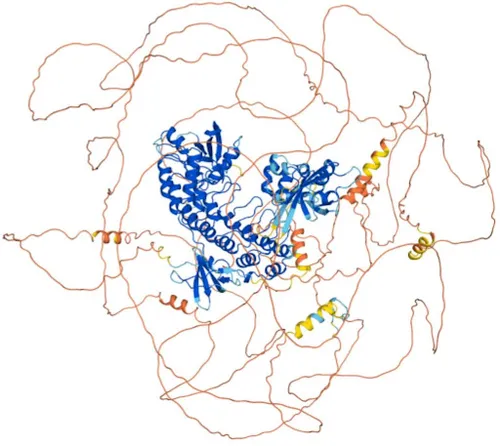
    But for things that there are not enough sequence diverse examples of, or for things that there are no examples, alphafold regularly just spits them out like a literal ball of spaghetti - because the assumptions it relies on are invalid. There's not enough statistical evidence - for those examples.

    I don't have a handy reference offhand, it's been a few years, but there is this image from their blog posts ( ref ) that shows whe I'm talking about. My understanding is that AlphaFold is an incredibly accurate and effective homology modeling strategy (how can we model structures we don't have data for based off similarity to structures we do have).

    Disclaimer: I am not an expert in structural prediction, homology models, machine learning, structural determination via crystallography or cryo-EM. I'm more experienced in consuming them for understanding the structure:function relationship.

  • source
  • parent
  • context
  • [–] 6 points 4 months ago (3 children)

    Not knowing your expertise, I'll risk making a fool of myself.

    But first, for everyone's sake: ALPHAFOLD ISNT AN LLM

    That isn't what alphafold is. Under no circumstances is it anywhere near close to a "database of every way ... proteins can fold." At all. And to construe it as anything other than an attempt at a way to predict or simulate the potential three dimensional structure a protein can adopt will mislead people.

    A protein does not have one shape. It has multiple. They're dynamic. They change shape. It's how proteins represent information. I'd argue that the ability of proteins to change their shape is one of their most important properties. (Analogy: play a song on an instrument with one note. Hard-mode: consider silence a note)

    Everything in Alphafold is a GUESSED MODEL and not reality. Crystal structures and cryo-EM structures are also MODELS. But they're based on empirical evidence.

    Alphafold is based on statistical evidence. It is evidence, but it is weaker. If we don't have an example of how a protein might fold in the structural database, alphafold will struggle to predict the structure. At least not without it sharing some type of sequence similarity.

    I see this in the AI drug companies and how they just treat predictive models the same as 2 angstrom crystal structures and it pisses me off.

  • source
  • parent
  • context
  • [–] 3 points 4 months ago

    Here is how it concerns you:

    By restricting what people can and can't do (by removing features you don't use), they slowly restrict our collective ability to independently verify their claims or to independently serve our own needs - making us more reliant on them.

    It's small and minor, but it's just like with the DMCA and the new ID laws. It's about slowly erecting barriers that impede our ability to act collectively or anonymously under the guise of it being "for our own good."

  • source
  • parent
  • context
  • [–] 1 point 5 months ago (1 child)

    So your answer is "Trust me, bro. We don't need to study this. It's obvious bro everyone knows or. Just don't do it. Don't raise wages bro it's bad. I promise. Everyone already knows this. There's no research for it But we know it's true. Trust me."

    I just want to make sure I understand your logic correctly.

  • source
  • parent
  • context
  • [–] 1 point 5 months ago (3 children)

    https://taxpolicycenter.org/statistics/historical-highest-marginal-income-tax-rates

    95 is not that high For 20 years it was over 90

    And not one person that has complained about the percentile has asked about what the top bracket would be.

    Are you really going to argue that a 95% tax rate on every $1 over $1,000,000 is not comparable to a 95% income tax when fully contextualized to being their one million and first dollar made in a year?

    Find me a place where raising the minimum wage devastated a local economy. I legitimately can't find one so I'm hoping you can help me learn. Here's a write up about how Walmart devastated local economies though.

    Honestly? The fact that we can even entertain, in America, that a state would have a median income of 25k shows truly just how fucked we are.

  • source
  • parent
  • context
  • view more: next ›