The article ArkScript September 2025 update is the last one I wrote, covering all the changes I made on the language this summer.

Finally, I have released this huge set of breaking changes that makes ArkScript v4, and I'm pretty proud of it. I won't stop working on the language, however it's a big milestone for me: I've reach a point where the language is more than decent to use every day, errors are correctly reported, and the documentation is pretty good too (I might be biaised, I wrote it myself so I don't have an objective point of view): https://arkscript-lang.dev/

I've also written an article comparing ArkScript with other Lisps (which is still a WIP but is already good enough) for the curious ones here.


As many others here, I have a home lab at home, with various containers like FreshRSS, Ampache…

I also have a netdata dashboard to monitor CPU and temps, disk usage… that sometimes send me alerts without me having configured anything, eg too much CPU used for more than 15 minutes.

However it doesn’t seem to cover log monitoring, or at least not in the way I want. I have a job and can’t dedicate thousands of hours to building something myself, nor configuring deeply some software stack.

All I want is my services to be monitored log-wise, with a single docker where you could mount multiple log directories, and have a simple interface that filters through the logs (based on their type/name, eg nginx logs aren’t treated the same way as kernel or auth logs, but without me having to configure more than the source type), to tell me if something is weird or just bad (eg someone logged in).

Does it exist without installing grafana + Prometheus + this and that + doing a shit ton of configuration and crying?


I’ve been working on this (not so little anymore) project for some time now, and I’m finally happy with the branding, UX and docs state.

It’s a scripting language I made at first as a toy, to learn new parsing methods, explore compiler optimizations, and go back to VM land where everything is low level and amazing (at least for me) ; it’s now a fully fledged language that can be used as a scripting language like Python or Ruby, and can also be very easily embedded inside a project, as one would do with Lua.

Let me know your thoughts and opinions on the project!


Two years ago I started to follow RogueBasin's roguelike C++ tutorial, a somewhat outdated tutorial in term of good practices and C++ version, but very on point in term of roguelikes.

My goal when I started Pataro what quite ambitious: I wanted to make a modern C++ roguelike from the tutorial, and write an updated version of said tutorial to help the community! Even better (or worse, in term of choosing your goals) I thought I could make a modern C++ roguelike library for people to use.

I got the first 9 parts of the tutorial working pretty smoothly, having set up an architecture inspired by Bob Nystrom about game architecture with roguelikes in mind (great talk by the way: https://www.youtube.com/watch?v=JxI3Eu5DPwE). Then I got to a big hurdle: saving and loading. Having used a lot of polymorphism, it makes quite hard to load correctly things and I stopped there.
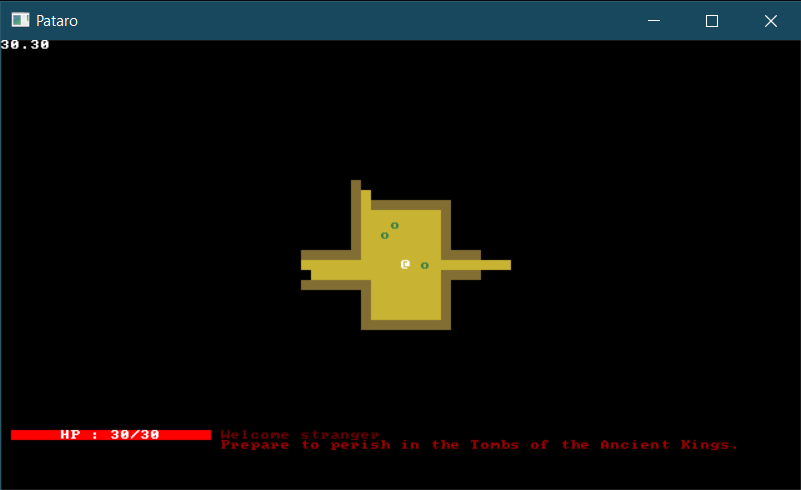
progress as of june 2021

Then a few weeks ago, I picked up the project again, with a much lower set of goals in mind:

  • finishing to implement the tutorial from RogueBasin
  • ease the configuration of the project, so that people can pick parts of it or just make a roguelike from it
  • fix a bunch of problems related to the map and how it is used to be able to extend it and modify it (imagine being able to have spells that could alter the map)
  • rearchitecture a few more things because it's still very rough on the edges
  • modernize the C++ code (again)

Progress as of july 2023