RE: toot.cafe/@baldur/117614251587I very much agree with Baldur’s line of thinking here. In my own framing:Arguing over whether the •single smoking gun• in the Microsoft or FAA fiasco is vibe coding or layoffs (or whatever) misses the big picture — and the big picture is dire.Working that out a bit in a thread.1/

you are viewing a single comment's thread
view the rest of the comments
[–] [S] 1 point 1 day ago* (last edited 1 day ago) (12 children)

When some big, messy, complex system breaks down, there is •never• a single smoking gun.See how.complexsystems.fail item 7: “Post-accident attribution to a ‘root cause’ is fundamentally wrong.”It’s never enough for just one thing to go wrong, or just one component to fail; if a single point of failure •does• in fact bring everything down, then that in itself is a sign of a multitude of other failures.2/
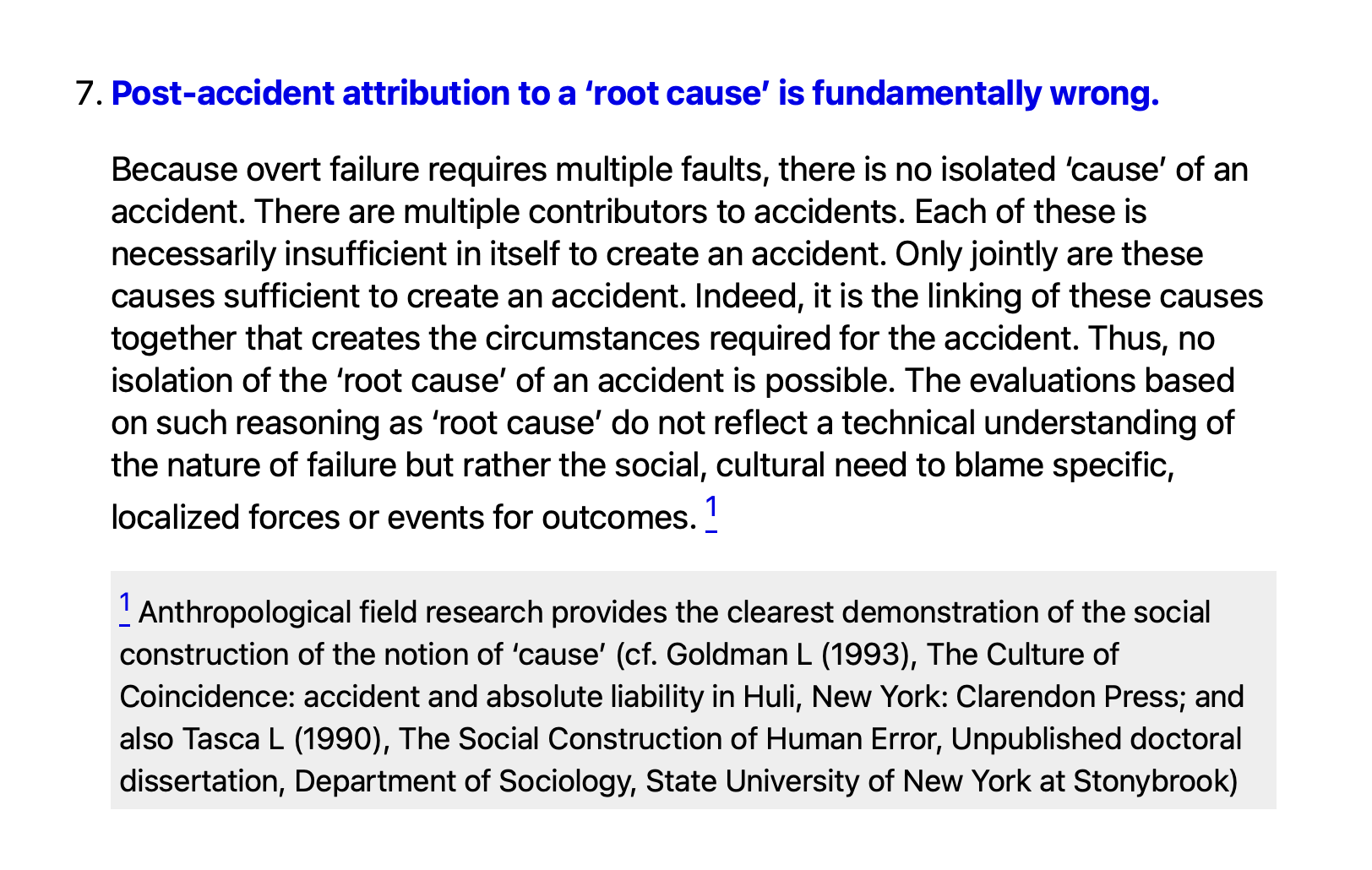
![7. Post-accident attribution to a ‘root cause’ is fundamentally wrong.

Because overt failure requires multiple faults, there is no isolated ‘cause’ of an accident. There are multiple contributors to accidents. Each of these is necessarily insufficient in itself to create an accident. Only jointly are these causes sufficient to create an accident. Indeed, it is the linking of these causes together that creates the circumstances required for the accident. Thus, no isolation of the ‘root cause’ of an accident is possible. The evaluations based on such reasoning as ‘root cause’ do not reflect a technical understanding of the nature of failure but rather the social, cultural need to blame specific, localized forces or events for outcomes.

Anthropological field research provides the clearest demonstration of the social construction of the notion of ‘cause’ (cf. Goldman L (1993), The Culture of Coincidence: accident and absolute liability in Huli, New York: Clarendon Press; and also Tasca L (1990), The Social Construction of Human Error, Unpublished doctoral dissertation, Department of Sociology, State University of New York at Stonybrook)](https://media.hachyderm.io/media_attachments/files/117/616/100/662/733/950/original/f936e6faae92cd2c.png)

  • source
  • hideshow 12 child comments
  • [–] 1 point 17 hours ago

    @inthehands For anyone interested in hours of excruciating detail on famous, infamous, and little known incidents - and the inevitable conclusion of multiple things going wrong but generally accelerated by poor management - this is the podcast for you!engineered.network/causality/

  • source
  • parent
  • [–] [S] 1 point 1 day ago* (last edited 1 day ago) (10 children)

    This warning means that trying to pick out one bogeyman here is a flawed approach, because (for example) “Was it layoffs or not?!” is a meaningless question. It was (as Baldur says) almost certainly “layoffs and….”That warning •also• means that companies like Microsoft can try to save face by cherry picking the least PR-damaging causal factor and trumpeting that as the real cause. Beware of such declarations when they arrive. If they name a single cause, it’s a PR stunt.I don’t think we know what really caused the MSFT or FAA outage. I doubt we’re going to anytime soon, maybe ever. The answer will be large; it contains multitudes.3/

  • source
  • parent
  • hideshow 10 child comments
  • [–] [S] 1 point 1 day ago (9 children)

    Even without knowing all the gory and confidential details, however, and even without looking for a single root cause or smoking gun, we can usefully assess the •landscape•. And if we do, we see serious problems — ones that are alarming, but also ones we can address.4/

  • source
  • parent
  • hideshow 9 child comments
  • [–] [S] 1 point 1 day ago* (last edited 1 day ago) (8 children)

    Was it layoffs? Was it reckless vibe coding?Ask instead: what kind of industry / socioeconomic environment are we in right now that these things are so very likely to be among the causal factors?If orgs are chucking people out the door at the same time they’re rolling codebases they don’t really understand into production, what does that say about the management environment? The financial and political pressures at play?I was riffing on this yesterday:hachyderm.io/@inthehands/117615/

  • source
  • parent
  • hideshow 8 child comments
  • [–] [S] 1 point 1 day ago* (last edited 1 day ago) (7 children)

    A lot of the riffing happening on engineering social media right now can look like cynicism or gallows humor, perhaps, but I think it’s also something deeper and much more positive: it’s people in the trenches recognizing and resisting an environment that is dehumanizing and psychologically oppressive and broadly harmful.When @grimalkina talks about how we treat software creators as “brains in jars” (see her book The Psychology of Software Teams), she’s putting her finger on both psychological experiences •and• systemic forces:6/

  • source
  • parent
  • hideshow 7 child comments
  • [–] [S] 1 point 1 day ago* (last edited 1 day ago) (6 children)

    “Brains in jars” is how you get management leaping like kittens at laser pointers any time somebody promises a way to commoditize developers.“Brains in jars” is how you end up believing that you can ship mountains of code that reflect no careful thought and that nobody actually understands (vibe coded or otherwise).“Brains in jars” is how you get Microsoft conducting mass layoffs with no apparent managerial understanding of the cost of lost institutional knowledge and damaged relationships, or the concrete risks that creates.7/

  • source
  • parent
  • hideshow 6 child comments
  • [–] [S] 1 point 1 day ago (5 children)

    Mix “brains in jars” with a version of capitalism where extreme wealth inequality means that investors and not customers are the ones with the money and power, and mix that with anti-trust law being effectively nonexistent, and mix that with a right-wing lurch toward corruption, and…well, there you have our present moment.A few other things belong on that list, I’m sure. Point is, the •kind• of failures we’re seeing the last few days — particularly the slow and strangely confused recovery — are symptoms of large systemic forces.8/

  • source
  • parent
  • hideshow 5 child comments
  • [–] [S] 1 point 1 day ago* (4 children)

    So LLMs and layoffs aren’t the root cause, because there is no such thing as a “root cause” here. And maybe they don’t even turn out to be one of the proximate causes.But if they’re not causes, they’re comorbidities.9/

  • source
  • parent
  • hideshow 4 child comments
  • [–] [S] 1 point 1 day ago (3 children)

    I quipped yesterday:When termites are eating the whole structure, can you identify which single specific beam made it fall? •That• is the framing I’m advocating in this thread.10/

  • source
  • parent
  • hideshow 3 child comments
  • [–] [S] 1 point 1 day ago* (2 children)

    So I say yes, do complain about vibe coding, do complain about layoffs, point that finger, mock, cajole, crack those jokes, post those memes — not because everything would be better if only the vibe coding would just vanish, but because it’s a way of drawing attention to the termites in society’s structural wood.All the meming and gallows humor is good if it is part of recentering and refocusing on humans.Let’s build and do great things by being kind, by being humane, by never losing sight of the value of the humans who touch and make every part of these messy systems that are breaking so badly right now.11/

  • source
  • parent
  • hideshow 2 child comments
  • [–] [S] 1 point 1 day ago (1 child)

    P.S. Apologies to termites, they are cool creatures, this is not an anti-termite account, these pernicious societal forces are way worse than termites; the metaphor works only inasmuch as you don’t want termites eating your home.

  • source
  • parent
  • hideshow 1 child comment
