you are viewing a single comment's thread
view the rest of the comments
[–] 37 points 6 months ago (9 children)

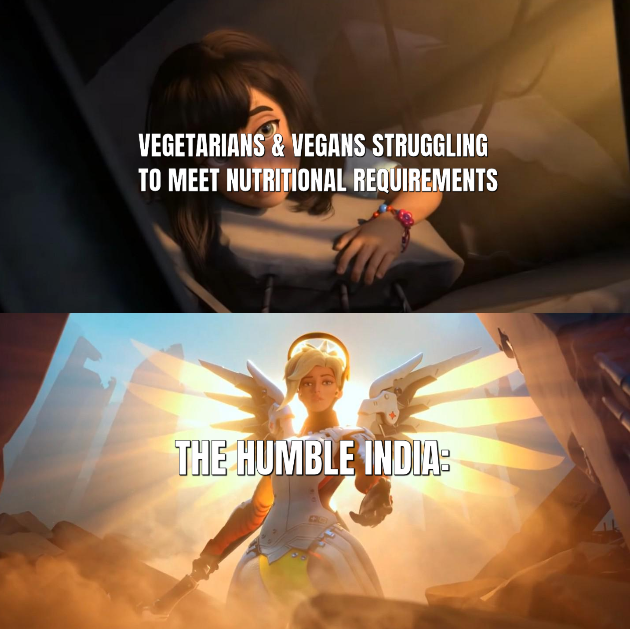
Those saying that the Indian population is protein deficient, stunted, and anemic: You're correct. Only a fraction has a balanced, protein-rich vegetarian diet as the norm.

But you don't have to make that mistake. There are thousands upon thousands of perfectly healthy vegan recipes in our repository. Use them.

  • source
  • hideshow 9 child comments
  • [–] 8 points 6 months ago (3 children)

    Only a fraction has a balanced, protein-rich vegetarian diet as the norm.

    Correct me if I'm wrong, but that's not because of bad dietary choices, but because of poverty? I mean, the problem isn't the vegetarian diet, but that people can't afford enough food in general?

  • source
  • parent
  • hideshow 3 child comments
  • [–] 9 points 6 months ago (2 children)

    At this point, few are poor enough to not afford the cheapest protein available.

    Info: https://lemmy.dbzer0.com/comment/25631871

    For example, I hail from the north-western region of India. We eat a lot of lentils, beans, and pulses. Once, I sat down for dinner with three of my coworkers who hailed from the eastern regions, near the Gangetic delta. That is a historically impoverished region, with rice making up the vast majority of their calories.

    I, alone, ate as much lentil stew as the other three combined. I am not particularly gluttonous. They just aren't used to eating lentils as anything other than flavoring for their mountain of rice, whereas for me rice is just the means of transport of lentils down my gullet.

    It is very hard for an Indian to not afford enough lentils, pulses, or beans. The government gives them away for free as part of rations for those too poor to afford them.

  • source
  • parent
  • hideshow 2 child comments
  • [–] 8 points 6 months ago (2 children)

    Hi it’s me. Someone who is vegetsrianish (moving towards cooking no meat at home (save for occasional fish and eating it on vacation or special occasions - kids 4th of July bbq party). I’m actually trying to get deep into Indian cuisine where I can find a balance of flavor and meeting all the nutritional needs while not porking out on carbs.

  • source
  • parent
  • hideshow 2 child comments
  • [–] 6 points 6 months ago* (1 child)

    There is a ton of debate on this and in some cases if you standardize for affluence / income level the differences disappear.

    There's a lot of questions about cutoffs used for certain conditions and whether they can be used universally.

    BMI is the most obvious example of a measure that should have for different cutoffs for different populations.

    The WHO cutoffs for anemia were established over 50 years ago based on predominantly European and North American populations.

    Sachdev et al., 2021 identified a subset of "healthy" Indian children from the CNNS data who had no iron, B12, or folate deficiencies and no inflammation.

    In this perfectly "healthy" group, the 5th percentile of hemoglobin—the statistical cutoff for anemia—was 1.0 to 2.1 g/dL lower than the WHO standards across all age groups.

    The researchers argued that if the population is "healthy" at lower Hb levels, using the higher WHO cutoff misclassifies millions of healthy people as anemic, creating a "false epidemic."

    Research published in the European Journal of Clinical Nutrition (2023) examined at what point adding more iron stops increasing a person's hemoglobin.

    For Indian women, the "steady state" was reached at a hemoglobin level of roughly 10.8 g/dL.

    The WHO cutoff for non-pregnant women is 12.0 g/dL. This suggests that even when an Indian woman has optimal iron stores, her body may naturally maintain a hemoglobin level lower than the Western-derived standard

    Most large-scale surveys in India use a finger-prick (capillary) test. Studies have shown that capillary blood often yields lower hemoglobin readings than venous blood (drawn from a vein) because of "interstitial fluid" dilution during the prick.

    When the CNNS used venous blood, the anemia prevalence among adolescents was found to be significantly lower than what previous capillary-based surveys had suggested.

    Just providing some context. There are many that advocate for universal cutoffs for a variety of reasons. But it should be understood that the interpretation of the data may not represent a meaningfully "deficient" state here. There are several examples of how using "normal ranges" that were based on a subset of the global population may lead us to dubious conclusions.

  • source
  • parent
  • hideshow 1 child comment