you are viewing a single comment's thread
view the rest of the comments
[–] 26 points 6 months ago* (last edited 6 months ago) (3 children)

It was so weird being raised in the US where India was/is exoticized as some far off unique flavor of humanity that is just one country among a far east of peculiar deviations from mainstream (read: european) history.

In reality Indian history is a good chunk of human history..... The current population is what 1/7th of earth?... and India's history stretches back very deep into human history.

I wish Indian stuff was portrayed in US culture more along the lines of "look at this other thing one of humanities oldest and largest cultures figured out before the rest of us did!". Not in a way that fetishes it, rather the opposite, introduce the basic logical point that India can't be ignored as a part of human history, too much of our story as humans has happened there and is happening there.

Same thing with China, though I feel like China's immensity of population is more often portrayed negatively in the US and thus this is less of a subversive point. However when it comes to history there is the same exact weird denial of Chinese history as there is Indian history in the US, whatever you think of the present day places they are major parts of the story of the human race. US culture focuses on Western European history like it is the main course and by the numbers it just isn't.

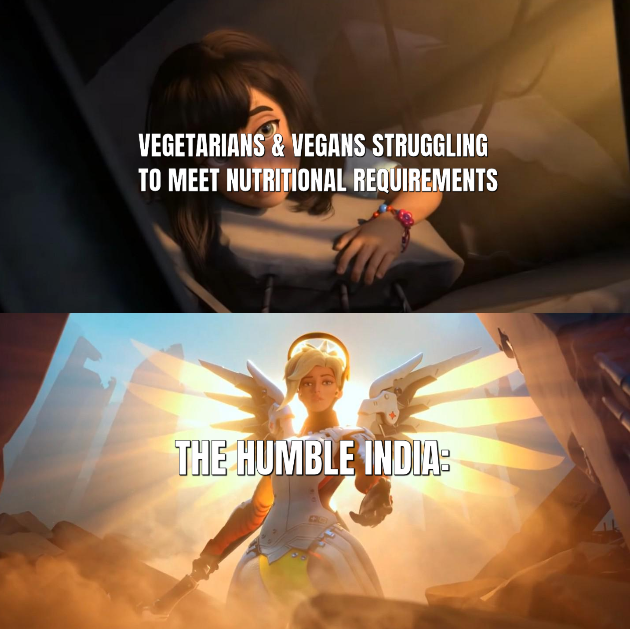
I dunno, I guess I say that all to make that point that I love Indian food, especially how good vegetarian and vegan Indian food often is, and I would argue that actually Indian food being awesome makes a lot of sense if you think about it. Indians have been perfecting the art of cooking for a long time with a massive diversity of styles.

  • source
  • hideshow 3 child comments
  • [–] 4 points 6 months ago (1 child)

    Agree, Indian food isn’t as well known in US. It’s more than just Butter Chicken, Naan, and biryani. It’s a whole diverse cuisine. I’ve noticed South Indian restaurants are less common in US compared to North Indian and South Indian food has so much good variety. Dosa, Vada, Idli, Utthapam, Sambal, etc.

    I’m Marathi myself and I only know 1-2 Marathi restaurants in my city. It’s hard to find things like Pav Bhaji, Kande Poha, Mugachi Usal, etc. in restaurants. So most of the time we end up cooking at home since we don’t get this food outside.

  • source
  • parent
  • hideshow 1 child comment
  • [–] 3 points 6 months ago* (last edited 6 months ago)

    This is by design. Throughout civilizational history, one's in-group was made up of the civilized and any outgroup were "barbarians". During the colonial era, as power and wealth shifted westward, the first global narrative of this kind was proselytized where one side of the world was civilized and the other was not.

    During this period a lot of the history of the Eastern world was distorted and warped to accurately fit that narrative. This was to promote the idea of a "civilizing mission", one where the exploitation of this era could be overlooked since the "lesser" who were victimized by it were "benefitted" by proximity to those more civilized than them.

    A global race based caste system is what came out of this era. Anyone with their eyes open can see it everywhere around them, regardless of which hemisphere you're in. Now, as power in the world rebalances, perhaps closer to a more natural state, the seams of that construct are slowly coming undone and the hegemon that had once defined the global narrative will no longer be able to silence the voices it once deemed as "lesser".

    I for one am excited for a future where people get to tell their own story and explore their own history. No, I don't think about the Roman empire very often but I do look at the Mauryan empire, Chanakya and his treatise on statecraft (the Arthashahtra), and the university of ancient Taxila with a deep fascination - and there's nothing wrong with that.

    I also enjoy reading verses from the Kamasutra which was remarkably forward thinking (though not perfect) for its time with regard to promoting financial independence for women, autonomy, mutual enthusiastic consent, respect towards sex workers and the importance of balance during courtship - all of which was cast aside as paganism when it was made known in this part of the world, in favor of the glossary on sex positions. It also discusses homosexuality and transsexuality inclusively, concluding:

    ​"In all things pertaining to love, who can say what is right and what is wrong? Let each person follow their own nature." — Book 2, Chapter 9

    Words to live by.

  • source
  • parent