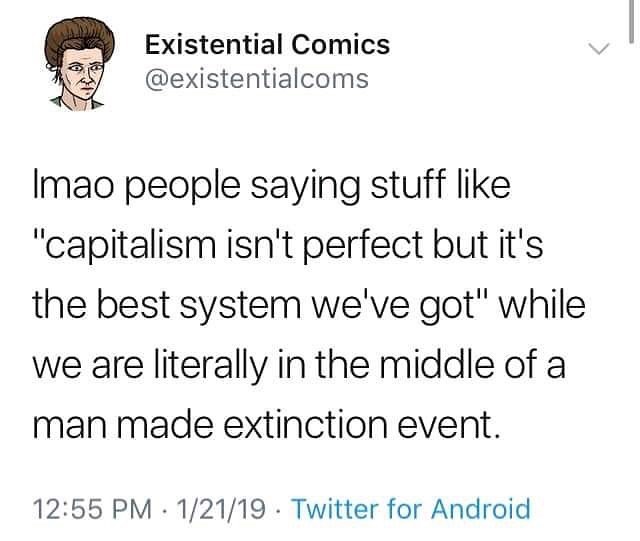
The main benefit of capitalism is the free market that it establishes. But it requires regulation to prevent control being centralizes by private oligarchs.
The "free market" and regulations are mutually exclusive. You can't have both, unless you consider a "free market" to exist on a spectrum between no regulations and maximum regulations and draw an arbitrary line between free and not free.
Communism has the same problem of central control of capital and markets, but in their case, its state connected oligarchs.
This is an issue with vanguardist marxism-leninism, not necessarily communism. I understand that this is the ideological strain of communism that people - especially Americans - are most familiar with for historical reasons, but there are many other strains that oppose centralized command and control economies, preferring more federal and democratic or consensus-based systems. In fact, the Bolsheviks initially rallied around the slogan "all power to the soviets." Soviets are workers' councils - the primary decision-making bodies and drivers of the Russian revolution - and they operated independently, freely associating with one another by choice. It was only after the revolution succeeded in siezing the state that the soviets were dissolved and replaced with "one big soviet" which was loyal to Lenin. It was briefly still somewhat decentralized and democratic (at least relative to what came before) until Stalin came to power and rapidly centralized the economic and political structure of the soviet union.
If we could have the free market without the incentives to centralize wealth and control, I would be very interested.
What exactly do you mean by "free market?" If we go by the conventional definition of a free market (capitalism without any regulations or checks of any kind) then what you're asking for here is fundamentally impossible. The economic system of capitalism is one that creates the incentives to centralize wealth and control by allowing - and then enforcing - private ownership of the means of production.