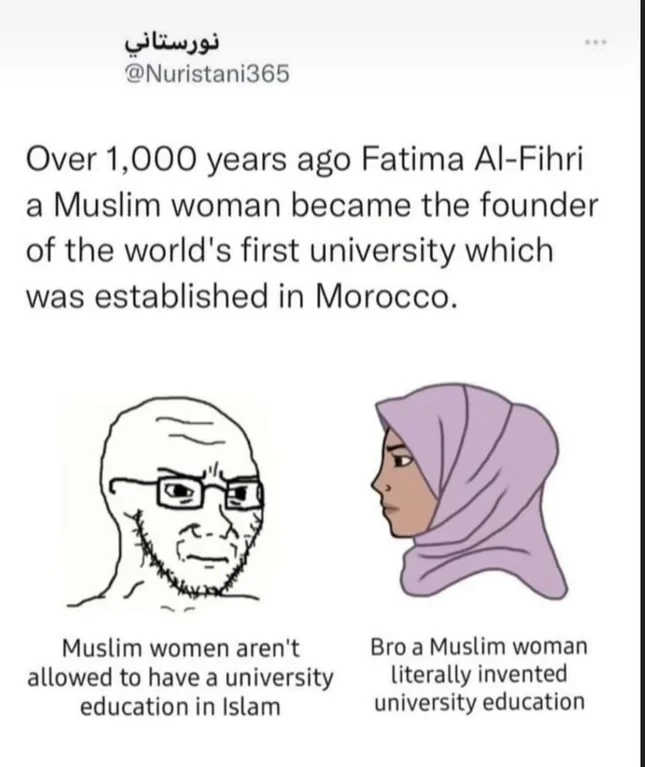
You’re not actually addressing the core point.
“…do you not understand how other modern universities started?”
Yes, actually I do. Many universities evolved out of religious institutions. That’s exactly the point. Being founded as a religious school doesn’t automatically make something equivalent to what we now define as a university. Institutions like University of Oxford developed into degree-granting, corporately structured institutions with recognized faculties, charters, and governance systems. Simply saying “others started religious too” skips over the structural differences that define a university.
“…accreditation for universities wasn’t a thing until the 19th century, so I don’t know what you expect that proves?”
Accreditation in the modern sense didn’t exist, sure. But formal recognition, charters, and institutional frameworks absolutely did. Medieval universities operated under papal bulls, royal charters, or legal privileges that formally established them as universities. So the absence of modern accreditation doesn’t mean there were no standards or distinctions at all. The question isn’t “was there 19th-century accreditation?” it’s whether the institution functioned as a university in the historical sense of the term.
Calling that “moving the goalposts” doesn’t make it so. It’s clarifying definitions.
And as for “tilting at windmills” that only works if the argument being challenged doesn’t exist. This at its core is a disagreement about classification and historical continuity. That isn't imaginary it’s a definitional and historical debate.
If you want to argue it qualifies as a university from inception, then please make the case based on the structure, curriculum, governance, and recognition not just origin story comparisons.