xkcd #3109: Dehumidifier

Title text:

It's important for devices to have internet connectivity so the manufacturer can patch remote exploits.

Transcript:

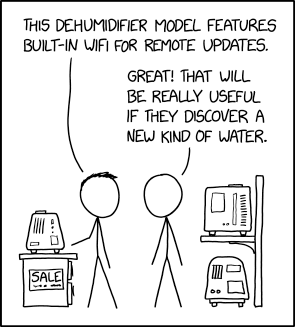
[A store salesman, Hairy, is showing Cueball a dehumidifier, with a "SALE" label on it. Several other unidentified devices, possibly other dehumidifier models, are shown in the store as well.]

Salesman: This dehumidifier model features built-in WiFi for remote updates.
Cueball: Great! That will be really useful if they discover a new kind of water.

Source: https://xkcd.com/3109/
explainxkcd for #3109

It's important for devices to have internet connectivity so the manufacturer can patch remote exploits.
you are viewing a single comment's thread
view the rest of the comments
[–] 84 points 1 year ago (82 children)

welll........ devils advocate.. i could see the wifi being used so the device can be incorporated into the home automation system [climate control]. its not about dehumidifying, its solely about engaging the dehumidifying as needed.

  • source
  • hideshow 82 child comments
  • [–] 139 points 1 year ago (23 children)

    Yeah, or the manufacturer bricks the device bcz they want to sell you a new one.

  • source
  • parent
  • hideshow 23 child comments
  • [–] a comment that isn't shown here: deleted, from someone you've blocked, or on another page. view the thread from it
  • [–] 26 points 1 year ago

    They didn’t brick it, but the Nest thermostats that customers bought before Google acquired the company will be offline only now. No opening of the firmware, so they’ll become useless at some point, and already have lost major functionality.

  • source
  • parent
  • [–] 32 points 1 year ago (10 children)

    That's why projects like this are great: https://github.com/Hypfer/esp8266-midea-dehumidifier

    My Midea Cube dehumidifier can never be bricked and will never send data outside of my home. It talks to Home Assistant via MQTT and nothing else.

  • source
  • parent
  • hideshow 10 child comments
  • [–] a comment that isn't shown here: deleted, from someone you've blocked, or on another page. view the thread from it
  • [–] 18 points 1 year ago (6 children)

    Yeah but I want to control it with the average humidity from sensors across my house

  • source
  • parent
  • hideshow 6 child comments
  • [–] 4 points 1 year ago (1 child)

    It's almost like you can just set the dehumidifier to a certain humidity level and fan speed and then never touch the settings again. That's what I did with my humidifier. It's as dumb as a box of rocks, but it quits working during the summer when the humidity goes up and then turns back on the rest of the year with zero interaction besides adding more water

  • source
  • parent
  • hideshow 1 child comment
  • load more comments (4 replies)
  • load more comments (3 replies)
  • [–] a comment that isn't shown here: deleted, from someone you've blocked, or on another page. view the thread from it
  • [–] 19 points 1 year ago (5 children)

    Hey bud, no need to attack someone's intelligence. You can pick apart their argument with sources like a big kid but nobody logged in to see you be a butthead online today.

  • source
  • parent
  • hideshow 5 child comments
  • load more comments (3 replies)
  • load more comments (2 replies)
  • [–] 50 points 1 year ago (28 children)

    Dehumidifiers already do that. They're equipped with hygrometers that kick the machine on or off depending on the relative humidity. It's old tech and it's pretty reliable, wifi isn't really necessary for it.

  • source
  • parent
  • hideshow 28 child comments
  • [–] a comment that isn't shown here: deleted, from someone you've blocked, or on another page. view the thread from it
  • [–] 1 point 1 year ago (6 children)

    In the UK, it's common for electric showers to be on a separate isolator that needs to be turned on before they'll heat up, and it also activates an extractor fan, and most people turn it off again when they're done showering. It's pretty simple for a home automation hobbyist to swap the regular isolator switch for a smart one, and then their system can know when they're about to shower and activate the dehumidifier immediately. This can be much better than waiting ten minutes for enough humidity to diffuse into the dehumidifier for the humidistat to activate then waiting another ten minutes for the cold side to cool enough for any dehumidification to start.

    I didn't say a home automation system would be measuring the humidity and reacting. The opportunity to do better comes from the potential to be more proactive if you can figure out a way to tell a computer about impending humidity.

  • source
  • parent
  • hideshow 6 child comments
  • [–] a comment that isn't shown here: deleted, from someone you've blocked, or on another page. view the thread from it
  • [–] 1 point 1 year ago (4 children)

    I was going to share a graph from when I put a DHT20 hygrometer in my bathroom to prove to my family that the humidity was the cause of the mould and they should stop turning the dehumidifier off when its built-in hygrometer said it should be running, but unfortunately, it was long enough ago that Home Assistant decided I no longer need my one-every-ten-seconds readings and now only shows hourly readings, which aren't enough to prove my point here. You'll just have to take my word for it that when I did this test, I was surprised to find that although the humidity at the other end of the room started rising quickly after the shower was turned on, it peaked fifteen or twenty minutes after it was turned off again because diffusion without something like a fan or a draught moving the air around can be really slow.

    My bathroom's a weird shape as it's long and thin and has a weirdly high ceiling at one end, so it's not going to have typical airflow, but it is a real bathroom that really exists, and I did have data in the past showing it dried out faster if I manually turned the dehumidifier to maximum (so it would run even if its hygrometer said not to) ten minutes before turning the shower on than if I did it immediately before turning the shower on. Whether I'm going to shower in ten minutes is something I can know but a hygrometer can't. This isn't even really related to whether the dehumifier is smart as mine isn't and I can operate its switch as easily as I could operate a smart switch, and my shower isn't electric, so there isn't a switch I need to operate before using it that could be made to do two jobs

  • source
  • parent
  • hideshow 4 child comments
  • [–] 1 point 1 year ago (3 children)

    It sounds to me like your problem is human error, not the lack of a smarter machine. You can't engineer your way around people being morons. The greatest engineering minds have figured that out years ago.

  • source
  • parent
  • hideshow 3 child comments
  • [–] 1 point 1 year ago (2 children)

    So you think the reason a hygrometer can't detect humidity ten minutes before it exists in order to start cooling the dehumidifier's compressor to the temperature it needs to be to start working is human error?

  • source
  • parent
  • hideshow 2 child comments
  • [–] 1 point 1 year ago* (1 child)

    No I'm saying you told your family to stop turning off the dehumidifier and they haven't stopped doing that. No amount of home automation or smart devices is going to change your family turning the dehumidifier off. You don't have a dumb system problem, you have a dumb people problem. And unfortunately a dumb people problem doesn't get solved by a smarter system.

    Dehumidifiers are already automatic. Black mold isn't going to take over your bathroom in 10 minutes.

  • source
  • parent
  • hideshow 1 child comment
  • [–] 1 point 1 year ago

    Turning the dehumidifier on ten minutes early means there aren't ten to twenty minutes where the shower's running with no dehumidification where condensation is able to settle on all the walls unimpeded, and the extra condensation takes a couple of extra hours to dry out again. Regardless of whether my family try to turn off the dehumidifier prematurely (and I only mentioned that as why I'd originally set a hygrometer up to graph the humidity in the bathroom, not as an ongoing problem), if that happens several times a day when someone showers, that's more than enough dampness for black mold to form.

  • source
  • parent
  • load more comments (1 reply)
  • [–] a comment that isn't shown here: deleted, from someone you've blocked, or on another page. view the thread from it
  • [–] 12 points 1 year ago (7 children)

    It's ironic that you can implement all this cool automation for a device but in the end still have to manually lug water to it.

  • source
  • parent
  • hideshow 7 child comments
  • [–] 11 points 1 year ago

    Well it's a **de-**humidifier. You need to lug water from it. For the dehumidifier in my basement, we have it hooked up to a hose that takes the water right down the drain.

    But I do take your point, it is pretty funny.

  • source
  • parent
  • [–] 4 points 1 year ago (5 children)

    Like how every source of power is still steam since before the industrial revolution.

  • source
  • parent
  • hideshow 5 child comments
  • [–] 9 points 1 year ago (4 children)

    Just most sources of power. Photovoltaic, wind and hydro aren't steam based.

  • source
  • parent
  • hideshow 4 child comments
  • [–] 1 point 1 year ago

    Almost no cars, trucks, or tractors are steam based anymore. I believe most ships are ICE as well, not to mention rockets, and animal/muscle power. As such I'd need a very deep analysis of the situation to believe any claim. (deep because in an ICE a large part of the power comes from burning fuel producing steam, so we can start debating how much of an ICE is steam - have fun).

    In any case my local electric utility generated more power from wind than all customers used last year, so I can make a good claim most of my power isn't from steam. If your utility isn't in the same situations or close you should be demanding they get with the times.

  • source
  • parent
  • load more comments (3 replies)
  • [–] 3 points 1 year ago (8 children)

    but a microcontroller with WiFi like the ESP8266 or ESP32-C3 costs less than an accurate hygrometer chip

    Ok, two things.

    First, the cost of the Wi-Fi chip is clearly not the issue here. The real expense/concern is the effort and software mechanisms needed to secure that network connection. Connecting to the Internet is easy, securing that connected device is hard.

    Secondly, at some point you still need the hygrometer, there's no way around that. Either your dehumidifier is tracking humidity, or your home automation system needs to track humidity. And you can't like... get that data from the web somehow, you need a local sensor, and it will generally only make sense to have it in the same room as the dehumidifier (meaning not necessarily where other smart home components are set up).

  • source
  • parent
  • hideshow 8 child comments
  • So, first off, smart devices shouldn't need to connect to the internet, only the local network. I have everything connected to Home Assistant, and then for access outside the house I have HA connected to the internet, meaning I only have one point I need to secure.

    On your second point, I think the poster above was talking about having both an in-built as well as wifi-accessible external sensor. It makes it possible to have a more powerful dehumidifier in one space, running to a lower humidity than needed based off what's going on in other rooms. Then have that air circulated by other fans, etc.

  • source
  • parent
  • [–] 3 points 1 year ago (6 children)

    You're missing my point. It's likely that the cheapest way to design and build a dehumidifier these days will already include a microcontroller interpreting results from a digital hygrometer because these components are cheap and easier to work with than purely electronic/electromechanical designs with no microcontroller. The cost of switching from a non-WiFi/Bluetooth/Zigbee microcontroller to one with one or more of these networks is negligible, and once you've got it, it's not meaningfully more expensive to pay a software engineer to expose the on/off switch and hygrometer readings via that network and have the marketing people write Smart! Now with WiFi! than it is to skip it and pay the marketing people to come up with some other nonsense to put on the box. If you care about security as little as the average IoT vendor does, then it's nearly free to turn a dumb device into a smart one, so if it makes a handful of extra people buy the device, manufacturers will make things smart. For a dehumidifier, there are reasons why a handful of people will prefer a smart one, so smart dehumidifiers get made.

  • source
  • parent
  • hideshow 6 child comments
  • [–] 1 point 1 year ago (5 children)

    It's likely that the cheapest way to design and build a dehumidifier these days will already include a microcontroller interpreting results from a digital hygrometer because these components are cheap and easier to work with than purely electronic/electromechanical designs with no microcontroller.

    Well this part is definitely not true. A microcontroller and Wi-Fi chip are definitely more expensive than a wire, a variable resistor and a knob, which is all a purely electro-mechanical system would need in addition to the hydrometer.

    The fancy digital version wouldn't be a lot more expensive, but it certainly wouldn't be the cheapest way to go.

    That said, I think you're right that most companies will opt to go the fancy digital route to try to sell a "smart" product with more features. But then I expect there will also always be companies that manufacture simpler, cheaper products as well.

  • source
  • parent
  • hideshow 5 child comments
  • [–] a comment that isn't shown here: deleted, from someone you've blocked, or on another page. view the thread from it
  • [–] 1 point 1 year ago (3 children)

    Look, I'll be honest with you, I've never built a dehumidifier (I'm sure you're shocked). I don't know what exact components tend to be used. What I do know is that I have a fairly new dehumidifier and we have another one from probably the early 80s. Somehow they both work. Again, I'm not sure what components were used in the older model, but given the age I'd be very surprised if the electronics it uses would be more expensive to manufacture than the newer one.

    Really, I think the idea I'm trying to get across is just that you can always aim lower. Sometimes the goal isn't achieving perfect precision, but rather achieving something good enough. Take toasters for example, most toasters don't have a timer at all. They have a little piece of metal almost touching a contact. When you turn the toaster on, that metal heats up and it bends until it touches that contact, ding toast is done. And when you turn the little dial from light to dark it just moves that piece of metal slightly further from the contact. My point is, it's not exact, it won't be the same on every toaster, and it will probably shift over time. It's a low tech solution for something that could absolutely be done in a more modern, more precise, and still inexpensive way (a simple timer). But it's cheaper and simpler to just do it the old way, and for many applications, that's fine.

    Hell, I'm certain there are dehumidifiers on the market that don't have any kind of humidity sensor at all. Even simpler...

  • source
  • parent
  • hideshow 3 child comments
  • [–] 1 point 1 year ago

    If you don't have a sensor then that is cheaper in the short term, but it quickly wastes a lot of energy running when the humidity is under control. For a dehumidifier you need more energy to get lower so the room well generally will be fairly consistent not too low humidity even as outside humidity changes, but you will use a lot more energy than a system that turns off when humidity is good.

    there are purely mechanical systems that used to be used. However they have some weird machining requirements so it isn't clear they are cheaper than a digital system (this partially depends on volume - make more and the machining gets cheaper per unit). The digital system is as we already have established is very cheap and lets you put buttons and LEDs on the unit for a few cents more - this is far more valuable to marketing than the possible savings (if any!) from a mechanical control.

  • source
  • parent
  • [–] 1 point 1 year ago (1 child)

    Again, I’m not sure what components were used in the older model, but given the age I’d be very surprised if the electronics it uses would be more expensive to manufacture than the newer one.

    That's fundamentally where you're going wrong, then. 1980s electronics (for a dehumidifier, it wouldn't even be electronics, it'd be electromechanical) are often much more expensive than modern approaches, and even when they're cheaper, it's typically not by much. Over time, it's got cheaper and cheaper to precisely make small things, but the costs of materials haven't meaningfully gone down, so the 1980s approach costs about the same as it did back then, whereas digital electronics have plummeted in cost. Now, anything where the best approach was electromechanical rather than electronic is almost certainly cheaper to do digitally.

    Take toasters for example, most toasters don’t have a timer at all. They have a little piece of metal almost touching a contact. When you turn the toaster on, that metal heats up and it bends until it touches that contact, ding toast is done.

    Another great example of being out of date. Fifteen years ago, cheap toasters almost always used a bimetallic strip and the dial controlled the position of the contact it touched so it would have to bend more or less before it disconnected. In nearly every modern toaster, however, you'll either have something like a 555 timer and the dial will control a variable capacitor that changes the frequency of an oscillator to make it count slower or faster, or it'll have a dedicated toaster control chip like the BCT5512 and the dial will control a potentiometer that a capacitor drains through. Mouser list the PT8A2511PE toaster controller for £0.111 in bulk, but the cheapest bimetallic switch they carry (which is too basic for a toaster because it's got a fixed switching temperature) is the F13A17005L360100, which is £1.93 in bulk, more than seventeen times the price. (I suspect they used to have cheaper ones back when toasters still used them, and they've been discontinued now toaster manufacturers have stopped ordering them.)

    But it’s cheaper and simpler to just do it the old way, and for many applications, that’s fine.

    A lot of the time, the old way is more complicated and more expensive. Technology doesn't just let us do things we couldn't before, it also lets us do existing things in new, better ways, and being cheap is one of the most in-demand things. It's lower tech to hire ten labourers with shovels for a week to dig a hole, but it's much cheaper and faster to hire one labourer with a digger to dig it in an hour.

    Hell, I’m certain there are dehumidifiers on the market that don’t have any kind of humidity sensor at all. Even simpler…

    Having no sensor at all is certainly the cheapest way to do it, but we were talking about ones that do have a sensor, and whether, once you've opted to have a sensor, there's any major cost to making the device smart. If you're aiming so low-end that you don't even have a sensor, then you're clearly not concerned about the marketing benefit of extra features, so wouldn't bother making it smart.

  • source
  • parent
  • hideshow 1 child comment
  • load more comments (1 reply)
  • load more comments (1 reply)
  • [+] 3 points 1 year ago (1 child)
  • [–] 7 points 1 year ago

    I can get a board from AliExpress with an ESP32-C3 on it with free shipping for £1.10, so I'm not inclined to believe the £0.765 unit cost for a 5000-part reel from Mouser is really the cheapest way to get them in bulk as the other parts on the same board and the shipping have to cost something.

    The cheapest hygrometer that Mouser sell is £0.748 per unit for a 10,000-part reel, and its datasheet says not to leave it for more than 60 hours in greater than 80% relative humidity (which is a pretty likely scenario for a dehumidifier) as it'll drift, and if it happens often, it'll age faster. You need to spend more to get rid of that restriction. I'll concede that the accuracy penalty if you cheap out isn't as bad as I thought - I'd not actually looked at a datasheet to see how badly modern hygrometers would drift, I just knew that they did - so plenty of manufacturers wouldn't care, but the parts are still comparable prices, not a factor of ten like you're claiming.

  • source
  • parent
  • load more comments (2 replies)
  • [–] 17 points 1 year ago (18 children)

    To steel-man the argument some more, if you have variable-rate electricity, it could turn on when electricity is cheap.

  • source
  • parent
  • hideshow 18 child comments
  • [–] 9 points 1 year ago* (last edited 1 year ago) (12 children)

    This can be done with something like Zigbee. Or even simpler: you hook a non-connected device up to a "smart" power socket. No need for the device itself to talk to the outside world.

  • source
  • parent
  • hideshow 12 child comments
  • [–] a comment that isn't shown here: deleted, from someone you've blocked, or on another page. view the thread from it
  • [–] 9 points 1 year ago (5 children)

    Zigbee is local and if you really wanted to you can use Home Assistant 100% offline it will be just neutered and basic.

  • source
  • parent
  • hideshow 5 child comments
  • [–] 7 points 1 year ago (4 children)

    im not sure why all these people jumped from 'wifi' to 'internet' as if they were the same thing. no one should be exposing their automation devices directly to the interwebs

  • source
  • parent
  • hideshow 4 child comments
  • [–] 1 point 1 year ago*

    Honestly, having any of these vulnerable devices on your network is exposing your whole network, assuming the network is connected to the web.

    Your best off using either a separate network for your smart devices with its own router, or setting up a vlan to keep your smart appliances and actual computers separate.

  • source
  • parent
  • [–] 4 points 1 year ago (1 child)

    Sadly, many wifi-enabled devices only work with some proprietary cloud-service and even if not, they're only one configuration error (or intentional backdoor) away from talking to the outside. Better have something that isn't physically able to talk to the internet no matter how badly I fuck up its configuration and my firewall.

  • source
  • parent
  • hideshow 1 child comment
  • Clearly I just trust my abilities to disable a devices internet access in my router more than you. I also know that my risk factor is really low, because I'm not a journalist or a politician.

    As well, I only buy smart devices that I can lock down, brands like LIFX & Shelly that have cloud services, but don't require you to connect to them for the device to function over LAN.

  • source
  • parent
  • [–] 7 points 1 year ago (1 child)

    I run home automation with lights, switches, outlets, heaters and some more and not a single device has internet access. They all use Zigbee (a simple radio protocol) to talk to homeassistant which is open source and hosted on a machine that lives under my desk.

    Separating tasks between the dehumidifier and outlet has the advantage that each individual device can be a lot simpler, leaving less attack surface. My power outlet can't read the humidity sensor, it doesn't need to talk to an external server, it doesn't even need to know that the thing connected to it is a dehumidifier. It's just a chip that receives a radio signal and toggles a relay on or off. That's it.

    Separating the two concerns also lets me replace the devices separately if one breaks or my requirements change. If I suddenly need wifi or bluetooth instead of Zigbee or if it's for some reason no longer supported by homeassistant, I can just replace a 9€ outlet instead of the whole dehumidifier that could get bricked by the proprietary app losing support.

  • source
  • parent
  • hideshow 1 child comment
  • [–] 5 points 1 year ago

    Home automation is still a dark art as far as the common person is concerned. Full of fear mongering from the media.

    Much like 3D printing was very mystical and full of "oh no 3d printed guns!" We have gone full appliance with 3d printing and it's no longer gatekeeped by geeks in their basements.

    I'm glad I still have at least one hobby that hasn't gone mainstream and I can still geek out on ESPHome.

  • source
  • parent
  • load more comments (4 replies)
  • [–] a comment that isn't shown here: deleted, from someone you've blocked, or on another page. view the thread from it
  • [–] 4 points 1 year ago

    Some places do electricity costs in 30 minute periods. If you know cost will spike when everyone gets home, and the sun sets, then running early makes sense. Other times, holding off for an hour might be more useful.

  • source
  • parent
  • load more comments (1 reply)
  • [–] 4 points 1 year ago* (last edited 1 year ago)

    That's the feature they sell. But, its real purpose is to monetize your data and/or lock you into some sort of ridiculous subscription service and/or run ads.

    That's pretty much ubiquitous for "smart" devices.

  • source
  • parent
  • [–] 3 points 1 year ago (4 children)

    Dehumidifiers aren’t there to make your house more comfortable though, they are there to keep (usually basements or garages) from growing mold. In fact they usually heat up the space they’re in. So unless you want to have a log of humidity, there’s stop no reason to automate it over WiFi, since the humidity setting on the unit is automatic.

  • source
  • parent
  • hideshow 4 child comments
  • [–] 3 points 1 year ago (2 children)

    dont be dictatatin' my humidity comfort level.

  • source
  • parent
  • hideshow 2 child comments
  • load more comments (1 reply)
  • load more comments (4 replies)