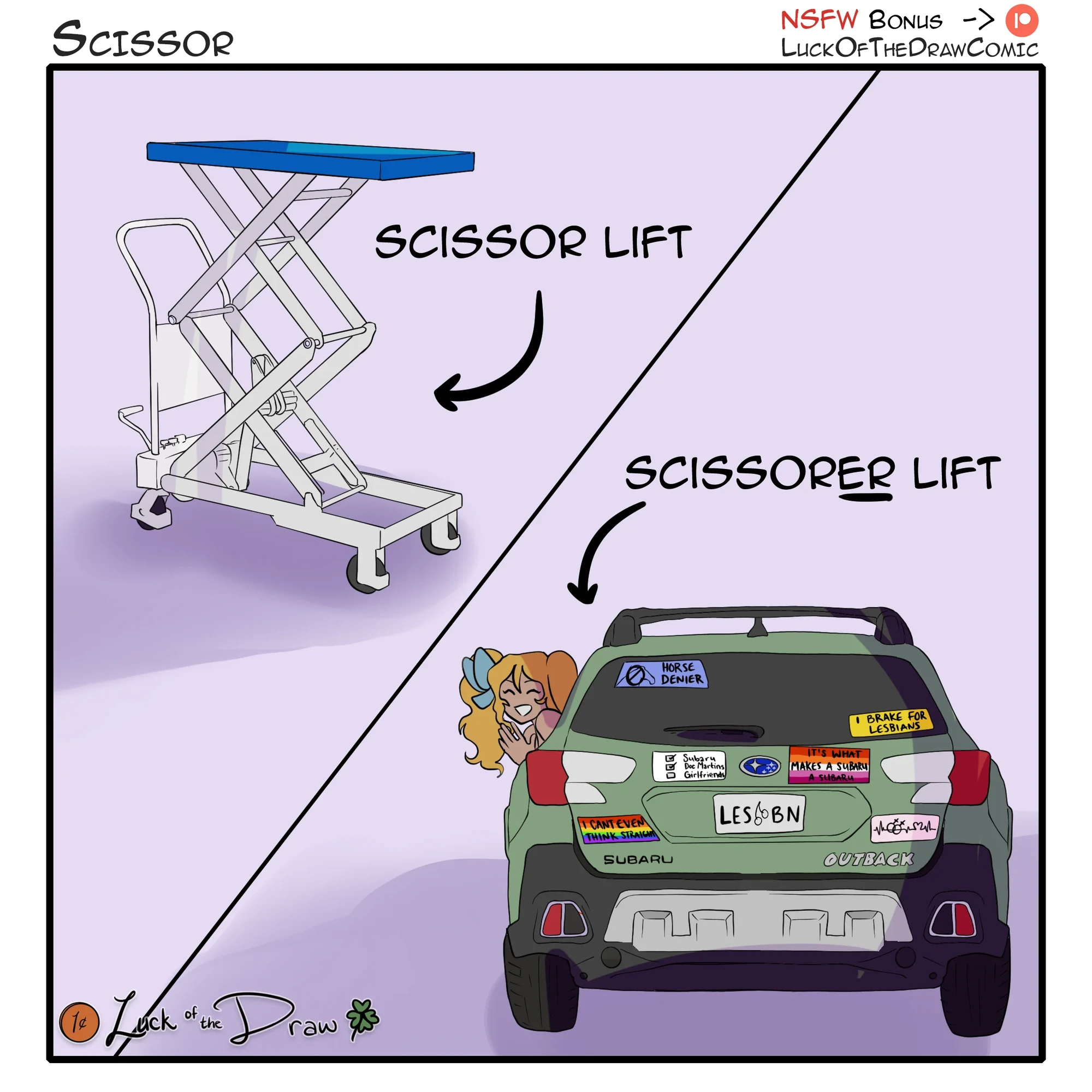
No, it’s not going to look like when you made your Barbies scissor (and we know you did) because humans have joints, and fat, and can get tired in strenuous positions.
I don't know what pride.com is, nor have I heard of the podcast they're linking to, however! nothing you're saying here actually disagrees with what I've said elsewhere in this thread. Yes, tribbing is a thing. No, the common depiction of "scissoring" is not representative of tribbing on the whole. Wikipedia even makes the argument that the use of the term "scissoring" is because the term "tribadism" (tribbing) is no longer used and use the term "scissoring" to describe the same sex acts (something I very much disagree with, and isn't exactly supported by how the term is used extensively in the remainder of that section)
tribadism is commonly omitted from mainstream sex research. Scholar Judith Halberstam stated, "If we trace the use of the term forward into present, we find that tribadism is one of those rarely discussed but often practiced sexual activities, and the silence that surrounds it now is as puzzling as the discourse it produced in earlier centuries." Halberstam added that Sigmund Freud "had nothing to say" with regard to the topic, "and few contemporary lesbian sex books even discuss it".
Google Ngram Viewer isn't a good source, btw. It's neat, but it's bad quality data that doesn't control for biases and it really shouldn't be used to indicate social trends.
The data sets of the Ngram Viewer have been criticized for their reliance upon inaccurate optical character recognition (OCR) and for including large numbers of incorrectly dated and categorized texts. Because of these errors, and because they are uncontrolled for bias (such as the increasing amount of scientific literature, which causes other terms to appear to decline in popularity), care must be taken in using the corpora to study language or test theories. Furthermore, the data sets may not reflect general linguistic or cultural change and can only hint at such an effect because they do not involve any metadata like date published, author, length, or genre, to avoid any potential copyright infringements.
As an example, a random alternative explanation for the trend seen (assuming the data is accurate which we cannot do with ngram viewer) that I've just made up is that papers about the details of lesbian sex were unpopular, and the body of scientific and recreational literature is catching up with the terminology used in their subject matter as the topic becomes less anathema in grant applications. This would very much line up with the dates, and explain the growing usage of the more technical terms as the broadly accepted terminology catches up with the usage of the terms in literature.
Edit:
The podcast, at least in pride's reporting, doesn't seem to corroborate that it's a real thing? Or at least it doesn't concretely do so, as they explain the podcast's interaction as:
The back-and-forth left viewers amused as they desperately tried to parse out whether the conversation was for real or just messing around, which actually proves quite thoroughly how confused society as a whole remains about the mythology of scissoring.
Which really doesn't seem like they're making the definite claim that it's real, and I'm not sure why it's being used as a source here in light of that ambiguity?
Seriously, what is pride.com? I've never heard of them before, are they a known entity?