The lives of a couple thousand plebs are worthless - Roman pride? Priceless!
Classical Antiquity (~100 BCE)
(media.piefed.social)
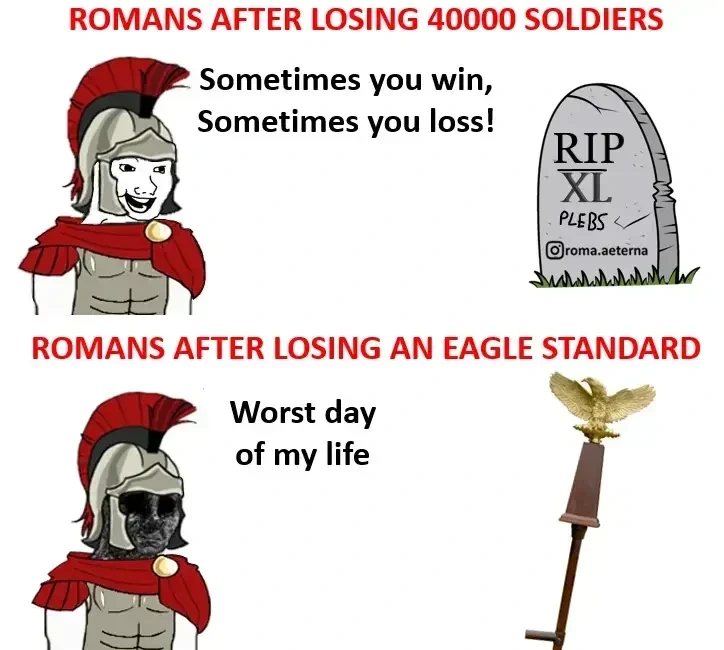
More detailed response here about mid-Republic vs. Early Empire on the manpower front.
https://piefed.social/comment/8560959
Basically, the mid-Republic could conscript militia whenever it needed to, and largely from recruiting pools within a few days' march of Rome itself; the Empire needed time and resources to train troops to an exacting standard, needed them to be largely volunteers, and had to collect them from all over the Mediterranean.
Also from my position as a non-Roman history buff it seems like they weren’t very devastated by, say, Cannae.
Cannae was very devastating, though! Rome won the war in the end, but Cannae mandated a massive policy shift.
First, in domestic policy, it resulted directly in the conscription net being considerably tightened, and non-citizens - including volunteer slaves - being recruited to refill the ranks. Additional taxes were levied in order to supply and arm new troops, and such was the atmosphere of utter desperation that human sacrifice - normally odious to Roman morals - was performed. This was always a discomfiting piece of history for later Roman writers.
Second, in military strategy, it decisively stopped Roman armies from moving to engage Hannibal in the hopes of driving him out of Italy. Roman armies had attempted four times to dislodge Hannibal - in the usual Roman spirit of pigheaded stubbornness which had served the polity well (if not necessarily the dead citizens) in every prior conflict. Instead, Rome adopts Fabius's advice of hemming Hannibal in and preventing him from choosing his battlefield for the next decade of warfare in Italy. The Romans, normally chomping at the bit to engage an enemy, and especially one in their heartland, uncharacteristically (for the Republican era) restrain themselves out of sheer terror of where another Cannae would put them. There was a period after Cannae where Hannibal legitimately could have taken the city of Rome itself, which would have pretty decisively ended the war, and the Romans were acutely aware of this at the time.
Third, it shifted the focus of the war to Spain, where Hannibal distinctly was not, and could not return to. In a funny way, this restores the great strength of the Roman military system - high motivation and aggression - by freeing them from the burden of having to act cautiously against the dreaded Hannibal.