1


'We are in the midst of a new wave of strong nation-state competition which runs directly against the urgent need to establish a new mode of relating to our environs, a radical politico-economic change called by Peter Sloterdijk “the domestication of the wild animal Culture.” Until now, each culture has disciplined/educated its own members and guaranteed civic peace among them, but the relationship between different cultures and states has remained permanently under the shadow of potential war, with each epoch of peace nothing more than a temporary armistice. The entire ethic of a state culminates in the highest act of heroism, the readiness to sacrifice one’s life for one’s nation-state, which means that the wild barbarian relations between states serve as the foundation of the ethical life within a state. It is in the interest of our survival to change such ethics – how?'

ArchiveDotToday version - http://archive.today/71RSR

2
submitted 2 months ago by to c/zizek
 
 
3


Slavoj Žižek talks Spider-Man, Olivia Wilde's sex appeal, Trump's liberal fascism; and his new documentary The Pervert's Guide to Utopias.

4


"The 'normal' process of our history runs towards different forms of final catastrophe: self-destruction through ecological collapse, through the uncontrolled reign of artificial intelligence, through global wars—these endpoints of our history are the true morbid phenomena. In such a predicament, we should pull the emergency brake on our historical process, or, to quote Walter Benjamin from his 'Theses on History': 'Marx says that revolutions are the locomotive of world history. But perhaps it is quite otherwise. Perhaps revolutions are an attempt by the passengers on this train—namely, the human race—to activate the emergency brake.'"

Archive.today - https://archive.ph/DS12j

5
6
submitted 2 months ago by to c/zizek
7


Even, and especially when repressed in the way that only JD Vance can be repressed, the unconscious speaks precisely in the form of that very repression.

As Lil Joel points out, JD Vance makes a half-hearted attempt at a joke about a Freudian slip; he terms it a "fake-ass Freudian slip". But actually, as Lil Joel points out, JD Vance actually DOES make a Freudian slip here. In punctuating that Canada is a state in a tonally ironic way, he unwittingly speaks the truth, that Canada, in fact, IS a state, as that word has quite a few valences ("state of the union", "the 50 states", "the state department", "nation state", etc...). For the future time-traveler (hopefully) wondering what the hell the relevance is, Vance is intending to make an allusion to Donald Trump's ironic/non-ironic slogan to make Canada a 51st state.

The pen stuck up Vance's ass writes out the exact message that his mouth speaks, in content, but in form, manages to subvert what he consciously thought he was saying, and to me it's funny that such a slip is really only possible by being delivered by someone as stiff, uncharismatic, and false as Vance. It's really his stilted punctuation that calls attention to how the logic can be extended.

Sometimes that Freudian joke about the two Jews traveling can be a little abstract seeming, so I'll render it here (in the version I found), as this is a great example of the logic of the joke in the wild:

Two Jews met in a railway carriage at a station in Galicia. "Where are you going?" asked one. "To Cracow", was the answer. "What a liar you are!" broke out the other. "If you say you‘re going to Cracow, you want me to believe you‘re going to Lemberg. But I know that in fact you‘re going to Cracow. So why are you lying to me?"

You can find the joke on page 85 in Freud's ebook: https://www.sigmundfreud.net/jokes-and-their-relation-to-the-unconscious-pdf-ebook.jsp

8
submitted 3 months ago by to c/zizek


"Nothing appears stranger to us today than apocalyptism. The liberal majority dismisses it as a pathological response to the deadlocks of capitalist modernisation, a sign of the total failure of our “cognitive mapping” of social reality. Yet nothing is a deeper mystery than apocalypse, despite the fact that ours is so clearly an apocalyptic time—the deepest and most comprehensively apocalyptic time in history. What is difficult to grasp is that apocalypse is not merely the catastrophe of creatures: ultimately, apocalypse is the apocalypse of God."

archive.today — https://archive.ph/Eskt2

9


"The Lacanian subject is a subject struggling in its own way with the fact that the apparatus determining it is itself struggling with a missing screw (a missing “binary signifier”). This is not an “autonomous” subject in any traditional sense, and yet it is also not entirely determined by the structure or reducible to it, because it emerges at the point where this determination—and its causality—breaks down. The subject is not the cause of this failure but, rather, its indicator, and the point from which this failure becomes noticeable, becomes something we can relate to, and eventually work with."

archive.today — https://archive.ph/lcoDP

10


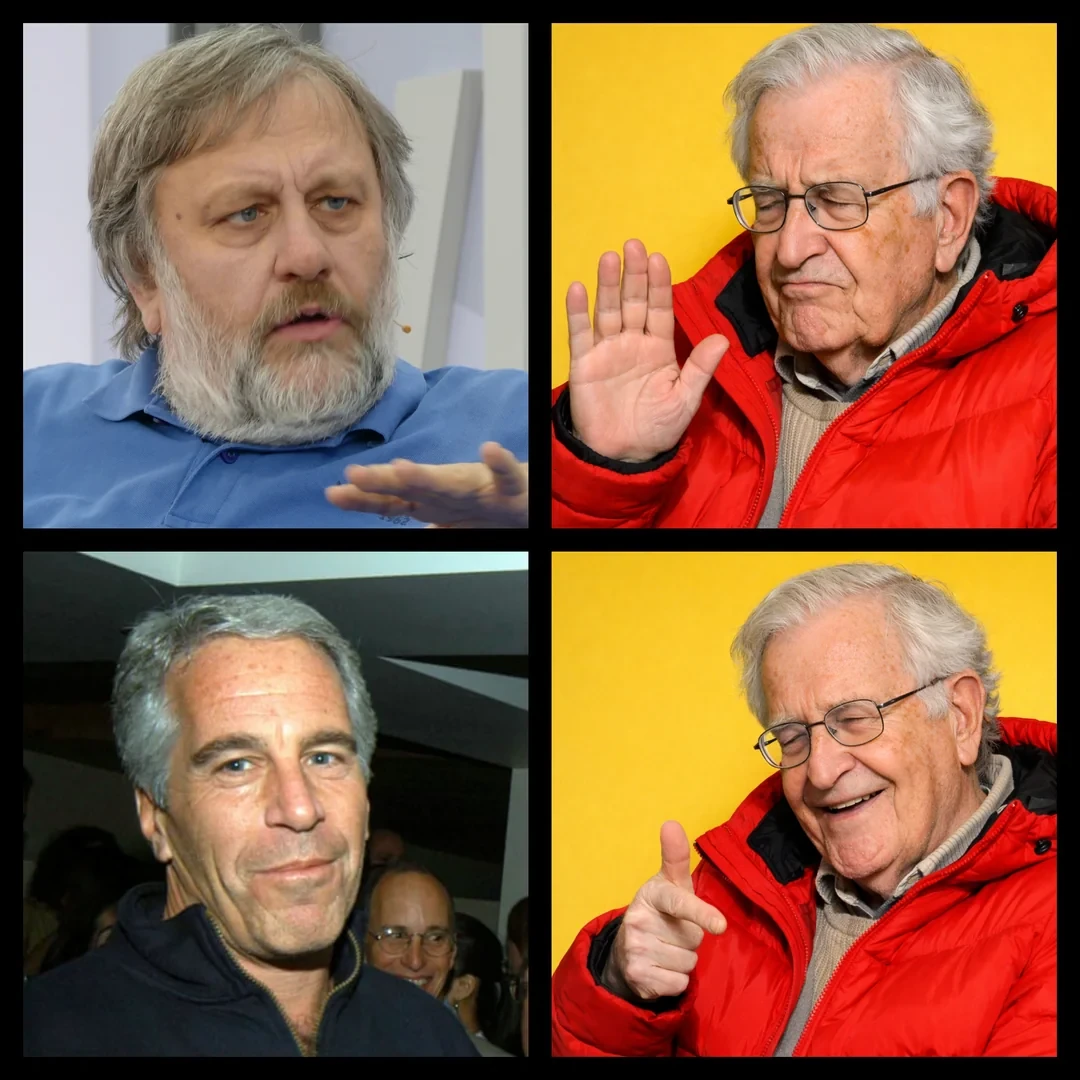
Manufactured Consent - yes, but for whom? To do what?

You have Zizek authentically in top-left, Chomsky in Drake's red attire with a disgusted face in the top-right, Epstein authentically in the bottom-left, and Chomsky in Drake's red attire with a face of approval in the bottom-right.
11


A quote from Chapter 5:

"The same principle of “less is more” holds for reading the body of a book: in his wonderful How to Talk About Books You Haven’t Read, Pierre Bayard demonstrates (taking an ironic line of reasoning which is ultimately meant quite seriously) that, in order to really formulate the fundamental insight or achievement of a book, it is generally better not to read it all—too much data only blurs our clear vision. For example, many essays on Joyce’s Ulysses—and often the best ones—were written by scholars who had not read the whole book; the same goes for books on Kant or Hegel, where a truly detailed knowledge often only gives rise to a boring specialist exegesis, rather than living insights. The best interpretations of Hegel are always partial: they extrapolate the totality from a particular figure of thought or of dialectical movement. As a rule, it is not a reading of a thick book by Hegel himself, but some striking, detailed observation—often wrong or at least one-sided—made by an interpreter that allows us to grasp Hegel’s thought in its living movement."

12


Expected early September of this year(Venice Film Festival). Only other details mentioned are that it will be 'incredibly timely'

Movie Poster with titled Text 'THE PERVERT'S GUIDE TO UTOPIAS' and Žižek in vampiric makeup with a rose-red button-up on a maximally sleek and shiny dark-green satin looking bed-sheets background
13


The talk was given on 22 MAY 2026 at the conference: "Knowledge Without Comprehension? On Spirit after Hegel in the Age of AI. - International Conference in Honor of Slavoj Žižek"

14


Zizek talking at a conference in Croatia's Subversive Film Festival with English subtitles.
The title of the talk is "Why let go of the nostalgia of self-governing Socialism"

15


I know, I know this is not Žižek, but Todd is mentioned in the wiki as a Žižekian author.

If nothing else, skip to 25:27 for a superb joke that I'm shocked I've never heard.

16
submitted 5 months ago by to c/zizek


I may or may not only be submitting due to Aussie locale :D

17


Alex: "Hello, how are you?"
Žižek: 80min monologue

18


Free Bird

19
submitted 5 months ago by to c/zizek


Story for those interested: https://vogueadria.com/slavoj-zizek-intervju/

6VueJ16O5Mrgwfc.webp

7QSTrhlUjW7H86O.webp

KvmkQEhHxRbuavA.webp

20
submitted 7 months ago by to c/zizek
 
 
21


A general question I can't even begin to answer but I wanted to toss it to the community after I came across this interesting interpretation/reply:

"I do think that yes, we can simply just shift our desire to another based on the fact that we feel like it is our duty to society. That does not mean that it is the user's own volition that is changing that desire, but rather it is the user's underlying desire for desire [that] has changed what the user desires, not the user that has changed it. It's important to call back to what Žižek says about how "We don't really want what we think we desire."

Since Žižek uses Lacan's psychoanalytic theory, he believes that our unconscious and desire are both structured by language. It is of Žižek's belief that Ideology, via shaping the Symbolic Order (language, society, culture etc.) is what determines how we observe reality, how we observe and conceptualize objects. It is the dominant Ideology that shapes our understanding and reality of the world in many more ways then we realize unless we question it through Hegelian dialetics (to oversimplify it, it is to think in a way that considers all perspectives. How could you do it? It is to question the fundamentals of it, to view it from a micro perspective and think of the wider implications of what it is that you think, considering the contradictions between opposing views in an attempt to synthesize them to reach an agreement that would be logical ).

There is a first to understand is the user's superego imposes that the user has an imperative to jouissance (Enjoy!). However, this superego is basically your internal moral police, it demands that you must constantly Enjoy! If you are not taking pleasure, you are doing something wrong, but if you are taking pleasure, it is not enough! This imperative to jouissance is from the big Other (a personification of the Symbolic Order), that is society. Late stage capitalism exploits this really well with the use of Ideology. Instead of jouissance, this used to be prohibition (that is the imperative to follow the law), but it shifted due to societal change with the influence of utilitarianism and hedonism. The cause for the user's desire is the unobtainable object that is the 'object petit a' - the object that is the projection of the user's lack of. It is an object that represents the cause of desire.

There is also the option to try to traverse the fantasy, an experience that is painful and traumatic, but necessary to emancipate oneself, that is for the user to dialectically think to themselves and figure out as to the influence that Ideology has in the way that it structures your unconscious and your desires.

I'm not sure if I'm misunderstanding of your examples of what Žižek might think in that scenario of liking philosophy. If I were to go through your example, it should be restructured like this.

I as a subject like philosophy.

Why do I like philosophy possibly? It gives me pleasure

Why does it give me pleasure? It is because I aspire and want to be a great thinker.

Why do I aspire and want to be a great thinker? Because it is my duty!

Why is it my duty? Because I want to do good in society?

Why do I want to do good in society? What is good?

This synthesis where we ask what even is the basic concept of good at first glance seems to be a basic question, but rather it is difficult to answer in that we don't know as to what moral authority that decides what is defined as 'good'. This is when we realize that we do it because Ideology has influenced us that we gain value in society and that we can find our true self from being considered a great thinker, what we actually desire is validation from the big Other and that is what we ultimately gain pleasure from. That is the objet petit a, we chase the obtainment of this object for the belief that it is what will give us validation from the big Order (society/God/whatever the personification of the big Other can be). The cycle of jouissance is sustained by the pleasure you gain from the validation of society (as Ideology tells you that being a great thinker is cool and has great value to society), BUT you feel guilty because you haven't reached being a great thinker which is what you think your goal is.

The user then feels like if Ideology is what has influenced me all this time, how can I be my true self if I am blind to reality because of Ideology? How can I be happy and enjoy life? Maybe I can change Ideology to be able to access my 'true' self.

It can lead you to the following: Does this mean that you should try your best to Ideology tells you to do in defiance of Ideology? No, that is Ideology at work. It wants you to have the illusion of choice, to make it feel like you as, the individual, are in control of your own reality and Ideology, and are able to challenge and change the system simply by defying it; it absolves you of a guilty conscience by feeling like you are doing something by defying it. This is what can pacify a person from making meaningful action. For example, I am using my agency to put this piece of recyclable drink into the bin, I am making the world a better place by doing the right thing. Another example, is that I do not use 'bad' word. This lets me be able to judge and shame other people who use 'bad' word so that I feel morally righteous.

This is exactly what Ideology wants you to do, to give yourself permission to enjoy Ideology. You feel like you are morally superior to other people and that can be enough to placate your anger to not want to destroy the system as a whole. That is for the seeking of validation from the big Other.

What if I just do it anyway, but instead of feeling guilty for it from the superego's imperative to Enjoy! has told me to, but instead take pride in the suffering that ideology has effectively imposed on me and do it anyway? No, "you should not be falling in love with your suffering. The identification with suffering is not proof that you are an authentic person." To do so, would be to see yourself as a powerful martyr and to find meaning in it when there isn't. That again, is Ideology at work.

Are we only left with being a cynic then? No.

Žižek suggests instead thinks we should, once the user recognizes what our fundamental fantasy is, that is to figure out what does the big Other actually want from the user.

Once we figure out what our fundamental fantasy is, it is then realize that we have no true self inside. What we think of as the true self is just the Ideal-Ego, the imaginary perfect self-image that can't ever be achieved (again, following from before, we don't know what we actually desire, the desire of that desire is what sustains our desire. It is not a fixed goalpost as we will always desire more and more). It is the masks (the Ego) that we wear that often reveal more truth than what our inside self is. It is through the masks that we wear that we have our intersubjective experiences.

Once we give this up, we are then okay to be content with the the fact and realization that we as subjects are imperfect, there is no need to chase happiness, and that there is no object petit a that we have to fantasize on reaching, we are freer. It is the constant questioning of our reality can we be our authentic self and free from feeling shit about a random fantasy that needs the validation from another larger Other. That in itself is liberating, it is to not be cynical from this, but instead you are brought closer to your truth of desire (your drive) that yes, can cause us to suffer, but it is what will fulfill you nonetheless. It can still be what you were doing before, it's the freedom in that it doesn't matter whether it's futile or not, you do it anyway."
—NeverDefyADonut

22
Slavoj Žižek (quokk.au)
submitted 11 months ago by to c/zizek
 
 
23
starter park (quokk.au)
submitted 11 months ago by to c/zizek
24
submitted 11 months ago by to c/zizek


I'm only really learning more about Žižek's thoughts since seeing this place, what's something you could suggest for me to read?

25
view more: next ›