
1


reddit-logoReddit has gone head-to-head with a group of filmmakers over the past two years, aiming to protect the privacy of its users.

In three separate cases, the filmmakers subpoenaed Reddit for details of users who commented on various piracy-related topics.

The movie companies said they are not planning to go after these people in court but want to use their comments as evidence in piracy liability lawsuits against ISPs, including Frontier Communications.

Anonymous Reddit Comments as Piracy Evidence

The film companies, including Killing Link Distribution and movant Voltage Holdings, argued that the Redditors’ comments were key evidence to show that ISPs didn’t implement a suitable repeat infringer policy, and that subsequently acted as a draw for pirating subscribers.

Reddit viewed the requests as intrusive. The company repeatedly objected to the subpoena requests with federal courts agreeing on three separate occasions that the Reddit users could remain anonymous.

The film companies disagreed with these decisions and took the matter to the Ninth Circuit Court of Appeals, requesting a reversal. However, after the underlying court case against ISP Frontier was settled a few weeks ago, this appeal was moot, with the plaintiffs requesting a dismissal.

Reddit Seeks $55k in Compensation

This week, Reddit is back in a California Federal Court, requesting compensation for the fees it incurred in successfully defending its users’ right to anonymous speech. Specifically, Reddit seeks $55,204.19 in attorneys’ fees from the film companies.

“In three separate cases now, Reddit has defeated what is essentially the same motion to compel, brought by the same group of movants, by the same counsel, seeking to enforce effectively the same unnecessary and irrelevant subpoena,” Reddit starts its motion.

The fees request only applies to the last subpoena battle. After previous courts struck down similar attempts, Reddit believes that the third subpoena request was not substantially justified. To back this up, it cites the court’s ruling, which concluded that the connection between the subpoena and the underlying lawsuit was “very, very weak” and that it would have “zero impact” on the case.

Under the federal rules, recipients of subpoenas can request to be compensated for their costs if the subpoena request was not “substantially justified”. Reddit argues that applies here.

Anti-Piracy Publicity Campaign

Additionally, Reddit argues that compensation is appropriate in this case because the subpoena request was unduly burdensome and improperly motivated. The filmmakers have already tried to get Reddit to comply with three separate requests, and it fears that these attempts may not be the last..

From Reddit’s motionReddit threaten

Reddit is also concerned that the filmmakers will continue to drag Reddit into similarly ‘improper’ subpoena battles, noting that these actions appear to be an “anti-piracy publicity campaign”.

The filmmakers spent substantial time and money on these subpoenas, which Reddit suggests is an attempt to publicly threaten its users and discourage them from discussing piracy on the site. That would essentially chill free speech, the motion concludes.

“Movants’ dogged pursuit of discovery litigation despite loss after loss, together with the complete irrelevance of the information sought, demonstrates their improper purpose—an attempt to chill lawful speech by Reddit’s users,” Reddit writes.

Pseudonymity is a Reddit Feature

Reddit believes that the $55,204 it spent on costs is reasonable, as the company was trying to protect an important feature of the site: the ability for users to communicate pseudonymously without requiring their legal names or addresses.

In a declaration, attorney Hayden Schottlaender of Perkins Coie LLP, who represented Reddit, notes that the 70+ hours spent on the case, were needed to properly protect Reddit’s interests.

“This level of counsel was necessary in light of the possible significant implications on Reddit’s business and users from an adverse ruling that would permit non-party discovery to unmask pseudonymous Reddit users notwithstanding their First Amendment rights to anonymous online speech,” Schottlaender writes.

From the declarationreddit declaration

With a proposed order for fees now on the table, the filmmakers still have the option to challenge the justification or the specific amount requested. After that, the court will have to decide whether Reddit is entitled to receive compensation.

—

A copy of Reddit’s motion for fees is available here (pdf). The cited declaration of attorney Hayden Schottlaender can be found here (pdf).

From: TF, for the latest news on copyright battles, piracy and more.


From TorrentFreak via this RSS feed

2


iptv-agreementWith almost no exceptions, people criminally prosecuted in the UK for serious pirate IPTV offenses say that it’s an absolutely horrendous experience.

The process drags on forever, often gets worse as it does so, and due to the Proceeds of Crime Act, doesn’t necessarily end when sentences are served. Reports of multi-year sentences are supposed to act as a deterrent, but only tell half the story.

When Liverpool man Mark Brockley fled the UK rather than face trial for reselling IPTV subscriptions in 2023, that wasn’t exactly a big surprise. Nor was it likely to end well.

The Social Media Curse

According to the Police Intellectual Property Crime Unit (PIPCU) at City of London Police, their investigation was triggered by a November 2018 referral by BT Sport (now TNT).

The company had spotted a Twitter account with the username @Infinity_IPTV advertising £15 per month subscriptions, promising an all-you-can-eat bonanza of movies, TV shows and live sports.

Also available via appinfinityapp

Eight months later on July 24, 2019, PIPCU officers raided Brockley’s Liverpool home, seizing devices including a laptop and a mobile phone, £1,200 in cash, and evidence linking the 54-year-old to the Twitter account reported by BT.

To avoid anything self-incriminating being used in evidence at trial, Brockley offered no comment throughout his interview. In June 2021 after two years in limbo, police arrested and then charged the Liverpool man with fraud and copyright offenses.

On the plus side, Brockley was released on bail but still had to wait almost two additional years before heading to trial. Four years from arrest to trial isn’t particularly uncommon in these types of cases; some describe the waiting as a sentence in itself.

You’ll Never Take Me Alive, Coppers

How many times Brockley was absent is unclear, but after being bailed in 2021, PIPCU notes that multiple failures to appear in court led to the biggest of them all; a May 2023 criminal trial by jury conducted in Brockley’s absence.

Police believed Brockley had likely fled to France, but his exact whereabouts were unknown.

£237,000 is a considerable amountpipcu-diff2

By failing to appear at his own trial, Brockley avoided what was always likely to be a stressful experience, one with virtually no chance of success. However, a defendant not having their say in court can be damaging, mitigation may be the only hope left.

Five-Year Sentence

Brockley was accused of being part of a “pyramid selling scheme” which saw him advertise subscriptions and sell them to individuals lower down. Published on the day of his sentencing, PIPCU’s calculations on the scale of the offending reads as follows:

The unit identified that Brockley had made 5,251 sales with a total value of £237,058 from 24 October 2014 to 8 May 2019. Of these, 1,408 sales, worth a total of £50,479, made a clear reference to IPTV services, but officers from PIPCU believe that the remaining payments were also related to the sale of these services.

The court heard that Brockley’s activities caused BT to lose an estimated £3m in revenue. The distinction between revenue on one hand, and profit on the other, can become less clear when presented in the media. Revenue takes no account of costs, so while BT reportedly ‘lost’ £3m, Brockley was said to have ‘made’ or ‘pocketed’ all of his £237K revenue.

In reality he made a non-specific amount of “tens of thousands” but as his solicitor pointed out at sentencing, Brockley’s failure to appear effectively destroyed any chance of a suspended sentence. The court handed down a five-year prison sentence; that raises the prospect of every £10,000 profit earning Brockley another year behind bars.

As an opportunity for deterrent messaging with impact, this may have been overlooked.

Ladies and Gentlemen: We Got Him

In a statement this Wednesday, City of London Police revealed details of an operation to locate Brockley and bring him back to the UK to serve his sentence.

“Financial investigations revealed that Brockley had been using bank accounts based in France. Further digital inquiries eventually traced him to an apartment block in Spain. In August 2024, he was located and arrested in Girona during a coordinated operation involving the PIPCU, National Crime Agency (NCA), Europol, and Interpol,” the statement reads.

Brockley filed an appeal against his extradition back to the UK and was released on bail. Replicating his absences in the UK, he reportedly failed to appear at multiple court hearings in Spain, making him a wanted man there too.

“In a coordinated effort between UK and Spanish authorities, Brockley was eventually arrested at Barcelona Airport while attempting to board a flight to the UK last week (Friday, 20 June),” City of London Police report.

“He was remanded in custody at Heathrow Airport and will now commence his five-year sentence.”

Nature of Offending Becomes More Serious With Time

A comparison of the police statements published on May 5, 2023, (immediately post sentencing) and this week on June 25, 2025, reveal differences that not only alter the nature of Brockley’s offending but also increase the amount of revenue generated.

The screenshots below show the 2025 statement on the left and the 2023 statement on the right, with relevant paragraphs from each placed side by side for clarity (originals here and here for reference).

Immediately after sentencing, it was reported that Brockley “made” £237,000. Yet, two years later, he’s reported as having “pocketed” £300,000.

Aside from the terminology implying significantly larger profits, an additional £63,000 has been added seemingly from nowhere in 2025.

During the past two years, Brockley’s status in the illicit IPTV market also appears to have undergone a promotion.

Immediately after sentencing, Brockley was described as an “IPTV reseller” who “sold subscriptions”. Yet two years later in his absence, it’s now alleged that he “ran a subscription-based IPTV service.” These aren’t just semantics; a person who sells tickets for Disneyland does not “run a Florida-based theme park.”

Strangely, even Brockley’s reseller brand has changed: Infinity Streams versus aFINITY IPTV today. The name change is cosmetic and may have a straightforward explanation; crucially it means very little in the context of the trial.

The previous discrepancies transform Brockley from a lower-tier player to the top man in his network, and then boost revenue by more than a quarter.

_____________________________________________ A Call For Basic Transparency

Details like the above are important but not straightforward to verify independently.

Basic transparency and relevant court documents should be routinely made available to the public in the UK, at minimum when the reported outcome is a matter of public interest.

Piracy cases like these are part of the deterrent strategy in the UK; as a result, original documents should be made available publicly by default.

From: TF, for the latest news on copyright battles, piracy and more.


From TorrentFreak via this RSS feed

3


cautionAfter a decade of focusing efforts overseas, the push for pirate site blocking has landed back on American shores.


There are currently two bills in the making; the Foreign Anti-Digital Piracy Act (FADPA) introduced by Representative Zoe Lofgren in February, and Representative Darrell Issa’s ‘American Copyright Protection Act’ (ACPA), which tackles the same issue from a different angle.

ACPA has yet to be formally introduced, but a draft of the framework was shared with stakeholders late May, with a request for input. While most of the back and forth takes place behind closed doors, the Re:Create Coalition and the Library Copyright Alliance (LCA) shared their critical comments publicly.

Overblocking Fears

The Library Copyright Alliance is pleased that libraries will be exempt from the blocking proposal, as they are not categorized as service providers. However, there are still concerns that the bill, as currently drafted, could lead to overblocking.

“LCA remains concerned that ACPA’s no-fault injunction structure could lead to over-blocking that could restrict access to information and thereby harm library users,” LCA writes.

The LCA notes that most cases will likely result in default judgments, as foreign sites typically unresponsive to actions filed in U.S. courts. In addition, service providers are unlikely to oppose orders on behalf of these unknown third parties.

“A service provider’s objective would be to implement the blocking in the most expedient manner possible, regardless of possible over-blocking,” LCA notes.

This predicted lack of scrutiny means that some sites may be classified as foreign piracy sites, even when they fail to meet the statutory definition.

Re:Create also raises overblocking concerns, focusing on the destabilizing impact the measures could have on the broader internet, suggesting that the potential fallout should be taken seriously.

“Advocates for site-blocking have downplayed the threat of overblocking and pooh-poohed the idea of ‘breaking the internet,’ saying that site-blocking can be achieved without threatening the integrity of the internet or lawful internet use. However, the latest research suggests site-blocking advocates may be trying to rush their idea into law before the facts can catch up to them.”

Re:Create cites an i2Coalition report which found that overblocking is widespread, especially when restrictions are applied to shared infrastructure like cloud platforms and CDNs. This is considered a potential threat to the internet’s architecture, the digital economy, and fundamental rights.

Solution in search of a problem?

Both groups mention overblocking in detail, but they also highlight separate issues. Re:Create, for example, notes that it’s not clear that site blocking is needed, questioning research that estimated a significant negative economic impact of online piracy.

“Site-blocking is a solution in search of a problem,” the group writes, citing a rebuttal from the Computer & Communications Industry Association’s Research Center, which points out several flaws in a key report that estimated $29.2 billion in lost U.S. revenues.

From Re:Create’s submissionsearch problem

This estimate is biased and based on flawed methodology, resulting in a multi-billion dollar figure that is “wildly out of step with previous studies that had concluded impacts from piracy were much smaller, potentially as low as zero,” Re:Create notes.

Move Site Blocking to the ITC

The LCA doesn’t mention the alleged damages, nor is it entirely against a site blocking bill. However, to prevent the risk of overblocking due to default judgments, it would like to shift the proposed forum from specific district judges to the International Trade Commission (ITC).

The library association argues that ITC judges already have expertise in intellectual property, and the ITC staff would represent the public interest, helping to prevent over-blocking.

“The staff’s ongoing involvement would help prevent over-blocking. Significantly, the ITC is equipped to order temporary relief, so it could act quickly to protect the interests of copyright owners,” LCA writes.

The idea of using the ITC as a forum to handle piracy related cases isn’t entirely new. In 2012, Rep. Issa’s proposed the OPEN Act, which would have tasked the Commission with stopping money flows to pirate sites. The bill was an alternative to SOPA and PIPA, but never passed.

A Sunsetting Clause?

The libraries also mention a novelty that, to our knowledge, has never been mentioned in public; a proposed sunsetting clause that is being considered by Rep. Issa.

“During one of the roundtables, Chairman Issa mentioned the possibility of the site-blocking legislation sunsetting after a set number of years. We favor sunsetting the legislation after five years,” LCA writes.

A sunsetting clause means that the law will automatically terminate or expire on a specific date unless Congress takes deliberate action to extend it. It is essentially a built-in expiration date for the bill, which ensures a thorough reevaluation of its impact and effectiveness in the future.

The ACPA framework is still in the discussion phase and the initial feedback shows that there may be room for improvement. This is especially true considering that these two responses are just the tip of the iceberg; there are likely others calling for more drastic enforcement too.

—

A copy of the comments shared by Re:Create can be found here (pdf) and the Library Copyright Alliance’s submission can be found here (pdf).

From: TF, for the latest news on copyright battles, piracy and more.


From TorrentFreak via this RSS feed

4


pugLast year, Italy officially implemented the ‘Piracy Shield‘, a system that aims to deter and decrease live sports streaming piracy.

Since then, Piracy Shield has blocked access to thousands of IP-addresses and domain names associated with unauthorized broadcasts.

Despite overblocking concerns, the massive blocking operation is seen as a key success by the authorities and many participating rightsholders. The same is true for the updated copyright law in general, which introduced fines of up to €5,000 for pirate consumers.

Study Reveals Piracy-Shield Impact

While there is no shortage of opinions on these measures, hard data on the impact of the increased anti-piracy efforts is less common. Initial data indicated that the Piracy Shield had little impact on legal subscriptions, but thorough research is lacking.

This week, new data from IPSOS adds more context. The IPSOS survey and report have been published annually for several years in collaboration with local anti-piracy outfit FAPAV. The most recent version covers 2024, which is the first year Piracy Shield was active.

A quick glance at the headline numbers suggests a trend going in the right direction. In the span of a year, overall piracy rates decreased, especially among teens. The same is true for piracy volume, which dropped significantly.

Piracy Trends in Italy: 2023 vs 2024

Metric2023 Survey Data2024 Survey Data**Overall Piracy Rate (adults)**39%38%**Teen Piracy Rate (10-14 years)**45%40%Pirates Converting After Block45%47%**Piracy Volume (Total Acts)**319 Million295 Million

Data sourced from the FAPAV/Ipsos surveys.

As shown above, pirates are increasingly converting to legal services after encountering a block. Nearly half of all pirates who ran into a blocked site or service reportedly sought legal options, which is a notable success. However, since the piracy rate only dropped a single percentage point in a year, piracy remained prevalent.

This brings us to some of the seemingly disappointing outcomes of the survey, including the prevalence of live sports streaming piracy, which is the main target of the Piracy Shield program.

The report finds that in 2024, 15% of the population had used pirate live sports streaming services at some point, which is the same figure as a year before. In other words, sports piracy did not decrease after the Piracy Shield launched.

When compared to 2023, prevalence of most types of piracy remained relatively stable, with a few single percentage point drops here and there. Of the researched content categories, film piracy was the most common with 29% of the population admitting to have pirated something in 2024.

Comparison of Piracy rate by Type

Type of Piracy2023 Rate2024 Rate**Overall Piracy (any type)**39%38%Film Piracy30%29%Series Piracy22%23%Software Piracy21%22%Live Sports Piracy15%15%Illegal IPTV Use23%22%

Percentage of the adult population in Italy that engaged in each type of piracy at least once during the year.

These percentages mostly apply to online piracy, but also include physical piracy and indirect piracy. The latter refers to receiving pirated content from another person, such as via a USB drive or by watching someone else’s copy.

Volume Down, Damages Up

While there was no drastic decrease in the piracy rates, the positive note is that the overall piracy volume dropped more significantly. The reported 295 million piracy ‘acts’ in 2024 represent an 8% drop compared to the year before.

On the flip side, however, the reported financial damages increased. Across all sectors, the study estimates the loss in turnover at €2.2 billion, a substantial 10% increase year over year.

The most dramatic increase is reported in the live sports streaming category. These losses were estimated at €285 million in 2023 and €350 million last year, a 23% increase. That’s despite the Piracy Shield measures, which are aimed at sports piracy.

Awareness

Piracy Shield definitely didn’t go unnoticed by the public at large, as the survey reveals that 70% are aware of the new anti-piracy law, which also introduced financial penalties for individual pirates.

For now, the law’s looming punishments lack deterrence, as 42% of the population doubts its effectiveness. At the same time, only 56% of the self-proclaimed pirates believe they risk being punished.

The Piracy Shield fares much better on this metric as an impressive 79% (of those who are aware of it?) believe that the anti-piracy blocking system is effective.

All in all, the IPSOS study indicates that there is still plenty of work to be done before online piracy is seriously tackled. With extensive piracy blockades and serious fines already in place, it will be interesting to see what comes next.

—

More details and information on the 2024 FAPAV/Ipsos study, released in Rome on Tuesday, is available here.

From: TF, for the latest news on copyright battles, piracy and more.


From TorrentFreak via this RSS feed

5


x twitterIn a complaint filed at a Nashville federal court two years ago, Universal Music, Sony Music, EMI and others, accused X Corp of ‘breeding’ mass copyright infringement.

The social media company allegedly failed to respond adequately to takedown notices and lacked a proper termination policy.

The National Music Publishers Association (NMPA) claimed it had sent over 300,000 formal infringement notices, many of which didn’t lead to immediate removals.

“Twitter routinely ignores known repeat infringers and known infringements, refusing to take simple steps that are available to Twitter to stop these specific instances of infringement of which it is aware,” the music companies alleged.

Twitter/X Wins First Battle, Case Continues

Last year, X scored a partial win when the court dismissed the music publishers’ direct and vicarious copyright infringement claims, and partially dismissed claims of contributory infringement.

Judge Trauger concluded that X can’t be held liable for making it ‘very easy’ to upload infringing material or for monetizing pirated content. These characteristics are not exclusive to infringing material and apply to legitimate content too, she argued.

With elements of the contributory infringement claim still intact, the lawsuit was allowed to move forward on those grounds. They include claims that X’s repeat infringer policy was inadequate and that it willingly turned a blind eye to pirating users, especially those who have a blue checkmark.

“Particularly striking is the allegation that X Corp. enforces its copyright policies less stringently against individuals willing to pay for its ‘verified’ service,” Judge Trauger wrote in her order.

X Seeks Documents from NMPA CEO

Over the past several months, both parties have conducted discovery to gather further evidence. As part of this process, X sought information from the NMPA, including its President and CEO David Israelite.

The NMPA is not directly involved as a plaintiff in the case, but since its infringement notices are at the basis of this lawsuit, X believes that its information is relevant.

The NMPA was willing to share information but refused to hand over other relevant information, according to X. This includes documents from its President and CEO, with the NMPA describing Israelite as an “apex” figure who did not “operate” the notice program.

X was unhappy with the refusal and earlier this month filed a heavily redacted motion to compel the NMPA to hand over the requested documents, including those related to its top executive.

According to X, Mr. Israelite oversees all aspects of NMPA’s operations, including legal strategy and advocacy. He has also made extensive public statements about the lawsuit and the alleged copyright infringement by X, even calling Twitter his “top legal focus” shortly before the lawsuit was filed.

Mr. Israelite’s involvement?israel

X also noted that on several occasions, Mr. Israelite had commented on X’s actions in the media. In 2023, after the lawsuit was filed, he informed the Hollywood Reporter that X can’t “hide behind the DMCA.”

“Maximum Pain”

The motion to compel is heavily redacted, but it appears that X believes that the NMPA played a key role in the lawsuit, and that it wasn’t merely concerned about the removal of infringing content.

“It is not disputed that NMPA conceived of and controlled the process that led to this litigation,” X writes, adding that Mr. Israelite has been very vocal in the press, condemning its actions, and hinting at a lawsuit before it started.

According to X, the requested discovery is important to show that NMPA used its takedown notice campaign as a tool to inflict “maximum pain” on X, to motivate Elon Musk’s platform to sign music licensing agreements.

“NMPA’s motive for initiating its notice program against X was not to obtain the removal of allegedly infringing videos posted to the X platform, but to inflict maximum pain on X’s business so that X would be more inclined to enter into music licenses with NMPA’s member,” X writes.

“Maximum Pain”max pain

These are explosive allegations that have yet to be proven; if indeed the case even makes it that far.

Suddenly… a Settlement is Looming

After a few days, X dismissed its motion to compel and around the same time, both parties informed the court that they were trying to “amicably resolve” the entire lawsuit, requesting a stay of 90 days.

There’s no evidence that there’s a causal link between X’s explosive allegations and the sudden agreement between the two parties. However, with less than a week between the two filings after nearly two years of battling it out in court, the timing is noteworthy.

Commenting on the change of course in the lawsuit, an NMPA spokesperson informed the Hollywood Reporter that the group hopes that the case will result in a licensing deal.

“The intent of the stay is to discuss with X the resolution of the suit and proper compensation to songwriters and publishers for past unlicensed uses, while providing an opportunity for go forward licensing.”

For now, Judge Trauger has granted the 90 days stay. If X and the music publishers can reach a settlement, with or without a licensing deal, the lawsuit will be over. That also means the finer details of the alleged ‘maximum pain’ strategy are unlikely to see the light of day.

—

A copy of X Corp’s motion to compel is available here (pdf). The order to stay the related case can be found here (pdf)

From: TF, for the latest news on copyright battles, piracy and more.


From TorrentFreak via this RSS feed

6


pirate-flagAfter a Virginia jury ordered internet provider Cox to pay $1 billion in damages for failing to take appropriate actions against pirating subscribers, shockwaves rippled through the ISP industry.
The verdict, in favor of major record labels including Sony and Universal, was a catalyst for many other ‘repeat infringer’ lawsuits. This resulted in yet more multi-million dollar claims and awards, with more still in the pipeline today.

Meanwhile, Cox did all it could to fight the verdict. This resulted in some small wins, including a recent ruling that the billion-dollar damages calculation needs a re-evaluation. However, the liability ruling stands.

In a final attempt to find the law on its side, Cox petitioned the U.S. Supreme Court last year. In essence, it argued that an ISP shouldn’t be held liable simply because it knew that subscribers were pirating, while challenging the assertion that merely knowing about subscriber piracy constitutes ‘willful’ copyright infringement.

U.S. Government Backs Cox

The Supreme Court signaled interest but before a decision to take the case on, the Court asked for the Government’s position on the matter. The request was honored two weeks ago.

The Solicitor General’s amicus curiae brief sides with Cox and urges the Supreme Court to grant the ISP’s position. This isn’t just in the interest of Cox, but also other ISPs and the public at large.

According to the U.S. Government’s view, an ISP is not automatically liable for copyright infringement if it fails to terminate subscribers after receiving copyright infringement notices. The brief states that the verdict of the Court of Appeals could have broad negative implications for ISPs and their subscribers.

The U.S. further argues that Cox’s actions were not willful, as “willfulness” generally requires knowledge or reckless disregard that the defendant’s own conduct was unlawful. Simply knowing about third-party infringements should not be sufficient.

Aside from fully backing Cox, the Solicitor General also urged the Supreme court to deny the record labels’ petition. The labels argued that Cox should be held liable for vicarious copyright infringement because it profited from piracy that it could have prevented.

Record Labels are “Bewildered”, Fire Back at U.S.

The U.S. position gave Cox and other ISPs reason to feel more positive about an eventual turnaround. Grande Communications, for example, wasted no time citing the Government’s position in its final remarks for its own, separate, Supreme Court petition.

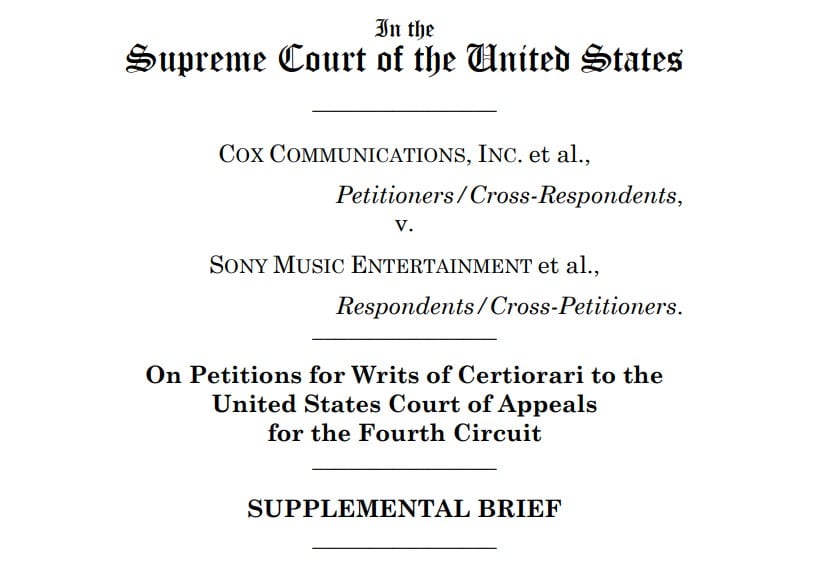
In a supplemental filing at the Supreme Court, the record labels characterize the Solicitor General’s recommendation as ‘bewildering’, given the evidence on record. In a direct, point-by-point rebuttal to the U.S. brief, the labels attempt to set the record straight.

Rebuttal

The brief argues that Cox’s contributory liability for copyright infringement is ‘straightforward’ and does not warrant Supreme Court review because Cox would face liability ‘In Any Jurisdiction’.

“Cox was held liable not because it failed to do enough to police infringement, but because it took no meaningful steps to stop infringement and continued serving specific, identifiable subscribers even after receiving explicit notice of their repeat (and often rampant) infringement,” they write.

The record labels focus more on the broader context that, in their view, shows that Cox ‘willfully’ decided to let repeat infringements slide because subscribers earn them revenue.

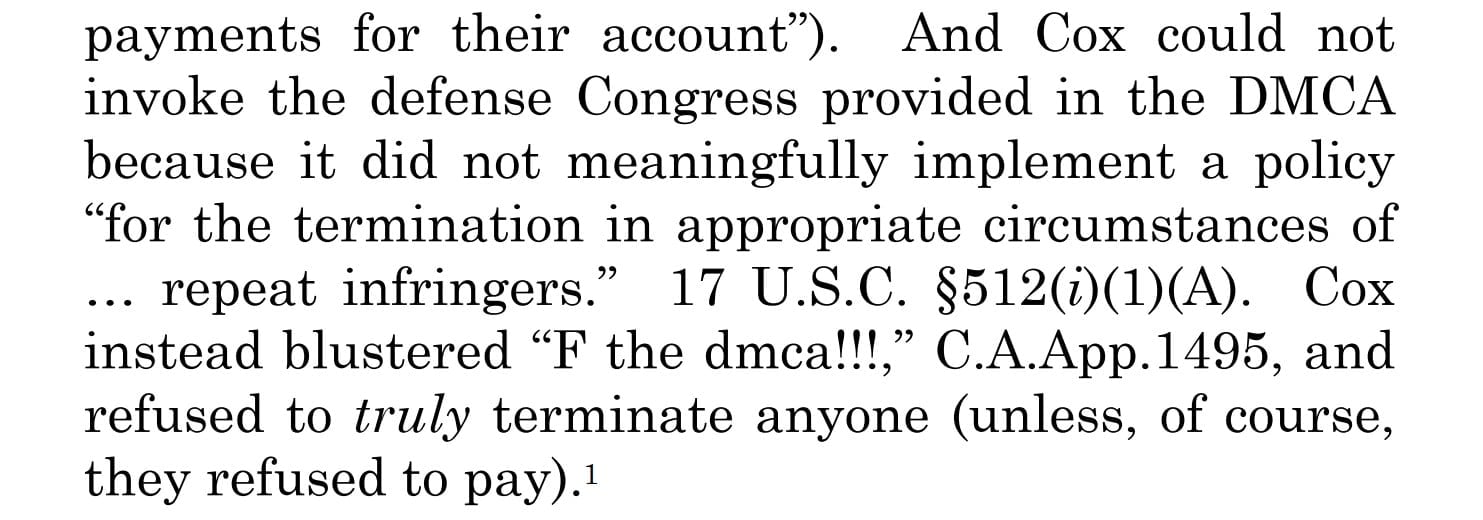
The ISP did not meaningfully implement a policy ‘for the termination in appropriate circumstances of repeat infringers’ and lost its safe harbor as a result.

“F the dmca!!!”

“This rebuttal is amplified by evidence of Cox’s alleged culpability and disdain for the law, including an expletive quote from an internal communication,” the rebuttal reads.

“Cox kept supplying the means of infringement because it said ‘F the dmca!!!’ and adopted an express policy of prioritizing profits from subscription fees over compliance with the Copyright Act or the DMCA.”

“F the dmca!!!”f the dmca

The labels note that lower courts have been clear on liability cases like this, and argue that the recent Supreme Court Twitter v. Taamneh ruling , which the U.S. cited, is not relevant in this context.

There is overwhelming evidence for Cox’s willfulness, they say, adding that Cox didn’t contest this finding during its appeal. Therefore, the petition should be denied, contrary to the U.S. Solicitor General’s recommendation.

Grant Our Petition (or both…)

The record labels also disagree with the U.S. when it comes to their own Supreme Court petition, which argues that Cox should also be held liable for vicarious copyright infringement. The brief reiterates that there is a real split in the lower courts on this matter.

Cox can be held vicariously liable if it has the right and ability to control the infringing activities and a direct financial interest in those activities. According to the Solicitor General, the lower court correctly concluded that this is not the case here.

The labels, however, argue that Cox did profit directly from pirating subscribers, by declining to terminate repeat infringers, which kept the subscription fees coming in.

The labels’ brief ends by asking the Court to deny Cox’s petition while granting theirs, the direct opposite of the U.S. recommendation. However, the labels offer a fallback. If the Court is inclined to accept the Cox case, it should also accept theirs.

“The Court should grant Sony’s petition and deny Cox’s. If the Court disagrees, it should grant both,” the record labels conclude.

—

A copy of the supplemental brief, submitted to the Supreme Court this week by Sony et al. is available here (pdf)

From: TF, for the latest news on copyright battles, piracy and more.


From TorrentFreak via this RSS feed

7


franceTraditional site-blocking measures that require local ISPs to block subscriber access to popular pirate sites, have been utilized by rightsholders in France for years. The aim is to deter piracy by making sites more difficult to find, but these measures are only partially effective.

More recently, site blocking requests have targeted other intermediaries. DNS providers including Google and Cloudflare, plus several of the largest VPN providers, were all ordered to make pirate websites unavailable through their services.

While several of these orders are still under appeal, rightsholders and lawmakers are pressing ahead. They believe that more can and should be done to tackle online piracy; sports streaming piracy in particular.

New Bill Enables Automated Real-Time Blocking

A new bill amending Article L. 333-10 of the French Sports Code passed the Senate this week. The ‘Lafon’ bill allows rightsholders to use a fully automated system to block piracy targets, without having to go through the French telecoms regulator Arcom for updates to the blacklisted sites.

Targeted intermediaries are required to implement these blockades ‘without delay’. That speeds up the blocking process, which is particularly important when dealing with constantly updating livestreams of pirated sports. Similar blocking regimes are already active in Italy, Spain, and the UK.

The proposed bill doesn’t specify any concrete blocking methods, but by allowing judges to target server IP addresses it logically paves the way for IP-address blocking.

Blocking IP-addresses

Speaking with the French news publication L’Informé, Xavier Spender of the Association for the Protection of Sports Programs (APPS), which represents beIN Sports, Canal+, Eurosport and others, says the aim is to reinforce existing blocking measures.

“We want to bring ourselves up to the level of the English, Spanish, and Italians, by implementing IP blocking adapted to the French context. Our goal is to block servers at the head of the network, that is, at the highest possible level of the pirate architecture.”

Other stakeholders also view automated and real-time IP address blocking as a must to tackle the country’s pirate streaming epidemic. An estimated 37% of Ligue 1 viewers currently watch football matches illegally.

“The adoption of this new system is vital to effectively protect our competitions and our economic model, especially as the LFP is about to launch its own channel,” the Professional Football League (LFP) commented.

Brice Daumin, general manager of Ligue 1 broadcaster DAZN notes that “Arcom doesn’t work weekends,” so something had to be done to more effectively tackle the problem. “In England, we can block 10,000 links in two days; in Italy, it’s 18,000. And with Arcom, it’s 5,000 per year.”

A ‘Secret’ Blocking Agreement

While the bill has yet to pass into law, stakeholders are already preparing a complementary agreement. According to a report from L’Informé’s Marc Rees, sports rightsholder group APPS has reached a private agreement in principle with Internet providers Orange, SFR, Bouygues Télécom, and Free.

Reportedly in the works since 2023, the agreement covers the finer details of a new blocking system, including the technical implementation and who will pay for the costs.

Thus far, specific details of the blocking system, including any plans for independent oversight, remain unclear. However, a source said that overblocking risks are being taken into account, adding that rightsholders remain responsible for their mistakes.

Overblocking and the Mafia

Calls for extended blocking powers arrive at a sensitive time, as recent expansions in Spain and Italy have resulted in several overblocking incidents.

However, according to APPS general delegate Xavier Spender, there is little to worry about as “everything will be put in place to ensure that there is no risk of over-blocking.”

Time will tell whether France will be able to prevent collateral damage, but it’s clear that APPS and its rightsholders are eager to implement broader blocking powers to deal with the piracy ‘mafia’.

“Today, we are facing mafia groups at the head of a piracy economy, with a model that resembles drug trafficking. To deal in particular with illicit IPTV offers, sold on every street corner, we need to adapt to enable real-time blocking,” Spender says.

From: TF, for the latest news on copyright battles, piracy and more.


From TorrentFreak via this RSS feed