1


Banner image: A pair of nudibranchs on coral in Manta Ray Bay, Yap in Micronesia. Image by Betty Wills via Wikimedia (CC BY-SA 4.0).

New conservation effort launched to protect coral reefs in Yap

Conservation groups have launched a new initiative to safeguard coral reefs in Yap, a state in the Federated States of Micronesia, through both scientific innovation and traditional stewardship.

The Yap Resilience Hub, a partnership between The Nature Conservancy (TNC) and the Great Barrier Reef Foundation (GBRF), is a three-year project that seeks to support local conservation efforts through 2028.

“Coral reefs are central to life in Yap and across island communities because they provide food, support livelihoods, and sustain cultural practices,” Berna Gorong, capacity building manager at TNC Micronesia & Polynesia, told Mongabay by email.

The reefs are traditional fishing grounds managed under community and clan tenure and “closely tied to identity, stewardship, and daily life,” Gorong said.

The Yap Resilience Hub plans to rely on a steering committee of government, traditional leaders and community representatives to help identify candidate reef areas for protection. The reefs will be selected based on five criteria, Gorong said, including their ecological condition and potential for recovery, connectivity to other reef systems, and community and governance readiness.

Once priority reefs are identified, she said the project will support local action plans, ensuring that community priorities and local leadership remain at the forefront of the conservation strategy. “Capacity building and capacity-needs assessments will be central so local partners can sustain the work beyond the project period,” Gorong said.

“By pairing community priorities with science, planning, and capacity building, [the project] aims to strengthen reef resilience and support the long-term well-being of Yap’s people and coastal communities,” she added.

While many Micronesian reefs remain relatively healthy compared to other global regions, they face increasing pressure from rising seas and climate change.

Dawnette Olsudong, a researcher at the Palau International Coral Reef Center who has conducted assessments on coral restoration in Yap and isn’t involved in the project, said proactive measures are important.

“I am hopeful that the launch of this project will strengthen our understanding of reef conditions and improve our ability to make informed conservation and restoration decisions,” Olsudong told Mongabay. She noted her research has helped identify sites that communities perceived as degraded and in need of restoration.

The Yap Resilience Hub project is part of the Resilient Reefs Pasifika initiative, funded by the GBRF.

2


Climate refuges may be key to restoring imperiled amphibians

Climate refuges may be key to restoring imperiled amphibians

Panamanian golden frogs (Atelopus zeteki) suffered significant declines due to chytrid. The species has not been seen in the wild since 2009. Credit: Roshan Patel, Smithsonian's National Zoo and Conservation Biology Institute.

As a deadly fungal disease ravages wild frog populations around the globe, scientists have identified potential locations in Panama where amphibians might persist despite the disease, according to new research from the Smithsonian's National Zoo and Conservation Biology Institute (NZCBI) and Smithsonian Tropical Research Institute (STRI) published in the Journal for Nature Conservation.

The amphibian chytrid disease, also known as chytridiomycosis or simply chytrid, is caused by the fungus Batrachochytrium dendrobatidis. It has spread like wildfire through Central and South America since the 1970s and is now ubiquitous. It is believed to have driven numerous species of neotropical frogs to the brink of extinction, including many in the genus Atelopus, commonly known as harlequin toads.

Now, as conservationists attempt to reintroduce captive-bred species to the wild, they hope to give the animals a leg up by identifying climatic refugia—places that are environmentally unsuitable for chytrid but well-suited to frogs.

Mapping seasonal disease risk

The chytrid fungus is present across almost all of the historic range of Atelopus species, but just as human influenza cases change with the seasons, the severity of chytrid disease fluctuates with temperature and humidity.

Using previously developed models that identified where the disease was present and when it was most severe, the authors built new chytrid suitability maps to identify places where reintroduced frogs might thrive without the threat of chytrid.

"We have tried releasing captive-bred harlequin toads back into the wild and experienced high losses due to the amphibian chytrid fungus that persists in the environment," said Brian Gratwicke, conservation biologist at NZCBI and senior author of the article.

"By mapping climatic refuges, we finally have a tool to rank potential release sites, allowing us to select places where the released animals have the best chance of survival."

Climate refuges may be key to restoring imperiled amphibians

Variable harlequin frogs (Atelopus varius) were the only species found surviving in chytrid-suitable sites, which scientists say is consistent with evidence that the species may have evolved resistance to the disease. Credit: Brian Gratwicke, Smithsonian's National Zoo and Conservation Biology Institute

Surviving toads reveal potential refuges

Researchers found that most harlequin toad species in Panama persist only at sites where more than 80% of the seasons were unsuitable for medium- and high-intensity infections. Only one species, the variable harlequin toad (A. varius), was found at sites suitable for the disease, which scientists say is consistent with evidence that the species may have evolved resistance to chytrid.

The models not only identify potential reintroduction sites but also point to places where wild Atelopus populations might remain.

"Our ability to identify climate refugia is critical if we hope to locate populations that might have disappeared from most places in their former range," said Carrie Lewis, a doctoral candidate at George Mason University and lead author of the publication. "These persisting populations could provide a source of genes to bolster populations under human care and provide opportunities to augment wild populations."

Climate refuges may be key to restoring imperiled amphibians

Like other Atelopus species, the critically endangered Pirri harlequin frog (A. glyphus) has experienced significant declines due to the amphibian chytrid disease. Credit: Brian Gratwicke, Smithsonian's National Zoo and Conservation Biology Institute.

Climate refuges may be key to restoring imperiled amphibians

A prior reintroduction trial conducted with Limosa harlequin frogs (Atelopus limosus) resulted in the deaths of numerous frogs due to chytrid. By choosing reintroduction sites considered unsuitable for chytrid, researchers hope to reduce losses in future reintroduction trials. Credit: Roshan Patel, Smithsonian's National Zoo and Conservation Biology Institute.

Climate refuges may be key to restoring imperiled amphibians

Researchers established captive assurance colonies for numerous species, including the critically endangered Toad Mountain harlequin frog (Atelopus certus), at the Panama Amphibian Rescue and Conservation Project in Gamboa, Panama. Credit: Roshan Patel, Smithsonian's National Zoo and Conservation Biology Institute.

Although there are currently a limited number of potential refuges, additional opportunities have been identified. The models also forecast areas that, while currently suitable for the disease, might become unsuitable in the coming years because of climate change. Researchers note that the shifting climate could also have negative effects on frogs adapted to cooler mountainous habitats.

"Guided by these climate refugia and Atelopus habitat-suitability maps, we have already begun surveying potential sites for habitat suitability and potential release trials," said Roberto Ibáñez, a STRI staff scientist and co-author of the study. "These tools will allow us to experimentally test the climate refugia hypothesis through future release trials."

3
4


cross-posted from: https://hexbear.net/post/9838153

The winning images of the 2026 British Wildlife Photography Awards - Geographical

Glowing Bright — a fluorescing spiny squat lobster photographed by James Lynott during a night dive in Loch Fyne, Scotland

A fluorescing spiny squat lobster. Image: James Lynott

From a fluorescing squat lobster to a sleeping swan cygnet — the winning images of the 2026 British Wildlife Photography Awards


More than 12,000 images were entered in the 2026 British Wildlife Photography Awards, which celebrate the variety, beauty and resilience of nature across the UK. The winning images range from familiar to overlooked forms of life, revealing behaviour, colour and texture in gardens, forests, rivers and coastal waters. Ben Lucas was named Young British Wildlife Photographer of the Year for his tender portrait of a mute swan cygnet asleep on its sibling. Together, the images offer a joyful record of Britain’s wildlife and a reminder of fragile habitats on which it depends.


Feathery Pillow

A mute swan cygnet asleep on its sibling

Ben Lucas’s portrait of a mute swan cygnet asleep on its sibling in Hornchurch, Essex


Glowing Bright

A fluorescing spiny squat lobster

A fluorescing spiny squat lobster photographed by James Lynott during a night dive in Loch Fyne, Scotland


Slime Moulds and a Water Droplet

One-millimetre-tall slime moulds and a water droplet

One-millimetre-tall slime moulds found by Barry Webb on a fragment of wood in South Buckinghamshire


Cutting Edge

A leaf-cutter bee peering from a clay bee hotel

Jamie Smart’s portrait of a leaf-cutter bee peering from a clay bee hotel in Powys, Wales


New Life

A developing common frog embryo

A developing common frog embryo photographed by Julian Terreros-Martin in Messingham, Lincolnshire


Beams of Brightness

Dawn light through frosty woodland in Bushy Park

Dawn sunlight breaks through frosty woodland in Bushy Park, West London, photographed by Mark Richardson


The 2027 competition is now open for entries at bwpawards.org. Photographers of all experience levels are invited to submit their photographs of Britain’s nature at its best.

5
6
7


Banner image: Endemic to Colombia, Lehmann’s poison frog (Oophaga lehmanni) is a critically endangered species threatened by the pet trade. Image by © Jonathan Vanegas/WCS.

Legal gaps allow rampant pet trade, poaching reptiles and amphibians towards extinction

  • Recent seizures of trafficked reptiles and amphibians provide insight into a booming trade in these animals, which are now coveted as pets worldwide.
  • Patchy legislation and loopholes in wildlife trade enable traffickers to pull reptiles and amphibians from their natural habitats and sell them abroad with impunity, conservationists warn.
  • They call for stronger national laws, making it illegal to sell wildlife protected in their native habitats, as well as creating a ‘positive list’ that identifies species that may be sold and kept as pets.
  • Conservationists also note the need for international measures to stop exploitation of reptiles and amphibians that are already harmed by habitat loss, invasive species, diseases and changing climate.

Spain’s law enforcement agency, the Civil Guard, announced on Sept. 25, 2026, that it seized 209 reptiles from breeding facilities in Jérica and Sot de Ferrer (Castellón), including critically endangered iguanas endemic to Fiji. Nearly half of the reptiles were protected under CITES, the global wildlife trade treaty. They also seized unlicensed handguns and nearly 200 rounds of ammunition.

Authorities arrested three individuals — two men aged 48 and 51 and a 37-year-old woman — on a litany of charges: Belonging to a criminal organization, wildlife-related offenses, smuggling, money laundering and illegal weapons possession.

The alleged traffickers reportedly smuggled reptiles from the wild in the Americas, Africa and Asia, and then bred them without permits, the authorities said. They added that these reptiles were then sold at European reptile and trade fairs, mixing smuggled animals with legally acquired animals — a practice called laundering that’s prevalent in wildlife trade. In this way, traffickers exploit the “legal gray area surrounding documentation that certifies the animals’ origins,” the authorities said in a press release.

The Spanish case is just one recent example among a slew of seizures and arrests involving rare tortoises, endangered turtles, poisonous frogs, endemic iguanas and many other protected reptiles and amphibians worldwide. The trade is lucrative — estimated to be worth some $2.5 billion — and comes with little risk. It’s often unregulated. Smugglers are rarely caught, and if they are, they get off by paying a small fine, which is absorbed as the cost of doing business.

Tortoises seized by the Civil Guard in Spain in a recent raid. Image courtesy of the Civil Guard.

Tortoises seized by the Civil Guard in Spain in a recent raid. Image courtesy of the Civil Guard.

As demand for these animals continues to grow, conservationists are calling on countries to close legal loopholes that allow traffickers to smuggle them across the world, sometimes by breaking local laws. Many reptiles and amphibians are sold as “low maintenance” first-time pets in stores or online, and some collectors pay thousands of dollars for rare species.

In a recent commentary published in Nature, the authors say countries must scrutinize their exports and imports, strengthen global frameworks to punish traffickers, and introduce regulations that permit only a limited list of vetted wildlife species to be kept as pets — also called a ‘positive list’ — to rein in the trade.

One in five of all reptile species and two in five amphibians are threatened with extinction, according to IUCN, the global conservation authority. With the planet heating up, habitats destroyed, fatal diseases decimating entire populations and invasive species replacing them, reptiles and amphibians are already under pressure. A skyrocketing trade in them could be devastating, the authors warn.

“This isn’t a new trade, but it’s becoming more of a problem,” said one of the commentary authors Susan Lieberman, vice president of international policy at the U.S.-based NGO Wildlife Conservation Society. “We’re seeing increasing pressure on more and more species in the wild across the globe.”

Case in point: The poisonous black-and-orange harlequin mantella frog (Mantella cowanii), which has almost disappeared from its native habitat in Madagascar, in part because of its popularity among collectors.

Galapagos marine iguanas are the only iguanas that live in the sea and eat algae. Despite the highest protections under CITES, and Ecuador never having legally exported any, these lizards are still widely traded internationally. Image by ©️Simon Pierce via iNaturalist (CC BY-NC 4.0).

Galapagos marine iguanas are the only iguanas that live in the sea and eat algae. Despite the highest trade protections under CITES, and Ecuador never having legally exported any, these lizards are still traded legally internationally. Image by © Simon Pierce via iNaturalist (CC BY-NC 4.0).

“This is certainly an urgent and frequently overlooked issue,” said Alice Hughes, who studies the reptile and amphibian trade at the University of Melbourne and was not an author on the commentary. “Unfortunately, repeated calls to notice and act on this gap have not yet gained the traction needed to bridge them.”

This commentary, she said, “does a good job of contextualizing many of the issues” and “highlighting opportunities to improve our ability to understand and regulate trade, and raise awareness of these issues.”

Lack of data makes it hard to monitor trade

More than half of reptiles and 40% of amphibians currently in trade are pulled from the wild, Hughes’ research shows. But only a handful — 9.5% of reptiles and 4.2% of amphibians — are regulated under CITES. The rest can be traded without oversight or monitoring — and most countries have little information on what is in commerce because no one’s looking.

The U.S. records all its wildlife imports, including traded species not regulated under CITES, in the Law Enforcement Management Information System (LEMIS) database. But there’s no such data in other countries — so many reptile and amphibian species fall through the cracks.

“Without … data on what is on trade, where it is coming from, the source, and the quantity, there is simply no means to assess the sustainability, or to tease apart legal and illegal trade more clearly,” Hughes said. In some cases, a species can be traded illegally from its native country to a third country, then re-exported to the intended destination with fraudulent permits and paperwork, she said.

The problem is particularly stark in the European Union, which is a hub of the reptile and amphibian trade, according to commentary co-author Sandra Altherr, a biologist and co-founder of the German-based NGO Pro Wildlife. “The EU wildlife imports are still largely a black box. We have no idea of the origin or the history of many animals, or even how many animals are actually entering the EU. And that, for me, is unbelievable.”

Endemic to Puerto Rico, a brown morph of the Cuvier's Anole (Anolis cuvieri), like the one pictured, was recently on sale for 4,000 euros ($4,460) at a reptile fair in Germany. Image by Geoff Gallice via Wikimedia Commons (CC BY 2.0).

Endemic to Puerto Rico, a brown morph of the Cuvier’s Anole (Anolis cuvieri), like the one pictured, was recently on sale for 4,000 euros ($4,460) reportedly at a reptile fair in Germany. Image by Geoff Gallice via Wikimedia Commons (CC BY 2.0).

The EU logs its wildlife imports in Trade Control and Expert Systems (TRACES), but experts say it mostly focuses on food control and biosecurity rather than wildlife trade and conservation.

It’s also accessible only to authorities with an EU account in countries that use the system, and not to most others. “This data is neither open — nor reportedly at a sufficient taxonomic resolution — for most taxa, meaning that as long as TRACES remains inaccessible to researchers, it will fail to provide the information that could be used to monitor and manage trade and its impacts on wild species,” Hughes said.

CITES records all legal transactions in listed species, but adding new species to that list is challenging without data, Lieberman said. “You need to prove not only that it’s in trade, but that trade is a threat … It’s a heavy lift to get anything listed, particularly for reptiles and amphibians where there might not be enough data.”

Adding a species to CITES needs a proposal submitted at a once-every-three-years gathering of all treaty signatories, and it must be accepted by more than a two-thirds majority. For newly described ones hammered by trade, which typically enter commerce within a year, waiting for three years could be too long, Lieberman said.

The commentary’s authors call for better data collection to address this. Lieberman said every country needs to create a LEMIS-like system to monitor all wildlife trade. “It’s not that hard with AI,” she said, since the bill of lading, needed for every shipment of animals, already has the details of the species being transported.

Measuring only 10 centimeters (4 inches) in length, the Vallarta mud turtle is the smallest turtle in the world. It’s a critically endangered species with fewer than 300 remaining in the wild, but are already on the pet market. Image by Sandra Weiss for Mongabay.

Hughes said trade data could be complemented with genetic barcoding, which uses DNA to identify a species, to verify what is being sold, and by digitizing invoices so authorities can “obtain exact lists of what is being traded.” Authorities can then flag irregularities, such as spotting species that are endemic to Australia, New Zealand, Fiji or Ecuador where it’s illegal to remove any wildlife from the wild. “With better data on trade, all other processes become easier,” she said.

Legal loopholes fuel trade in amphibians and reptiles

In the U.S., the Lacey Act makes it illegal “to take, possess, transport, or sell wildlife that has been taken in violation of any law.” But in most countries and the EU, a species protected by law in its country of origin can be sold legally once it’s outside the region.

Traffickers exploit this loophole in EU regulations by smuggling protected species to Europe, breeding them, and selling the offspring legally — even selling to the U.S. market, mislabeling them as captive-bred, thereby circumventing the Lacey Act.

“The E.U. represents a major gap for global trade at present, often stated to be more lax than the United States and providing a route for animals to be taken from the wild and end up in the global pet trade,” Hughes said.

A variable harlequin frog (Atelopus varius), a critically endangered species coveted for its colors and patterns, is sought after by collectors in the exotic pet trade. Image by ©️Randall Jiménez via iNaturalist (CC BY-NC 4.0).

A variable harlequin frog (Atelopus varius), a critically endangered species coveted for its colors and patterns, is sought after by collectors in the exotic pet trade. Image © Randall Jiménez via iNaturalist (CC BY-NC 4.0).

The international trade in Galapagos land (Conolophus spp.) and marine iguanas (Amblyrhynchus cristatus) is a stark example. Ecuador never legally exported any of these endemic reptiles, but there’s a thriving legal commerce in ‘captive-bred’ marine and land iguanas from the archipelago, mostly from Europe and Africa. All Galapagos iguanas are now protected under CITES, but they continue to be smuggled.

Altherr from Pro Wildlife said it’s “quite easy” for traffickers to launder wildlife into the EU. “When you pass the customs, then it’s fully legal to sell these animals here … anyone selling or owning [such wildlife] is not required to prove that it was obtained legally.”

Other challenges include poor enforcement and lack of political will. Many countries lack the resources and funding needed to detect and stop wildlife trafficking. Some nations are plagued by corruption, with poaching and transport aided by police, environmental officials or customs agents that turn a blind eye or validate fraudulent paperwork. Fewer than half of the countries in the world impose maximum penalties of at least four years in prison for wildlife-related crimes.

Opportunities for reform

The authors point to opportunities to rein in the global pet trade. The EU, for example, has commissioned three feasibility studies. One of them, published in 2025, looks at formulating a regulation like the U.S. Lacey Act, called Criminalisation of Illegally Sourced Wildlife Trade.

“Legislation that respects the laws of range countries should be a minimum,” Lieberman said, adding that she hopes other countries pass similar laws.

The second study looks at creating an EU-wide ‘positive list’ of species that can be kept as pets without harming their wild populations; that don’t become invasive; and that can be kept without concerns for their welfare. The third study looks at ways to reduce demand for wildlife as pets. These two are expected to be published later this year, Altherr said.

At the upcoming gathering of the U.N. Convention against Transnational Organized Crime (UNTOC) to be held Oct. 19-23, 2026, delegates will purportedly submit a resolution that would expand the charter’s purview. If passed, it would launch negotiations on a new protocol on crimes affecting the environment, including wildlife trafficking.

The Lau banded iguana, endemic to Fiji, is an endangered species that is sought after by reptile collectors.

The Lau banded iguana, endemic to Fiji, is an endangered species that is sought after by reptile collectors. Image by Leszek Leszczynski via Wikimedia Commons (CC BY 2.0).

“It’s high time that wildlife crime, fisheries crime, illegal mining — all of those things — are treated as serious crime. These are transnational crimes,” Lieberman said. “They are often connected with drug and weapons smuggling, and we want the criminal justice community to take it seriously.” Similar protocols exist for human trafficking and arms trafficking.

Such a protocol helps countries work together on enforcement, extradition, training and technical assistance on environmental crimes.

“It will define a level playing field of what are crimes that affect the environment,” Lieberman said. “CITES is a great treaty, but it doesn’t really deal with criminality … So if a [UNTOC] protocol is adopted, then governments that ratify the protocol would be bound by it.”

Other international organizations are taking note. In 2025, the IUCN World Congress agreed to create a task force to develop guidelines on regulating the pet trade. Because bribery, fraud and money laundering enable wildlife trafficking, an industry often run by crime syndicates, the authors say the U.N. Convention against Corruption should also be strengthened to fight it.

The short-term solution to rein in the pet trade is to get a grip on it and improve enforcement; in the medium term, to change legislation and regulations; and in the long term, to both establish a new protocol and change consumer behaviors, Lieberman said.

8


Endangered Lantau toads show genetic and call differences that could signal an emerging species

Lingnan University finds endangered Lantau Short-legged Horned Toad

The short-legged horned toad, an endangered species in Hong Kong, is a small frog measuring around 40 mm in length. It is characterised by short hind limbs, small horn-like projections above the eyes, and skin coloration and patterns that closely resemble dead leaves. (The photo shows the Short-legged Horned Toad population on Lantau Island.) Credit: Lingnan University

The short-legged horned toad (Boulenophrys brachykolos), listed as endangered on the International Union for Conservation of Nature (IUCN) Red List of Threatened Species, is the only known small frog species in Hong Kong belonging to the genus Boulenophrys of the family Megophryidae.

A study led by the Division of Science at Lingnan University has found that the Lantau Island population of the short-legged horned toad shows clear genetic divergence from other local populations, along with several notable differences in the mating calls of males.

The research team suggests that the Lantau population represents an early stage of speciation. Geographic isolation of Lantau Island from other landmasses likely contributed to these unique evolutionary traits. The team recommends treating the Lantau population as a separate conservation unit in the future.

These findings have been published in the journal Current Herpetology.

Distinct genes and faster mating calls

The short-legged horned toad is found in mountain streams on Lantau Island, Hong Kong Island, Kowloon, the New Territories and adjacent Shenzhen. The research team, led by Lingnan University, collected 19 samples of the short-legged horned toad (nine from Lantau Island, six from Hong Kong Island and four from Kowloon) to examine their genetic and morphological characteristics.

Lingnan University finds endangered Lantau Short-legged Horned Toad

The study shows that Short-legged Horned Toads are visually almost identical, making evolutionary differences difficult to detect through traditional field surveys alone. (The photo shows the Short-legged Horned Toad population on Hong Kong Island.). Credit: Lingnan University

The results show that the short-legged horned toads on Lantau form a distinct genetic group separate from those on Hong Kong Island, Kowloon and Shenzhen. This suggests that the Lantau population has been separated from other populations for a considerable period.

In addition, the team recorded and analyzed the mating calls of male short-legged horned toads from Lantau Island, Hong Kong Island and Kowloon. They found significant differences between the calls of the Lantau Island population and those of other local populations. The Lantau population produces calls with a faster rhythm and shorter individual notes.

Similar appearance masks evolutionary differences

In terms of physical appearance, the team found no marked differences between frogs from Lantau Island and other regions, indicating that physical characteristics alone may be insufficient to distinguish the Lantau population from other populations.

Jonathan Fong, the corresponding author of the study, associate dean (administration and education) of the Wu Jieh Yee School of Interdisciplinary Studies and associate professor of the Division of Science at Lingnan University, said the study provides a more comprehensive approach to evaluating evolutionary divergence among populations of the same species.

He said, "Many amphibians look very similar, making evolutionary differences difficult to detect through traditional methods that examine morphology alone. By integrating genetic and acoustic data, we found that frogs on Lantau Island have a distinct genetic makeup and male toads have different mating calls. This suggests that the Lantau population is following a distinct evolutionary trajectory."

Isolation strengthens the case for separate conservation

Sung Yik-hei, the first author of the study and adjunct assistant professor of the Division of Science at Lingnan University, explained that Lantau Island became geographically isolated from the mainland approximately 10,000 years ago. The geographic isolation likely reduced gene flow between populations, allowing the Lantau short-legged horned toad population to develop unique genetic traits over time. The study also highlights that Hong Kong may harbor undiscovered biodiversity.

Sung said, "The results suggest that the short-legged horned toad population on Lantau Island may represent an early stage of speciation, although current evidence is insufficient to determine whether the Lantau population constitutes a distinct species. The short-legged horned toad is an endangered species, and if the Lantau population declines or becomes extinct, its unique genetic traits could be lost and could not be replaced by populations from other areas.

"We therefore propose that conservation management recognize the Lantau population as an independent conservation unit, giving due consideration to its specific conservation needs to ensure the survival of this unique native population."

9
10


Banner image: The short-eared dog inhabits the Amazon and prefers untouched forests. Image courtesy of Guido Ayala & María Viscarra/WCS Bolivia.

Study gathers over 4,000 photos to find Bolivia’s rarest Amazonian dog

  • A study conducted for more than 20 years with camera-trap surveys in different parts of the Bolivian Amazon has recorded 594 independent events for the short-eared dog in more than 4,600 images.
  • This species, popularly known in Bolivia as the ghost dog, is one of the least-known canids in the world. Its survival depends highly on the quality of its natural habitat, according to experts.
  • In the Bolivian forests, it can generally be found in protected areas or Indigenous territories, which scientists say underscores the importance of these kinds of areas for biodiversity conservation.

It has a fox-like snout, webbed toes and a thick tail. It’s called the short-eared dog (Atelocynus microtis), but also the ghost dog (perro fantasma in Spanish) in Bolivia, and the Amazonian dog. It’s one of the world’s least-known canids and one of the least frequently sighted carnivores in Latin America.

Now, though, a study conducted over the course of more than two decades — from 2001 to 2024 — in Bolivia has revealed more than 4,600 camera-trap images that show how it lives, the places it inhabits, and why this species is so dependent on South America’s forests remaining intact to survive.

The research underscores that the ghost dog is very much an Amazonian species, and in particular a forest one. In Bolivia, it can be spotted in the country’s continuous Amazonian forests, in the northern portion of the department of La Paz, but also in the department of Pando, in northern and northeastern Beni, and in the far north and northeast of Santa Cruz.

It’s also found in the pre-Amazonian forests of the Andes mountain range, also called piedmont forests, at elevations up to 750 meters (2,460 feet).

Robert Wallace, a British biologist from the Wildlife Conservation Society (WCS) in Bolivia and a co-author of the new study, said the team conducted a systematic review of published and unpublished distribution records of the species in Bolivia. Throughout the 23 years, they also carried out 34 intensive camera-trap surveys in the lowland areas of the Greater Madidi-Tambopata Landscape (in northwest Bolivia) and the Llanos de Moxos Biocultural Landscape (northern Bolivia).

Popularly called the “ghost dog” (perro fantasma) in Bolivia, Atelocynus microtis is one of the world’s least-known canid species. Image courtesy of Guido Ayala & María Viscarra/WCS Bolivia.

Popularly called the “ghost dog” (perro fantasma) in Bolivia, Atelocynus microtis is one of the world’s least-known canid species. Image courtesy of Guido Ayala & María Viscarra/WCS Bolivia.

Wallace said the short-eared dog is native to the Amazonian forests, not the Amazonian grasslands. “Our [collected] data shows that what it seeks the most is the forest itself, as it avoids transitional habitats leading to more open areas. It is a forest species,” he said.

He added that the use of hidden technology, such as camera traps, makes the mysterious dog not as hard to find as people think. Even so, Wallace said, it’s still challenging to witness the species directly: this canid is quite skittish and has a highly developed sense of smell, which allows it to avoid encounters with humans and natural predators.

video from a camera trap

“The short-eared dog is primarily diurnal, but also crepuscular, meaning it’s quite active around dawn and dusk. It can be active at night, but the vast majority of camera-trap sightings occurred during the day,” Wallace said.

He added the species’ preferred biome type is the lowland forest, “not right next to the river, but in the mature forest, further inland.”

A two-decade-long initiative

The study was backed by WCS Bolivia and included a lot of camera trapping, done every year during the dry season.

This method revealed an animal with a relatively low-slung body, short legs, small and rounded ears, a large head, and dense, dark fur ranging from blackish-gray to reddish-brown, with a dark dorsal stripe and a long bushy tail that usually drags on the ground. Its feet are partially webbed, meaning the toes are connected by a membrane — a unique trait among Amazonian canids.

The camera-trap surveys yielded a combined 4,635 photos covering 594 separate events featuring the short-eared dog.

“Camera-trap surveys provided significant information on the behavior and relative abundance of the short-eared dog, suggesting that it is more abundant than previously believed, although it remains a relatively rare medium-sized carnivore,” Wallace said.

He said it’s encouraging that the short-eared dog’s relative abundance was higher in protected areas and Indigenous territories that overlap with protected areas, emphasizing that this reinforces the importance of these kinds of areas for biodiversity conservation.

A short-eared dog approaches a veterinarian in the Bolivian Amazon. Image courtesy of Renata Leite Pitman.

A short-eared dog approaches a veterinarian in the Bolivian Amazon. Image courtesy of Renata Leite Pitman.

“These results have important implications for conservation, as they suggest that large tracts of continuous forest, comparable in size to larger protected areas, will be necessary to uphold viable long-term populations of short-eared dogs,” Wallace said.

According to the Bolivian environmental NGO ORÉ, six species of canids are known in Bolivia, including the short-eared dog, also known in the Amazon lowlands as the bush dog (perro de monte in Spanish). ORÉ noted that the species shouldn’t be confused with the more common bush dog ( Speothos venaticus ) or the black-footed fox (Cerdocyon thous).

ORÉ collaborated on a 2024 related study with the Noel Kempff Mercado Natural History Museum, located in Santa Cruz de la Sierra, the largest city in Bolivia. The organization told Mongabay that the short-eared dog is the only species in its genus and is a solitary carnivore. It measures 70-100 centimeters (28-39 inches) in length, stands 35 cm (14 in) tall, and has a bushy black tail — except at the base — that’s long enough to touch the ground.

The short-eared dog’s survival depends on forest quality. Image courtesy of Renata Leite Pitman.

The short-eared dog’s survival depends on forest quality. Image courtesy of Renata Leite Pitman.

The short-eared dog’s characteristics

The dog’s head is large and more brownish than its grayish back. Its snout has a distinct black line running from the nose to the area below the eyes. The ears are small, hence the name, but emerge above the crown of the head. They’re rounded and light brown, contrasting with the head’s tone. The dog can weigh between 9 and 10 kilograms (20-22 pounds), with the females up to 30% larger than the males. The species’ diet is believed to consist of amphibians, fish and reptiles, although it also eats fruit.

Marco Greminger, a veterinary zootechnician and professor at the Autonomous University of Beni in Bolivia, told Mongabay that a ghost dog was once captured alive near the university. He said the animal was found hidden in a disused ground-level air duct.

“It was incredible how we managed to capture that ghost dog alive. They called me to help, and I did it. The [short-eared] dog came into the kennel; it was really weak. I remember giving him 350 grams [12 ounces] of chicken liver — which is rich in folic acid — chicken feet, and an oral rehydration solution. He ate all 10 pieces I gave him,” Greminger said.

He added the animal has a strong odor. “It’s stronger than that of a porcupine or a fox; it’s more sour,” he said.

The short-eared dog prefers upland forests, living far from the riverside. Image courtesy of Renata Leite Pitman.

The short-eared dog prefers upland forests, living far from the riverside. Image courtesy of Renata Leite Pitman.

Veterinarian and ecologist Renata Leite Pitman, a researcher at Duke University in the U.S., has studied short-eared dogs for 14 years, calling them “very elusive and hard to spot.” In that time, she’s located just five of them in the wild, in the Amazon Basin, her place of fieldwork, and fitted them with tracking collars to study their habits. “They are very shy, totally different from pets,” she said.

In 2023, Pitman was contacted by Greminger, who was seeking advice after finding the dog in the air duct. “I shared what I had been feeding it. We agreed and coordinated a few steps. She recommended papaya; I had been giving guava,” Greminger said.

This story was first published here in Spanish on May 6, 2026.

11


Banner image: An Australian flatback sea turtle (Natator depressus). Image by © Dylan Goldspink via iNaturalist (CC BY-NC 4.0).

Karajarri celebrate Australia’s first ‘Sea Country’ Indigenous Protected Area

  • The Kimberley region of northwestern Australia is a biodiversity hotspot and ancestral home of the Karajarri people, who recently dedicated Karajarri Jurarr Ngurra, Australia’s first “Sea Country” Indigenous Protected Area (IPA), covering around 237,000 hectares (587,000 acres) of marine and coastal ecosystems.
  • Proponents of IPAs say they can empower Indigenous Australians as decision-makers in land management, combining traditional ecological knowledge with conservation goals.
  • IPAs now account for 54% of Australia’s progress toward protecting 30% of its territory by 2030.
  • While research shows every $1 invested in IPAs yields up to $3.40 in social, economic and environmental returns, advocates stress that Indigenous communities still need meaningful, sustained support.

In northwestern Australia lies a remote and wildly diverse region called the Kimberley. There, the iron-red soils of the Pindan Country connect forests and the Great Sandy Desert, all bracketed by a vast stretch of Indian Ocean coastline. Its springs and wetlands host migratory birds. Offshore, sawfish, as visually striking as they are rare, ply the waters just beyond the unbroken Eighty Mile Beach, itself a nesting site for the little-known flatback turtle (Natator depressus).

The Kimberley has also long been a home to humans, as rock art more than 17,000 years old attests, and among the heirs of that legacy are the Karajarri people. Over the past 30 years, the Karajarri secured legal recognition of their claims to the land, later establishing an Indigenous Protected Area (IPA), Karajarri Pirra Ngurra, that now covers an area of land nearly the size of Rwanda in the state of Western Australia. They also developed a ranger program that draws on long-held cultural knowledge of the landscape.

In March 2026, the Karajarri people dedicated Karajarri Jurarr Ngurra, Australia’s first “Sea Country” IPA, comprising 237,489 hectares (nearly 587,000 acres) of marine and coastal ecosystems. It includes part of Malumpurr, the Karajarri word for Eighty Mile Beach. The IPA “strengthens long‑standing efforts by Karajarri Traditional Owners and Karajarri Rangers to protect the region’s biodiversity and keep Country healthy,” Malarndirri McCarthy, Australia’s minister for Indigenous Australians, said in a March 20 government statement about the Karajarri Sea Country IPA dedication.

The aim of the Karajarri IPAs is to support a mutually beneficial relationship between the land and its longtime stewards, says Jesse Ala’i, former Land and Sea Country manager for the Karajarri Traditional Lands Association.

“In order to have healthy Country, you need healthy people,” Ala’i says. Likewise, he adds, “Healthy people need healthy Country.”

Gwion Gwion rock paintings in the Kimberley region of Western Australia

Gwion Gwion rock paintings in the Kimberley region of Western Australia. Image by TimJN1/Bradshaw Art via Wikimedia Commons (CC BY-SA 2.0).

Across Australia, more than 90 IPAs dot the land. And the government recently allocated A$13 million ($9.4 million) in initial funding to add new ones. The IPAs are a critical piece of Australia’s strategy to protect 30% of the country’s territory by 2030, part of the global 30×30 goal aimed at halting biodiversity loss.

“We’re well underway to reaching that target and IPAs are providing more than half of that contribution,” Murray Watt, Australia’s environment minister, said in the government’s statement.

To date, Australia has protected nearly a quarter of its land and oceans, a spokesperson for the environment ministry told Mongabay. According to the Indigenous-governed nonprofit Country Needs People, IPAs account for 54% of that goal. But the organization’s CEO, Paddy O’Leary, says the role of Australia’s extensive IPA network goes beyond meeting those goals.

“The magic sauce in an IPA comes from creating a model that, done well, will put Traditional Owners in a much more proactive position in terms of managing their Country,” O’Leary says.

The relationship between Indigenous Australians and the land they live on is well known, he adds. “It’s historical fact and a truth.

“There’s so many advantages to making that connection more recognized, more seen and more respected,” O’Leary says.

The Eighty Mile Beach is a nesting site for the flatback turtle.

Flatback turtles nest on, and live off, the coast of Malumpurr, also known as Eighty Mile Beach. Image by © glyall via iNaturalist (CC BY-NC 4.0).

Self-determination and conservation

From the government’s perspective, IPAs are part of the conservation puzzle for protecting the continent’s ecosystems, including those underrepresented in the country’s National Reserve System, O’Leary says. But the designation of an IPA is more than that for Australia’s Indigenous peoples, including Aboriginal groups like the Karajarri as well as distinct peoples from the Torres Strait off the country’s northern coast, he adds.

“It’s a stamp that puts a distinctive Indigenous view on how a given area should be managed,” O’Leary says. “It centers Aboriginal and Torres Strait Islander people as not just participants or people to be consulted, but decision-makers and key drivers of the management.”

The IPA tag also provides a pathway for these groups to collaborate with outsiders, he adds. “It makes visible to other stakeholders who might want to collaborate the set of priorities that local Traditional Owners want, and it combines both biodiversity and cultural values in management as well as a governance framework that is built — in a good IPA, should be built — from the ground up by the Indigenous community.”

But building that foundation takes significant time and resources, O’Leary says. This year’s federal funding is intended to be a “catalyst,” to be augmented by grants from supportive NGOs or state governments.

“[It’s] not a huge amount of money, but for small groups, it’s often a very useful amount,” he says.

Map of Australia's Indigenous protected areas.

A map shows the locations of Australia’s Indigenous Protected Areas and Key Biodiversity Areas. Image by Mongabay.

Role of the rangers

For the Karajarri people, the journey to their own IPA started in the mid-1990s, when a group of elders applied for “Native Title” rights. About a decade later, after government recognition, the Karajarri started their ranger program and began the consultation process for an official IPA. In 2014, the Karajarri people declared their IPA, covering almost 2.5 million hectares (6.1 million acres) of land in the Kimberley. Sustainable resource use is allowed over the vast majority of the land, while part is managed with the same protections as a national park.

The state of Western Australia supports the Karajarri Ranger program, which serves as a fundamental cog in the functioning of an IPA and a source of employment for communities, Ala’i says.

“It’s impossible to separate Indigenous ranger programs from IPAs,” he adds. Ala’i is not Karajarri; instead, he came to his work on the IPA from a background in conservation biology.

“When I heard about ranger programs, I was like, ‘Oh, that’s the thing,’” he tells Mongabay. “It’s that intersection for me of the environment and social community development, capacity building [and] mentoring.”

Matilda Murley, a marine invertebrate ecologist and research associate at the University of Western Australia, has spent nearly a decade collaborating with the Karajarri people, working with the rangers on a Karajarri-led project to monitor their shoreline ecosystem in ways that make sense for both their culture and biodiversity.

“They are the cultural custodians being paid to look after Country,” says Murley, who is not Karajarri. “They’re looking out for the community priorities.”

For Western science, the Kimberley coast has largely been a blank spot on the map, with few details about what exists there. But as Murley’s project developed through systematic data collection, as well as workshops and interviews in the Karajarri community, it became clear how much knowledge had been passed down over generations.

“They are the main scientists,” she said of the Karajarri people. “They have this amazing historical knowledge of how things have changed.”

That knowledge and working with these types of projects can be springboards for both the community and individuals, Murley says. “We’re upskilling the rangers.”

Ala’i notes that scientists have learned that a collaborative approach leads to far more successful projects, and it’s benefiting Indigenous communities in Australia, who struggle with much higher rates of poor health and poverty than the broader population. The Karajarri Rangers have co-authored scientific publications with Murley and were also part of a team to report the first adult female dwarf sawfish (Pristis clavata) ever recorded by Western science.

“We’ve got rangers that have gone off to university now,” Ala’i says.

Government agencies, too, are beginning to catch on to the power of thousands of years of experience in the landscape, particularly when it comes to fire, he adds. “You need to turn to Indigenous fire regimes if you want to deal with fire in a changing climate.”

The springs and wetlands of Pindan Country host migratory birds.

The springs and wetlands of Pindan Country host migratory birds. Image by Robert Clemens via Unsplash (Public domain).

Malumpurr, or Eighty Mile Beach, in the Kimberley region.

Malumpurr, or Eighty Mile Beach, in the Kimberley region. Image by Wendy Tempels via Unsplash (Public domain).

A dwarf sawfish (Pristis clavata)

The Karajarri Rangers have co-authored scientific publications with ecologist Matilda Murley and were also part of a team to report the first adult female dwarf sawfish ever recorded by Western science. Image by David Morgan via IUCN Shark Specialist Group.

Rock art more than 17,000 years old in Kimberley.

Rock art more than 17,000 years old in the Kimberley region. Image courtesy of Caroline Jones via Flickr (Public domain).

Costs of conservation

Globally, embracing Indigenous-led conservation is increasingly seen as an efficient path for confronting biodiversity loss, climate change and other environmental woes. Research published in 2016 tracked the impact of government and “third-party” funding on five IPAs across Australia. The authors found that every $1 invested in the IPAs and their ranger programs netted between $1.50 and $3.40 in “social, economic, cultural and environmental outcomes.”

At the same time, the Australian government provides billions of dollars to the fossil fuel industry, as well as biodiversity-damaging practices in agriculture, fisheries and forestry, according to a recent study. Around the world, governments spend some $500 billion annually on “harmful subsidies,” which the Kunming-Montreal Global Biodiversity Framework calls for reforming by 2030.

Ala’i notes that, however cost-effective IPAs might be, the communities still need meaningful support and shouldn’t be seen simply as a less expensive solution. Still, he says, “I still think it’s fundamentally the best system the government’s ever created” to address conservation and socioeconomic problems.

“It’s very self-determined, if allowed to be, which is what all the research shows is the best way to allow Indigenous people to close those inequalities,” Ala’i adds. “It just hits all the boxes.”

O’Leary of Country Needs People acknowledges the system isn’t perfect, and says successful IPAs rely on careful planning, support and engagement. But, he says, they represent a critical tool that’s being used right now.

“Yes, there are a lot of things to be improved,” he adds. “But this is happening on the ground now in real time. It’s not being theorized in academic papers or in international forums alone. It’s actually happening on the ground for people, and that is where the rubber hits the road.”

John Cannon is a staff features writer with Mongabay. Find him on Bluesky and LinkedIn.

12


Why are there so many lizards in Australia? The ancient climate holds a clue

If you travel around Australia, you will find an incredible diversity of lizards.

The three-toed snake-tooth skink (Saiphos reticulatus), for example, is a peculiarly long and stumpy legged reptile that burrows in rainforest and is covered in a brilliant orange and black-banded pattern. Alpine water skinks (Eulamprus kosciuskoi) are incredibly cold-tolerant and mottled with black and greenish yellow, like mossy rocks in mountain streams. Prickly forest skinks (Concinnia queenslandiae) are delightfully chunky-headed, spiky, armoured rainforest gems.

These lizards are all members of Australia’s largest evolutionarily related group of vertebrate animals, known as the Sphenomorphini. Their ancestors arrived in Australia some 28 million years ago, likely crossing land bridges and rafting across islands from Southeast Asia during glacial periods when sea levels were lower.

In a new paper, colleagues and I describe the most complete and detailed evolutionary tree of this group to date. This helps us to understand why there is such a mountain of species diversity within this group. A crucial clue is in the climate.

An orange lizard slithering on a rock.

Three-toed snake-skink (Coeranoscincus reticulatus). nicgambold/iNaturalist, CC BY-NC

Building the evolutionary tree

Previous estimates in Sphenomorphini lizards concluded there were about 270 species in the group.

For our new study, we gathered more than 5,000 genetic identifiers to build a “species tree” of the entire group that reveals a total of at least 314 member species.

Our evolutionary tree shows most modern Sphenomorphini genera in Australia seem to appear in a six-million-year burst.

The timing of this burst is telling. It coincides with the Early Miocene – a climatically tumultuous period roughly 23 million to 16 million years ago, marked by the expansion of Antarctica’s ice sheets.

Australia, which by then had broken off from the southern supercontinent of Gondwana, saw a significant reduction in rainfall. As rainforest declined, the continent became more arid.

This suggests climatic changes may have driven the diversification of Sphenomorphini, with new species forming in response to the changing conditions.

This raises the question: how exactly did the new species form?

While several processes are known to drive the evolution of new species (such as sexual selection and competition), two major forces appear to be crucial to the story of the Sphenomorphini.

One is known as “allopatric speciation”. This is when a new species forms by the simple physical splitting of a population. Over millions of years, each population accumulates enough mutations via simple chance that if they were ever to meet again they would be too different to interbreed.

The second major force is known as “ecological divergence”. This is when populations of a single species develop niche traits in response to different environmental conditions. The populations now have differing selective pressures. Eventually, they stop mating with each other and enough different mutations accumulate to create an entirely new species.

The exact role of each of these forces is still unclear and will be the focus of our future research.

A black and yellow lizard on a rock.

Alpine water skink (Eulamprus kosciuskoi). calamanthus/iNaturalist, CC BY-NC

Heeding the warnings

Lizards are a massive component of the storied history of life on this planet. Now that we are slowly unravelling the mysteries of their evolution, we should perhaps heed the warnings.

In the Sphenomorphini, the details seem to paint a picture of arrival, climatic change likely accompanied by extinction and diversification, and for some, persistence in the face of a changing environment.

But bear in mind, the climate shifts that upended the Australian rainforest domination and led the Sphenomorphini to generate such diversity were incredibly slow.

Much changed in the 12 million years between the so-called early Miocene and middle Miocene climatic events. Yet global temperatures only declined around 2°C–3°C.

An equivalent degree of warming in only a mere few centuries would likely be catastrophic for these remarkable creatures – along with so much other life on Earth.

13


Banner image: A black crowned crane (Balearica pavonina), which is found within the African-Eurasian flyway. Image by H. Zell via Wikimedia Commons (CC BY-SA 3.0).

Up to half the bird species using the African-Eurasian flyway are declining

  • Every year, billions of birds migrate long distances with the changing of seasons — according to BirdLife Africa, 40 to 50 percent of avian species migrating to and from Africa are in decline.
  • BirdLife Africa’s Kariuki Ndang’ang’a says climate change and infrastructure collision stand as three of the main reasons for the decline in migratory bird species.
  • Because many birds rely on the same sites each year to make their transit, loss or degradation of even small areas can push an entire population towards collapse.

Each year in May, World Migratory Bird Day draws attention to the billions of birds that migrate long distances with the changing of the seasons, a living braid of ecosystems separated by thousands — even tens of thousands — of kilometers. According to Kariuki Ndang’ang’a, BirdLife International Africa’s regional director, about 2 billion birds fly along the African-Eurasian flyway every year: the populations of between 40 and 50 percent of these migratory bird species are in decline.

Ndang’ang’a told Mongabay added that the birds that travel furthest are at greatest risk. Some species, like Abdim’s stork (Ciconia abdimii), migrate relatively short distances within the continent, but palearctic migrants — those coming from distant landscapes in Europe or Asia — are particularly vulnerable, experiencing over a 30% decline in the past 30 years.

“Because these birds depend on specific stopover sites (like Lake Chad or the Nile Delta), the loss of even one small wetland can cause an entire population to collapse,” Ndang’ang’a wrote in an email.

(Ciconia abdimii) Abdim's storks at Masai Mara NP, Kenya. Image by tsowerby via iNaturalist (CC BY-NC 4.0)

Abdim’s stork at Masai Mara NP, Kenya. Image by tsowerby via iNaturalist (CC BY-NC 4.0)

According to Ndang’ang’a, habitat loss, climate change and infrastructure collision stand as three of the main reasons for the decline in migratory bird species.

“For instance, the drainage of wetlands for agriculture or urban expansion has greatly affected migratory birds as they search for resting and feeding ground,” he said. Lake Chad, on the southern edge of the Sahara Desert, has lost 90% of its surface area since the 1960s, depriving millions of birds such as the European roller (Coracias garrulus) a refuge.

Climate change presents another challenge for migrating birds, he said.

“Rising temperatures cause ecological mismatches where birds arrive at breeding grounds after their primary food sources (like caterpillars) have already peaked. The European warblers have ended up reaching their breeding grounds in poor condition because the Sahel wetlands in Africa are drying up earlier than usual due to changing rainfall patterns.”

“Thirdly, poorly manned infrastructure such as power lines and wind turbines cause thousands of deaths annually for large soaring birds like storks and raptors, which often follow [fly along] specific mountain ridges or valleys where wind farms are built,’’ he added.

Egyptian vulture (Neophron percnopterus) at Mishraq Shewa, Ethiopia. Image by Paul G. Schrijvershof via iNaturalist (CC BY-NC-ND 4.0)

Egyptian vulture at Mishraq Shewa, Ethiopia. Image by Paul G. Schrijvershof via iNaturalist (CC BY-NC-ND 4.0)

Paul Matiku, the executive director of conservation NGO Nature Kenya, says there are several successful projects aimed at preventing the death of migratory birds from collisions with energy infrastructure.

“For instance, in the intervention at the Gabal-el Zayt wind farm in Egypt, conservationists and engineers use a protocol to temporarily stop wind turbines when large flocks of migratory birds are detected approaching the site. This has significantly reduced the mortalities of birds such as the white stork from collisions without causing substantial power losses to the grid.”

In Sudan and Ethiopia, power lines have been retrofitted with visibility markers and insulation to prevent the electrocution of species like Egyptian vultures (Neophron percnopterus).

“In Kenya, Nature Kenya worked with Birdlife International and government partners and produced wind power strategic environment assessment report which helps to map places that are most important for migrating birds and which should be avoided during wind power placement,” Matiku said.

Nature Kenya has also enlisted residents of local communities with first hand knowledge of the most common places where birds fall victims of power lines. The NGO provides training for site support groups to gather better information to guide the relevant authorities to rethink powerline design.

From Africa to Central Asia, the European roller’s migration builds relationships

European.roller.Coracias.garrulus_BostonliqUzbekistan_bereztletikINaturalistBYNC4.0TrackerFitting2_KrugerNPSA_LourencoAfonso scaledMa Ming_June 2025TrackerFitting2_Jean-RichardSnoer DSCF1161 scaled30 December 2025_All scaledTrackerFitting3Yining_XinjiangChina_Ma Ming 3988 scaledEuropeanRoller_KrugerNPSA_LourencoAfonso scaledJessicaWilmotBirdLifeSA_Jean-RichardSnoer DSCF0121 scaled

BirdLife SA's tiny staff dedicated to the European Roller Monitoring Project is supported by the Royal Society for the Protection of Birds. The tracking devices are paid for by individual donors. Image courtesy of Lourenço Afonso.

World Migratory Bird Day’s May date has been chosen to coincide with the peak migration period for birds using not only the African-Eurasian flyway, but others linking East Asia to Australia or North to Central and South America.

“Migratory birds connect continents,” said Blessings Chingagwe, who works for one of BirdLife’s partners, Wildlife and Environmental Society of Malawi in March.

“A bird feeding at Chia Lagoon may have travelled thousands of kilometres from Europe or Asia. If just one important wetland along the flyway is lost or degraded, it can affect populations across multiple countries. Protecting wetlands in Malawi is part of protecting a global ecological system.”

14


7 minute the cave part

15
16


Banner image: Awareness of leopard cats is generally low across their range, as they are small, difficult to spot, and are sometimes mistaken for domesticated cats or leopard cubs. This one was photographed in the Sundarbans mangrove forest of West Bengal state, India. Image by Soumyajit Nandy via Wikimedia Commons (CC BY-SA 4.0).

Asia’s mainland leopard cat is abundant but still cloaked in mystery

  • Widespread, adaptable, and classified globally as a species of “least concern” on the IUCN Red List, the mainland leopard cat can be found across much of Asia. However, research on the species remains relatively limited.
  • Despite its global status, local populations face serious threats — including habitat loss, hunting, vehicle collisions, and genetic isolation — and in some cases are considered locally critically endangered. Global assessments can mask these regional declines due to how conservation status is assessed.
  • Researchers highlight knowledge gaps caused by underfunding, language and geopolitical barriers, along with unshared data. They stress that more focused studies, genetic research, and conservation initiatives that involve local communities are essential to protecting this ecologically important species.

There’s good news about Asia’s mainland leopard cat: Prionailurus bengalensis is thought to be one of the world’s most abundant, widely distributed wildcats. With a conservation assessment of “least concern” on the IUCN Red List, sightings are reported from India to the Russian Far East.

That’s partly because mainland leopard cats are highly successful generalists. With two recognized subspecies — P. b. bengalensis and P. b. euptilurus — this small cat is adaptable to multiple habitats, ranging from forest to shrublands to grasslands, and including areas altered by humans.

But this good news comes with a caution: Surprisingly little is known about this felid, say experts, and it may be less plentiful and more at risk than sightings alone indicate.

Leopard cats have been understudied, a trend common among small cat species, which garner less public interest than big cats, and a reality that translates into less funding for research and conservation. As a result, P. bengalensis population surveys have only been conducted at a handful of sites, leaving lots of blank spots on range maps.

Despite perceived abundance, researchers note that this felid also still faces conservation challenges and could benefit from more attention from funders and the public, as the species plays an important, if underappreciated, role in controlling rodent populations.

A leopard cat in the Russian Far East, where it lives alongside leopards and tigers but receives relatively little attention compared with its larger, dynamic cousins. Image courtesy of Yuriy Smityuk.

A leopard cat in the Russian Far East, where it lives alongside leopards and tigers but receives relatively little attention compared with its larger, dynamic cousins. Image courtesy of Yuriy Smityuk.

Of ‘least concern’ but at risk of local extinctions

Roughly the size of a domestic cat, Asia’s mainland leopard cat was first recognized as a distinct species in 2017, when recent molecular studies and morphological differences led scientists to list it separately from the Sunda leopard cat (Prionailurus javanensis) found on Southeast Asian islands.

The mainland leopard cat’s conservation status was most recently assessed for the IUCN Red List in 2021 by an international team of researchers, who, based on available evidence, determined that the species’ overall population and range “have remained more or less the same.”

However, country-level data on leopard cat populations, as with many smaller mammals, is spotty or generally does not exist, says Priya Singh, an India-based independent researcher and one of the IUCN assessment leaders.

“We have standalone studies, which cover small areas, and then based on those studies we have to extrapolate and make intelligent guesses about what the population of that species would be at a larger level,” Singh says.

IUCN 2022 Leopard cat (Prionailurus bengalensis) distribution map. While considered one of the most abundant widely distributed small cats, and given a “least concern” listing by the IUCN, detailed P. bengalensis population data don’t exist for many locales and the species may be at risk, or even locally extinct, in some places. Image by Embladc via Wikimedia Commons (CC BY-SA 4.0).

IUCN 2022 Leopard cat (Prionailurus bengalensis) distribution map. While considered one of the most abundant widely distributed small cats, and given a “least concern” listing by the IUCN, detailed P. bengalensis population data don’t exist for many locales and the species may be at risk, or even locally extinct, in some places. Image by Embladc via Wikimedia Commons (CC BY-SA 4.0).

The design of the Red List framework can sometimes create misperceptions about actual conservation status, says Thomas Gray, tiger recovery lead at the WWF Tigers Alive Initiative, who was involved with the Red List assessment for the mainland leopard cat.

That’s because IUCN Red List assessments are based on a species’ three most recent generations, or a minimum of 10 years. “This shifting baseline means that some of the big declines in animal abundance that will have been caused by habitat loss over the past 30 years are kind of irrelevant in Red List assessments now,” Gray adds.

“You can [also] have situations where a species may be critically endangered in a place, may be extinct in [another] place, but its global conservation status remains ‘least concern’ because what we are looking at [with the Red List] is global, range-wide trends of population,” he says.

Critically endangered local leopard cat populations include those on Japan’s Tsushima and Iriomote islands, each of which hosts roughly 100 of the cats. Conservationists warn too that habitat loss and human activities have reduced leopard cat numbers in Taiwan, where fewer than 500 individuals remain, putting it perilously close to local extinction.

Alongside the 2021 Red List survey, the mainland leopard cat is also currently being assessed for the IUCN’s Green Status of Species, an additional evaluation that classifiers introduced in 2021 to measure the extent to which a species is depleted or recovered.

The Green Status is intended to address gaps in the Red List framework “by considering regional status, recovery status, and conservation impact,” explains Elliot Carlton, a species survival officer with the IUCN SSC Centre for Species Survival Cats.

He highlighted the example of the European wildcat, another small felid that was assessed to be of “least concern” for global extinction based on the Red List framework, yet whose Green Status assessment was found to be “largely depleted.”

“Hopefully, the Green Status assessment will provide insights into the differences in status, threats, and data quality across the mainland leopard cat’s range,” Carlton says. “I hope that, together with the Red List, the Green Status can highlight where further research efforts are needed and support planning for the species.”

A leopard cat in India’s West Bengal state. India’s population of leopard cats is not contiguous, with individuals in the western part of the country isolated from the rest of the leopard cat’s range. Image by Soumyajit Nandy via Wikimedia Commons (CC BY-SA 4.0).

A leopard cat in India’s West Bengal state. India’s population of leopard cats is not contiguous, with individuals in the western part of the country isolated from the rest of the leopard cat’s range. Image by Soumyajit Nandy via Wikimedia Commons (CC BY-SA 4.0).

Challenges to data gathering

Researchers, including IUCN collaborators making overall assessments, are confronted by many challenges in their attempts to study leopard cats, not least of which are the sociopolitical workings of human society that can vary widely between the 19 countries over which the cat’s range extends.

Language barriers are one factor that can hinder information sharing, with hundreds of languages spoken across the small cat’s far-flung territory, ranging from Mandarin Chinese to Russian, Hindi-Urdu to Nepali and Japanese. In addition, Northeast Asia tends to be underrepresented in Red List assessment teams, which primarily work in English, Gray says. As an example, he cites the “huge amount of very high-quality research that happens in China,” but which might not be fully incorporated into IUCN assessments.

Geopolitical tensions also create blind spots that hinder surveys and conservation planning. “Almost nothing is known about leopard cat populations in North Korea,” notes Kyungmin Kim, a postdoctoral researcher at the Research Institute of EcoScience at Ewha Womans University in South Korea.

“Recent research suggests that indiscriminate snaring is widespread across North Korea, with leopard cats reported as bycatch in this process,” she says, adding that some studies have indicated worrisome state involvement in illegal wildlife trafficking.

Anonymous Japanese illustration of a wildcat, identifiable as a leopard cat (Prionailurus bengalensis). The species also appears in India on a postage stamp. Image by Anonymous from Honzō kōmoku (Japanese edition of Jōō 2/1653) via Wikimedia Commons (Public domain).

Anonymous Japanese illustration of a wildcat, identifiable as a leopard cat (Prionailurus bengalensis). The species also appears in India on a postage stamp. Image by Anonymous from Honzō kōmoku (Japanese edition of Jōō 2/1653) via Wikimedia Commons (Public domain).

The extreme case of North Korea aside, other countries in the leopard cat’s range have less-than-stellar transparency records, though it’s unlikely governments hinder the sharing of knowledge about the species, according to Gray.

“For species that are highly politically significant and/or have had lots of money invested in them, it can be extraordinarily difficult to get the data you need,” he says. “For the leopard cat, it’s not as if no one cares, but for species [of] ‘least concern’ globally, there are no political concerns.”

Another problem: Data on leopard cats garnered during studies of other species, known as bycatch data, sometimes remain unshared and unutilized, says Yadav Ghimirey, director of Friends of Nature Nepal and first author of the Red List assessment for the mainland leopard cat.

“There are some organizations that do a lot of field work but publish only on some species. But camera trapping and other surveys provide data for a lot of other [bycatch] species as well,” Ghimirey says. He notes that this bycatch data could be shared with students and researchers to help governments with conservation planning.

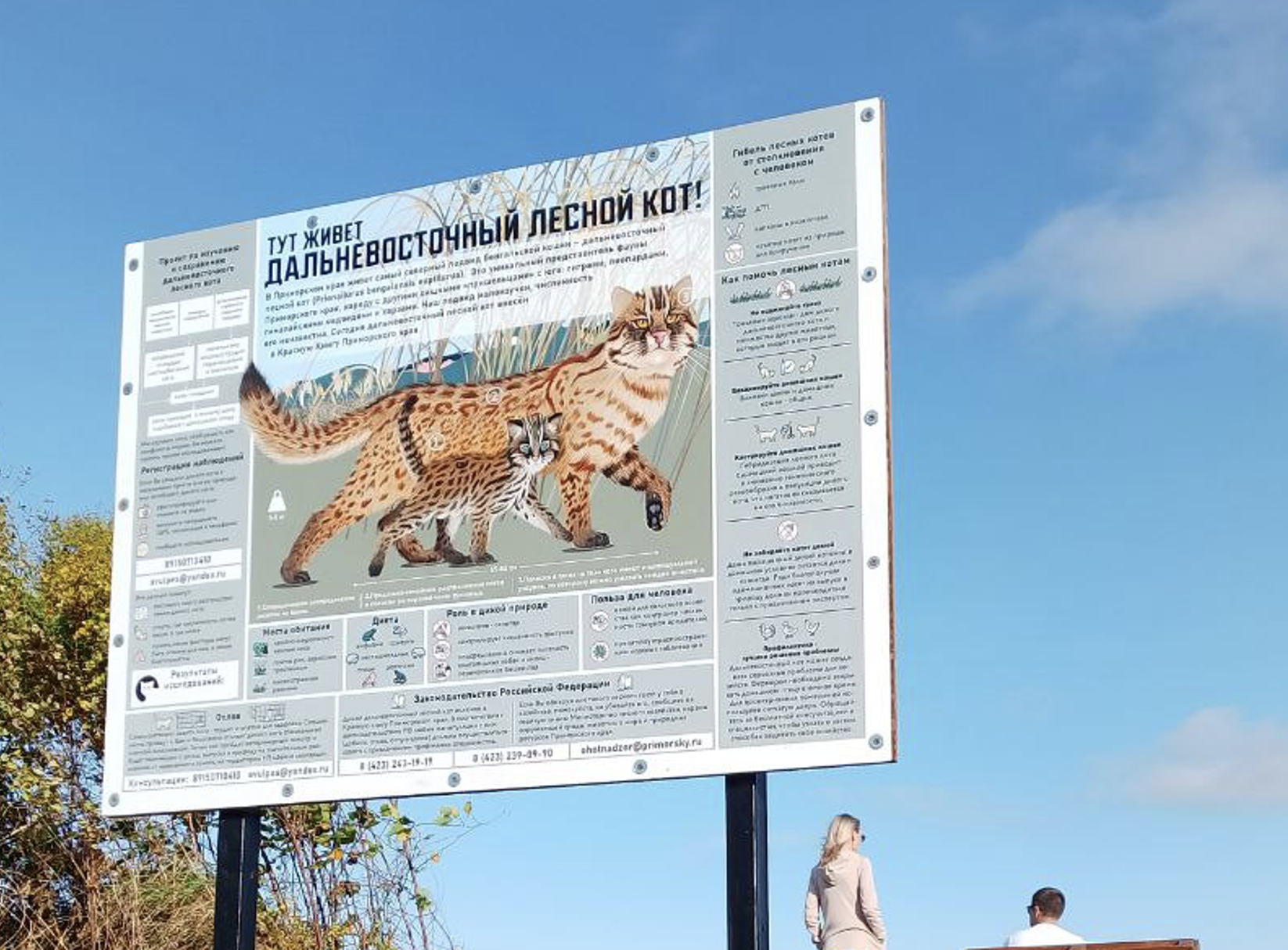
A sign placed to educate local communities in the Russian Far East about the mainland leopard cat. The more people know about this small wildcat, say researchers, the more likely they are to appreciate it and aid in its conservation, and the less likely human-cat conflict may be. Image courtesy of Ekaterina Blidchenko.

A sign placed to educate local communities in the Russian Far East about the mainland leopard cat. The more people know about this small wildcat, say researchers, the more likely they are to appreciate it and aid in its conservation, and the less likely human-cat conflict may be. Image courtesy of Ekaterina Blidchenko.

Conservation threats and opportunities

While mainland leopard cats may be far from global extinction, the species does face numerous threats.

Among the most vulnerable are “island populations,” which include cats inhabiting actual islands, and those outside the species’ contiguous range on the mainland, such as the leopard cats of India’s Western Ghats region, Singh says. She notes that these isolated populations face risks related to inbreeding. “They are the ones that could end up losing out on their actual conservation or threat status when we do this wide-scale assessment.”

Vehicle strikes are also a common issue, especially as the cats’ habitat becomes increasingly fragmented by road construction. In addition, the IUCN Red List notes that “hunting and snaring occur in most parts of [the] Mainland Leopard Cat’s range and is particularly intense in South-east Asia.” The cat is also traded or hunted for its meat and fur, as well as for illegal adoption, domestication, and hybrid breeding, in parts of its range.

Another threat: conflict with humans over poultry, which leopard cats have been known to snatch. But in the Russian Far East, conservationists are meeting with success in dealing with these human-cat conflicts, says Ekaterina Blidchenko, a senior research assistant at Kedrovaya Pad State Biosphere Nature Reserve and at Land of the Leopard National Park.

A Prionailurus bengalensis kitten in Taiwan, where only 500 leopard cats remain. Taiwan’s leopard cats are among several “island” or isolated populations facing greater local extinction threats than the species overall. Image by ourskyuamlea via Pixabay.

A Prionailurus bengalensis kitten in Taiwan, where only 500 leopard cats remain. Taiwan’s leopard cats are among several “island” or isolated populations facing greater local extinction threats than the species overall. Image by ourskyuamlea via Pixabay (Public domain).

Blidchenko’s team developed a signboard to educate local farmers about the leopard cat and involve them in conservation. Placed in more than 10 villages adjacent to national parks, the signs offer contact information to local people interested in cat-proofing their poultry pens or requesting humane cat relocations. “People are increasingly resorting to humane methods of capturing leopard cats visiting chicken coops,” she says.

“[T]he leopard cat very often encounters people in anthropogenic landscapes (highways, agricultural lands, poultry houses), unlike large cats such as tigers and leopards. So it is very important to work with people to highlight the importance of preserving this species of small cat and its valuable place in the ecosystems of Northeast Asia,” Blidchenko adds.

The signs her team have placed in local communities also invite individuals to submit information on leopard cat sightings, which will help researchers map the cat’s range and populations, as well as improve understanding of threats.

Involving local communities is key to conservation, particularly outside of protected areas, Singh agrees. In her experience, “anyone who sees a wild cat — whether it’s big or small — out in the wild gets excited, whether it’s tourists or people working in their fields.”

Due to its large range, transboundary collaboration is key to understanding and conserving the mainland leopard cat. The IUCN Red List and Green Status assessments are two key initiatives toward that end, although much remains unknown about this species. Image by Davidvraju via Wikimedia Commons (CC0 1.0).

Due to its large range, transboundary collaboration is key to understanding and conserving the mainland leopard cat. The IUCN Red List and Green Status assessments are two key initiatives toward that end, although much remains unknown about this species. Image by Davidvraju via Wikimedia Commons (CC0 1.0).

Last cat standing

The leopard cat, perhaps due to its small size and adaptability, is sometimes the only non-threatened wild felid — or sometimes the only wild felid at all — left in parts of its range. This is the case in South Korea, which lost its Siberian tigers and Amur leopards in the 1920s and 1970s, respectively. There, the leopard cat, which prowls boundaries between forests and agricultural or residential areas, is under pressure from habitat fragmentation and vehicle strikes, Kim says.

“In South Korea, public awareness and interest in the leopard cat remains remarkably low relative to its ecological significance,” she says. “I believe that if more people came to know that this small and beautiful animal is Korea’s last remaining wild felid, public interest in, and commitment to, its conservation would grow quite naturally.”

Although South Korea’s case may be representative of the leopard cat’s low profile across its range, there have been notable exceptions: A leopard cat photo taken by Peking University professor Luo Shu-Jin via camera trap near the 2022 Winter Olympics ski slopes in Beijing (another locale where leopard cats are the only remaining wild felid) went viral when it was released in 2021, according to CNN.

The photo brought Beijing’s wildlife into view, Luo says. “In an age of rapid urban expansion, can humans and wildlife find a new equilibrium? The study on leopard cats in Beijing sets the stage for such a query,” she says.

China’s overall leopard cat population is estimated at 230,000 individuals, according to the IUCN, although Luo notes that detailed population surveys are still lacking across much of the country. In 2021, China designated the felid as a National Class II protected species. (For comparison, the giant panda is a Class I protected species.)

Elsewhere, “in Southeast Asia, the leopard cat is remarkably resilient and abundant,” Gray says. “It’s essentially the only wild cat left across the vast majority of Laos, Cambodia and Vietnam.”

He cited a 2022 study that found “relatively high” densities of leopard cats in three different forest types in Cambodia. The study’s authors note that leopard cats even appear to thrive in oil palm plantations due to the abundance of rodents there.

A leopard cat in South Korea. The mainland leopard cat is divided into two subspecies, Prionailurus bengalensis bengalensis and Prionailurus bengalensis euptilurus, which exhibit differences in their coats and markings. Image by Kim Hyun-tae via Korean National Institute of Biological Resources (Korea Open Government License Type 1).

A leopard cat in South Korea. The mainland leopard cat is divided into two subspecies, Prionailurus bengalensis bengalensis and Prionailurus bengalensis euptilurus, which exhibit differences in their coats and markings. Image by Kim Hyun-tae via Korean National Institute of Biological Resources (Korea Open Government License Type 1).

Given the historical lack of research into leopard cats, Singh says she would like to see new studies designed to focus specifically on leopard cat biology — as opposed to data produced only as a byproduct of big cat studies.

Genetic mapping is also needed to better understand population connectivity and inform management within distinct conservation units, Kim says.

Despite the leopard cat’s continent-spanning range, Blidchenko emphasizes the need for local focus. “While we can’t influence global processes, we can influence some specific situations,” she says. “Through the personal stories of leopard cats that have encountered humans, we can raise awareness of this species and highlight the challenges these beautiful creatures face.”

17


The golden-headed lion tamarin, captured in the photo above, is a small primate species found only in the northeastern Brazilian state of Bahia.

The tamarins, Leontopithecus chrysomelas, have bright reddish-golden manes, and similarly colored paws and tails. They live among tree branches, eating fruit and the occasional bird egg or small vertebrate. They sleep huddled together with their extended family units in tree holes.

Flávia Zagury, a biologist and photographer, photographed a family of tamarins at the Primatology Center of Rio de Janeiro, a state research center with a mission to preserve Brazil’s primate heritage.

“I was so impressed by this creature, their colors are incredible,” Zagury told Mongabay in an audio message. “[The tamarins] were vocalizing a lot … I sensed a lot of curiosity coming from them.”

These tamarins are among Brazil’s most threatened primates, having faced a nearly 60% population decline in just three decades. From 1992 to 2024, agricultural and urban expansion took over more than 40% of their habitat. Now, they have just 13,000 square kilometers (5,000 square miles) of available forest, and much of it is fragmented.

A large part of the existing range of the tamarins is made up of cacao agroforestry farms called cabrucas, where the crop is grown underneath a canopy of native trees. Luckily, cacao is also one of their favorite fruits.

In recent years, coffee monocultures and livestock pastures have taken over many cacao farms, adding to the primate’s extinction risk. Locals have been working to better protect them: the city of Ilhéus in Bahia made the golden-headed lion tamarin its official mascot to raise awareness in 2024 and increase local pride for sustainable cacao farms. A rehab center was also inaugurated in March 2026 to help reintroduce tamarins found in urban spaces back into the wild.

“My next mission is to see them in the wild,” Zagury said.

Banner image: A golden-headed lion tamarin (Leontopithecus chrysomelas). Images courtesy of Flávia Zagury.

Banner image: A golden-headed lion tamarin (Leontopithecus chrysomelas). Images courtesy of Flávia Zagury.

18


Banner image: The Maud Island frog of New Zealand is expected to face rising wildfire risk due to climate change. Image by Phil Bishop via Wikimedia Commons (CC BY-SA 2.5).

Scientists forecast wildfire risk for species survival under climate change

A new study warns climate change could increase the global area susceptible to wildfires in the future, putting many more species at risk than today.

Previous research has shown that climate change is increasing the risk of wildfires as precipitation patterns change and vegetation becomes drier in parts of the world. Researchers have now projected how the length of fire seasons and the extent of burned area might change in the future under four scenarios of greenhouse gas emissions. Using these forecasts, they also assessed the future impact of wildfire for 9,592 species of animals, plants and fungi, currently reported on the IUCN Red List as threatened by wildfire.

Under the moderate-emissions scenario, where current greenhouse gas emission trends continue, the researchers found that by 2100, the extent of burned areas globally could increase by 9.3%, and that nearly 84% of fire-threatened species will be exposed to higher risk of wildfires.

Xiaoye Yang, study lead author from the University of Gothenburg, Sweden, told Mongabay by email that “there are clear spatial disparities in future wildfire risk to biodiversity.”

Regions such as South America and Oceania are expected to face especially elevated risks of burning, Yang said. Fires in high-latitude areas of the Northern Hemisphere are also projected to increase rapidly in the future, although they’ve historically been rare in these regions, he added.

The study found that the top 1% of species most affected by wildfires (96 species) are found in South America, South Asia, southern Australia and New Zealand. These species, including the Maud Island frog (Leiopelma pakeka) and North Island saddleback (Philesturnus rufusater), a bird, both from New Zealand, share common traits, the authors write: they have very small geographic ranges and are already threatened with extinction.

Species in areas newly threatened by wildfires may lack adaptive experience with fire, making them particularly vulnerable to emerging wildfire regimes, Yang said.

At the same time, some regions like Central Africa could see a reduction in burned area in the future, the study found. About 1,000 species in Africa could also experience lower exposure to wildfire risk.

“Although the increase in wildfire risk will vary across regions — meaning that some countries contributing more to emissions may not experience proportional increases in wildfire impacts — collective action remains crucial,” Yang said.

Carla Staver, a professor at Princeton University in the U.S., who studies wildfires in savannas, told Mongabay that framing wildfires as a blanket biodiversity threat is a limited perspective, since certain ecosystems depend on fires. “For example, the 41.8% of African species that could experience a decrease in wildfire risk probably mostly occur in savannas, which are fire dependent, so reductions in fire activity in those systems aren’t good news either,” she said.

19


A window on the wild: The best of British wildlife photography | Country Life

Two hares boxing

It's boxing day for the brown hares of Bintree in Norfolk, captured in Sarah Darnell's 'The Fur Flew'

(Image credit: Sarah Darnell/British Wildlife Photography Awards)

A bee stuffs its face with pollen

Hello petal: A shower of pollen is scattered by a foraging bee illuminated in the glow of the sun in Alison Bell's highly commended 'A Kind of Magic'.

(Image credit: Alison Bell/British Wildlife Photography Awards)

A spider waits on a daisy.

A camouflaged flower crab spider blends in with the colour of the blooms in the hope of ambushing any unsuspecting bees, moths and other insects in Adam Ferry's 'Waiting on a Daisy'.

(Image credit: Adam Ferry/British Wildlife Photography Awards)

An own looking at the camera with its head upside down

Turning heads: Cate Barrow attracts the icy stare of a short-eared owl in her 'Upside Down Owl'

(Image credit: Cate Barrow/British Wildlife Photography Awards)

The cover of the book, featuring a hedgehog

More than 250 of the winning and shortlisted images are published in 'British Wildlife Photography Awards Collection 14' (£35, Graffeg Books). Entries are now open for the 2027 competition.

(Image credit: British Wildlife Photography Awards)

A falcon holds another smaller bird in its talons

Trouble afoot: A plucky juvenile starling struggles to escape the clutches of a sparrowhawk in Mark Parker's 'Nemesis', winner of the Animal Behaviour category.

(Image credit: Mark Parker/British Wildlife Photography Awards)

A bug has eaten a hole through a leaf and is posing in the frame

'So glad you could come': A dew-doused azure damselfly appears to beckon the viewer through a nibbled leaf that forms Lee Frost's 'Nature's Window'.

(Image credit: Lee Frost/British Wildlife Photography Awards)

A vixen and her cub in a field

Someone to look up to: A fox cub is a study in adoration under the watchful care of its mother in Victor Soares's 'Admiration in a Fox's Eyes'.

(Image credit: Victor Soares/British Wildlife Photography Awards)

A mouse shakes a dandelion

When time flies: A flurry of feathered seeds dances from the shaken head of a delicate dandelion clock as a bank vole contemplates sinking its teeth into the stem in Paul Williams's 'Zephyr'.

(Image credit: Paul Williams/British Wildlife Photography Awards)

A bee is pictured carrying a leaf

Flyleaf: a patchwork leaf-cutter bee in Chris Jackson's 'Bringing in the Leaves', which was highly commended in the Hidden Britain category. The bees cut discs out of greenery and glue them together with saliva to build cells to house their larvae.

(Image credit: Chris Jackson/British Wildlife Photography Awards)

20


Banner image: Dorymyrmex ants clean workers of a different ant species. Image by Moffet, 2026 (CC BY 4.0).

Unusual ant interaction hints at mutualistic ‘cleaning’ system

Some coral reef ecosystems famously have “cleaning stations,” where fish line up to be cleaned by other species of fish and shrimp. Entomologist Mark Moffet recently published observations of what appears to be a similar relationship in ants.

In the Chiricahua Mountains of the U.S. state of Arizona, Moffet, from the National Museum of Natural History, was watching harvester ants (Pogonomyrmex barbatus) collecting seeds when he noticed something odd. He saw several harvester ant workers frozen in place. When he zoomed in with his camera, Moffet saw the harvester ants covered with cone ants (Dorymyrmex spp.).

At first Moffet assumed he was seeing aggression between the species. On closer inspection however, he observed that the small cone ants were licking and nibbling the larger harvester ant workers, not fighting with them. Moffet observed the cone ants inspecting the harvester ants’ open mandibles, which could easily crush the smaller cone ants.

Moffet observed at least 90 individual harvester ant workers being tended this way and concluded that they might be getting cleaned by the cone ants. He even watched harvester ants approach the nests of cone ants and wait for cone ants to attend to them, which reminded him of reef fish lining up for a cleaning by cleaner fish species.

The big question is: What is each species getting out of the arrangement? Moffet consulted colleagues and came up with several possible explanations. Perhaps the ants exchange microbes, which create a healthier microbiome for both species. Or maybe they swap pheromones, to keep harvester ants from attacking cone ants later on. Maybe the cone ants impart an antifungal substance they’re known to produce.

Another possibility is that the cone ants get a free meal. “The Pogonomyrmex are called ‘harvester ants’ because they harvest seeds and store them in underground larders,” Moffet told Mongabay by email. “Seeds are high in calories and a carbohydrate-rich dust from them are likely all over the ant’s body surfaces — an energy rich snack that would be invisible to the eye.”

In return for that snack, the cone ants may be helping the harvester ants stay free from disease by eating seed dust that could potentially contain harmful microbes.

The cleaner ant system might be an example of mutualism — a symbiotic relationship that benefits both species — but this hypothesis needs more research. “I want to go back and take a further look. But proving that this is a mutualism would take quite a bit of time — what we need is an interested PhD student!” Moffet wrote.

Daniel Kronauer, an ant biologist at Rockefeller University in the U.S., who wasn’t involved with the cleaner ant research, told The New York Times that “It’s a pretty unique observation” that could lead to new directions in research.

21


Why these toads are evolving faster than anyone expected

An invasive cane toad (Rhinella marina) is measured in Australia. (Chris Barlow / Macquarie University via SWNS)

By Stephen Beech

Cane toads have leapt ahead of evolution theories by growing bigger and changing more rapidly than expected, according to new research.

The invasive species has bulged in size since being introduced into Japan less than 50 years ago, reveals the study.

Scientists say their findings suggest environmental pressures can drive rapid biological change.

The study comparing invasive cane toads in Japan and Australia found "substantial" changes in body size and shape have developed much more rapidly than suggested by long-held ideas of the pace of evolution.

Researchers measured and weighed wild-caught cane toads on Ishigaki Island in southern Japan and compared them to toads measured in Australia, Hawaii and South America.

A large cane toad outside. (Photo by Flávio Santos via Pexels)

The most striking difference was in body size with adult toads from Ishigaki weighing an average 190 grams (0.4 lbs) compared to 135g (0.3 lbs) for toads from Australia, while their average length was 122 millimeters (4.8 inches) compared to 111mm (4.3 ins).

The findings, published in the journal Royal Society Open Science, also showed that Ishigaki toads had wider heads, shorter arms and longer legs than toads from other locations.

Cane toads have spread to more than 40 countries worldwide from their ancestral habitat in north-eastern South America.

They first spread to Puerto Rico and then to Hawaii and from there to Australia in the 1930s.

The toads of Ishigaki were introduced from Hawaii, via Taiwan and the Daito Islands, in 1978.

Senior researcher Rick Shine said: "Given these populations of toads in Japan and Australia shared a common history in Hawaii until the 1930s, these differences in size and body shape have developed in less than 100 years.

"The idea that evolutionary change happens at a glacially slow pace is being challenged by recent evidence showing rapid changes in species confronted with novel challenges, like being translocated to a different habitat."

The study didn't collect sufficient data to allow researchers — from Macquarie University and the University of Sydney in Australia plus Kyoto University in Japan — to test alternative theories about what might be driving the changes in body size.

But the research team speculated that the larger body sizes of Ishigaki toads could reflect favorable climatic conditions, particularly year-round rainfall or the impact of lower pressure from predators on the island.

Shine, an evolutionary biologist and ecologist at Macquarie University in Sydney, added: "We don't have a clear idea of the evolutionary forces that might be involved, so we can't say why body mass and shape has changed among the toads in the Japanese system."

22


Some rays flash decoy eyes while others never do, as evolution's hidden trade-off comes into focus

Why some rays have 'fake eyes' – and others don't

Pacific Starry Skate. Credit: Andy Murch.

From butterflies to peacocks, bold circular "eyespots" are among nature's most eye-catching patterns. But why do they appear in some animals and not others? A new study of skates and rays finally provides an answer—and it lies in the full range of defenses an animal has at its disposal.

In a study examining more than 580 species—over 90% of all known skates and rays—researchers from Stockholm University have mapped the evolutionary history of conspicuous markings across this ancient group of cartilaginous fishes.

By analyzing multiple anti-predator defenses together, rather than studying eyespots in isolation, they were able to explain why such dramatic visual signals appear in some groups but are completely absent in others. The work has been published in Nature Ecology & Evolution.

"Our results show that you have to look at the full range of options for avoiding predators. Eyespots evolve only under certain ecological and defensive conditions. They are one solution among many in the evolutionary arms race between predator and prey," says lead author Madicken Åkerman.

Why some rays have 'fake eyes' – and others don't

Mediterranean Rough Skate. Credit: Andy Murch

Why some rays have 'fake eyes' – and others don't

Rasptail Skate. Credit: Andy Murch.

Different species, different toolkits

Skates and rays face a wide range of predators, including sharks, marine mammals and large fish. Some species defend themselves with powerful electric organs or venomous spines. Others rely more heavily on camouflage, burying themselves in sand on the ocean floor.

The researchers found that species equipped with such robust defenses rarely evolved conspicuous markings. In contrast, smaller-bodied species without those weapons were much more likely to develop bold spots or eyespots—particularly if they lived in well-lit, shallow waters less than 200 meters deep.

"Eyespots are far from random. They tend to evolve in species that lack strong physical defenses, such as venomous tail stings or electric shocks, and that live in bright, shallow waters where visual signals are effective," says senior author John Fitzpatrick.

Why some rays have 'fake eyes' – and others don't

John Fitzpatrick at Stockholm University. Credit: Anette Gärdeklint Sylla/Stockholm University

"Evolution seems to favor different defensive toolkits. If you already have a strong mechanical or electrical defense, you don't also need a visual warning signal," says Madicken Åkerman.

A stepwise process

The study also uncovered a surprising evolutionary pattern: eyespots almost never evolved directly. Instead, species typically first gained simpler markings—such as bold spots—which were later refined into the classic concentric-ring eyespots seen in some skates. In evolutionary terms, gaining simple markings was about 100 times more likely than gaining eyespots outright.

"It appears to be a stepwise process. Other markings come first, and over time they refine into eyespots," says John Fitzpatrick.

Yet conspicuous markings are also frequently lost. This makes sense when considering the trade-off at play. In deep, dark waters where little light penetrates, a visual signal cannot be seen—and therefore offers no protection. Under those conditions, the cost of being conspicuous outweighs the benefit—and the markings disappear.

23


Banner image: Lilac-breasted roller in Etosha National Park, Namibia. Image courtesy of Giles Laurent via Wikimedia Commons, CC BY-SA 4.0.

How Namibia's bird conservation projects build community resilience (commentary)

  • Droughts and land degradation often erode communities’ social bonds, but in the Karas region of Namibia, bird conservation initiatives have become a rallying point.
  • Women and youth are at the forefront of these initiatives, which has inspired confidence among peers and shown that conservation is not the domain of scientists alone, but also a practice of everyday community resilience.
  • “It is time for policymakers, NGOs, and donors to support these initiatives not just as biodiversity projects, but as investments in community well-being,” a new op-ed argues.
  • This article is a commentary. The views expressed are those of the author, not necessarily of Mongabay.

In Namibia’s Karas Region, birds are more than symbols of freedom or beauty — they are teachers of resilience. Their survival in arid landscapes mirrors the endurance of the communities who live alongside them. Grassroots bird conservation projects here have revealed something profound: protecting birds can also strengthen families, nurture hope, and build social cohesion.

Across villages in Karas, parents and children tend habitats together, restoring nesting sites and planting native vegetation. These acts of care are not only ecological interventions; they are lessons in patience and problem solving. When a child sees a weaverbird return to a reed bed that the community has protected, it is a moment of triumph that teaches perseverance in the face of environmental challenges.

Women and youth are at the forefront of these initiatives. In one community, a group of young women organized bird walks for schoolchildren, teaching them to identify species like the sociable weaver and the pale chanting goshawk. Their leadership has inspired confidence among peers and shown that conservation is not the domain of scientists alone — it is a practice of everyday resilience.

Sociable weavers nesting in acacia trees, Karas Region, Namibia. Image courtesy of Martha Karas.

Sociable weavers nesting in acacia trees, Karas Region, Namibia. Image courtesy of Martha Karas.

These projects also counter the isolation that environmental stress can bring. Droughts and land degradation often erode social bonds, but bird conservation has become a rallying point. Families gather to monitor nesting sites, share stories, and celebrate small victories. In doing so, they weave resilience into the social fabric. Conservation here is not only about biodiversity; it is about belonging.

The ecological benefits are clear. Protecting bird habitats safeguards pollination, seed dispersal, and pest control — services that sustain agriculture and livelihoods. But equally important is the emotional strength these projects cultivate. In Karas, conservation has become a human resilience strategy: a way to confront uncertainty with collective action and hope.

This perspective challenges the conventional view of conservation as a technical exercise. Too often, policies focus narrowly on species counts or protected areas. While these metrics matter, they overlook the lived experience of communities who find strength in caring for nature. By recognizing conservation as both ecological and social, we broaden its value and deepen its impact.

Lappet-faced vulture soaring over arid plains, Karas Region, Namibia.

Lappet-faced vultures like this are native to the arid plains of the Karas Region, and organizations like Vultures Namibia ensure there’s awareness of them. Image courtesy of Martha Karas.

The lesson from Karas is urgent. As climate change intensifies, resilience will be as critical as resources. Grassroots bird projects show that resilience can be cultivated through simple, shared acts of care. They remind us that conservation is not only about saving species, but about sustaining the human spirit.

It is time for policymakers, NGOs, and donors to support these initiatives not just as biodiversity projects, but as investments in community well-being. Funding should prioritize programs that empower women and youth, foster intergenerational learning, and strengthen social bonds through conservation.

Birds in Namibia’s Karas Region are survivors of harsh landscapes. But they are also mentors of resilience, teaching us how to endure, adapt, and thrive together. By listening to the voices of those who lead grassroots efforts, we can reimagine conservation as a strategy for human strength as much as ecological survival.

Supporting these projects is not charity — it is foresight. In every nest protected, in every child inspired, we see the seeds of resilience that will carry communities through the challenges ahead.

Conservation, at its best, is a story of hope. And in Karas, that story is being written by birds and the people who care for them.

Martha Karas is a Namibian writer based in the Karas region.

24


If you are ever confronted by a toad, you soon see why there is little chance of confusing it with its froggy cousin.

I realised this after discovering a glorious, warty specimen settled on damp concrete in the garage one autumn. It was not only its copper-coloured eyes, squat boxer face and bumpy, waterproof skin — allowing it to survive away from water for longer — but its size that impressed. Wild toads can live for more than a decade; this creature may have been as old as my son.

After some deliberation (and Googling) I moved my toad to a pile of logs and fallen leaves near the pond. It was silent as I transported it, in gloved hands to protect its skin from mine, which meant it must have been a female: only male toads squeak when picked up.

Sadly, a report recently found that the chance to perform a toad relocation may become rarer than ever. Led by Dr Silviu Petrovan of the University of Cambridge in collaboration with the charity Froglife last October, it used one of the biggest data-sets ever gathered for amphibian population trends; between 1986 and 2021, a dedicated team of volunteers counted migrating toads during the spring breeding season. The findings were sobering: over the past 40 years, the UK population has declined by nearly half. The common toad (Bufu bufo), now reassessed as ‘near threatened’ in England and Scotland, may soon need a new name.

'In 2025, 275 active patrols helped almost 135,000 toads complete their lust-driven journey to reproduce'

Common toad (bufo bufo) England poking its head above water

(Image credit: Getty Images/Westend61)

One of two species native to Britain, the common toad has a place in our culture not enjoyed by the natterjack, whose home on sandy coasts and modest population has meant few of us will ever encounter one. The common toad, however, has had a near-ubiquitous presence in Britain since the last Ice Age: a study of frog and toad bones at Repton in Derbyshire found evidence of local populations as far back as the 8th century. The excavation concluded there was a toad boom in the 14th century, which might explain why the creature begins then to creep from folklore into literature.

From magic and medicine to myth, toads have been linked always to the suspicious and powerful: a toad is the first ingredient Shakespeare’s witches drop into their cauldron in Macbeth, the 15th-century Scottish poet Robert Henryson makes his toad treacherous and Milton’s Paradise Lost has Satan himself choosing to inhabit one for his disguise.

As with all folklore, there is confusion: what is bad is also powerful and power is something people try to harness. Across medieval Europe, women were advised that a toad effigy clamped between the knees during childbirth could ease labour pains. Meanwhile, toads were thought to carry a jewel in their heads that changed colour to warn of poison and protect against evil — or, as Shakespeare wrote in As You Like It, the toad was ‘ugly and venomous, wears yet a precious jewel in his head’.

Exquisite houses, the beauty of Nature, and how to get the most from your life, straight to your inbox.

These ‘toad-stones’, mentioned since the Middle Ages, became especially popular between the 14th and 17th centuries. They were, in fact, often fossilised fish teeth, but that did not stop people believing the proper way to extract one was to sit a toad on a red cloth until it belched the stone up, to be caught and set into a ring or amulet for luck.

'Frequently one comes upon shapeless masses of 10 or 20 toads rolling over and over, one clinging to another without distinction of sex'

Two toads on top of each other

Two toads, inspiring enough for George Orwell.

(Image credit: Getty Images/Stephan Gehrlein/500px)

Modern literature has given the poor old toad a gentler reputation. In his superb 1946 essay Some Thoughts on the Common Toad, George Orwell describes the creature after hibernation as having ‘a very spiritual look, like a strict Anglo-Catholic towards the end of Lent’. The essay credits the toad — not the cuckoo — as the herald of spring. His description of toad copulation brings to mind a particularly lively urban Saturday night, with the creature entering ‘a phase of intense sexiness. All he knows, at least if he is a male toad, is that he wants to get his arms round something and if you offer him a stick, or even your finger, he will cling to it with surprising strength and take a long time to discover that it is not a female toad. Frequently one comes upon shapeless masses of 10 or 20 toads rolling over and over, one clinging to another without distinction of sex’.

My own re-homed toad did not hop into her new refuge, but crawled, stretching her limbs across the leaves like an aged yogi. The glands in her bumpy skin contain toxins that deter predators, meaning that, unlike the frog, she can stroll away from trouble rather than leap. I never saw her again, nor any sign of the alien-like double-rowed strings of eggs she might have left clinging in the pond. Around St Valentine’s Day, amorous toads leave hibernation and begin their migration to ancestral breeding ponds, sometimes many hundreds of feet away. Most return to the very pond of their birth, using chemical signals and magnetic orientation to find their way — regardless of whether a new A-road now crosses their route. The long, jelly-like strings of eggs hatch within days. It takes two or three months for a tadpole to become an inch-long toadlet, which must then brave cars and predators as it leaves the water to find new ground for feeding and hibernation.

Toads return to the same ponds, which means when those ponds are drained or built over it breaks a link that is both ancient and ecological. Although a toad’s skin may look tough enough for a witch’s cauldron, it is porous. Agricultural pesticides seep through it, poisoning the animal, at the same time as killing off its food sources, such as spiders, beetles, worms and slugs. The creatures that prey on pesticide-poisoned toads are also affected, hedgehogs and otters among them, which often skin the toad inside out to avoid its toxic glands. Climate change, too, plays its part. Last year saw the driest spring in more than a century, disrupting hibernation and the availability of a toad’s choice of food, and milder winters cause toads to wake too soon, losing body condition and producing fewer eggs.

Why should we care about the much-maligned toad, apart from the fact that a world with one hiding in your garage is richer than a world without? The answer lies in the natural cycle. As with birds and insects, the decline of once-common species sends ripples along the food chain. As Froglife’s report notes: ‘It is not extinction, but the population decline of abundant species that will have the most serious ecological consequences. Abundant species tether food webs, account for much of the interaction diversity in a given community, and carry out ecosystem services’.

There is some good news. Froglife reports that, although toad populations crashed by 68% per cent between 1985 and 2013, efforts in the past eight years have brought ‘regional recoveries’, reducing the total decline to under half. Much of this is thanks to the Toad Patrols — volunteers who literally carry toads across roads by the bucketful. In 2025, 275 active patrols helped almost 135,000 toads complete their lust-driven journey to reproduce.

'It would be a shameful thing to have created a landscape that in only 40 years manages to kill off a creature that has survived 400 million, through the extinction of the dinosaurs to the Industrial Revolution'

toad tadpoles two to three weeks after hatching.

It takes two or three months for a tadpole to become an inch-long toadlet, which must then brave cars and predators as it leaves the water to find new ground for feeding and hibernation.

(Image credit: Getty Images/Naturfoto Honal)

Community-led action can sound worthy, but futile. In fact, there is precedent in the revival of another creature once commonly squashed on tarmac: the hedgehog. As rural populations continue to fall, urban hedgehogs are making a comeback. The excellently named HogWatch project has seen dramatic rises in hedgehog populations in Highgate Wood, north London, in only eight years, thanks solely to citizen action. In October 2024, the National Hedgehog Conservation Strategy—launched by the People’s Trust for Endangered Species and the British Hedgehog Preservation Society — became the world’s first of its kind, providing a frame-work for NGOs, government, landowners and communities. The Hedgehog Street campaign has already recruited more than 100,000 ‘hedgehog champions’.

Are toads the new hedgehogs? Let’s hope so. It would be a shameful thing to have created a landscape that in only 40 years manages to kill off a creature that has survived 400 million, through the extinction of the dinosaurs to the Industrial Revolution.

In the meantime, anyone with a garden can help. Despite not being able to build amphibian tunnels for commuting juveniles, Jenny Tse-Leon, head of conservation and Impact at Froglife, says that ‘the restoration and creation of more and better-connected ponds and habitats such as woodlands and grasslands are essential to their survival’. No matter the size of your garden, a small pond, log pile, stones or even an upturned flowerpot can become a summer refuge and a winter hibernaculum.

One day, perhaps, the sight of a toad making its slow, dignified way through the garden may become as common as it once was — and our children, too, might move one from a garage to a bed of leaves and see for themselves why these characterful creatures have long been woven into the fabric of British culture.

25


Family photo: parenting in the animal kingdom | The Narwhal

Doting mates, coddling parents and a touch of tough love; the animal kingdom has a lot to teach us about rearing young.

As a wildlife photographer for 14 years, I’ve had the chance to see these parents in action, and feel the loss of young left to fend for themselves. 

I’ve spied a Cooper’s hawk, watching closely as its parents hunt, so it can one day feed its own family. I’ve seen an eagle drop a fish into a river for an eaglet, when their own angling skills weren’t yet up to snuff.

Perhaps the most relatable scene was a worn out male fox, taking an afternoon nap in the grass, as his kits rough-housed nearby.

From the fields, rivers and skies of Ontario, here are some of my favourite family portraits.

A Cooper's hawk flies from a tree with a small branch in its talons

As they mature, the eyes of Cooper’s hawks change colour from brown to orange to red. A pair has been hunting in the woods behind my apartment for the past few years, and last year they were joined by a hatchling.

A Cooper's hawk sits on a branch, looking at the camera

A Cooper's hawk with a brown-feathered back flies from a branch

A young Cooper's hawk sits on a branch

The young Cooper’s hawk spends time watching the adults dart between tree branches to capture mourning doves, mice and even squirrels. This is a skill it will need to survive.

A kingfisher flies in front of a rock wall with a small fish in its beak

In the seven years I’ve been visiting the Nith River in Ayr, Ont., belted kingfishers have nested in a sandbank. When there are young in the nest, the adult male is busy delivering fish and crustaceans to them. Often he will perch on a nearby tree before deciding to enter the nest — a security precaution, to keep their location hidden from predators.

A young sandhill crane and two adults fly in front of trees

Two sandhill crane couples I know of return to their nesting areas south of Cambridge, Ont., each spring. Both pairs laid eggs in 2024. One pair’s nest was flooded and abandoned, but this other couple successfully raised a young one, called a colt. They forage close to the nest when the colt is young, but it will eventually be strong enough to fly with its parents.

A cluster of sandhill cranes gather around a small creek through farmers fields

Each December, sandhill cranes, both young and old, gather in fields along the shore of Lake Erie for migration, although some will remain in Ontario through the winter.

Deer families traditionally include a doe and her offspring from recent years, and they’ll sometimes join with others to form a larger herd. One winter, while wandering across a path, I had the feeling I was being watched. When I turned around I spotted this doe with two fawns.

Three deer stand on a snowy trail

Another mother and fawn approach the Grand River in Brantford, Ont., for a drink. I would often see them crossing the river here.

A mother and baby deer stand at the edge of a lake with purple flowers and forest behind them

A peregrine falcon with a tag on its leg flies towards the camera

Peregrine falcons are the world’s fastest animal, using their roughly 300-kilometre-per-hour flight speed to capture birds much larger than themselves. A pair took up residence on the roofs of two churches in downtown Cambridge, Ont., in 2023 and 2024. They were attracted no doubt by an abundant supply of pigeons and gulls close by.

A peregrine falcone swoops down from a rooftop under blue sky

A peregrine falcon takes off from a rooftop with a partially eaten rodent in its talon

In the spring of 2024, the pair were joined by one of their offspring, seen on the left, which noisily chased the adults whenever they caught a pigeon. I noticed the adults didn’t like to share, but the young one would feed on scraps until her hunting skills were perfected.

A young black bear peeks out from behind a tree

Black bear cubs normally remain with their mothers for roughly a year and a half. This cub was foraging in the woods surrounding Killarney, Ont., with no siblings and no mother in sight. There was an extraordinarily high number of orphaned cubs that year and the Ontario Ministry of Natural Resources couldn’t possibly rescue all of them. A weight limit of 15 kilograms was set, with cubs believed to be below that number targeted for capture and care at a sanctuary. After sharing my photos with one of the ministry’s bear technicians, this one was deemed to be a healthy weight with the potential to survive the winter on its own. A few weeks later I was told by locals they had seen two cubs scavenging at the Killarney town dump. Hopefully, this one made it through the winter.

A bald eagle swoops down while one eagle watches on and a young one screams from the nest

In spring, an adult female bald eagle lays her eggs in a nest constructed with moss, twigs and tree branches snapped from nearby trees. She spends up to 35 days on the eggs, only occasionally getting relief from her mate to stretch her wings — always in the vicinity of the nest. The adult male is the constant provider, delivering food to the nest. When the eggs hatch, his hunting activity is frantic, and the eaglets quickly grow.

From what I’ve seen, each year, one of the fledglings will remain dependent upon the adults for food, even after his or her siblings have left the territory to fend for themselves.

A bald eagle flies low over the water, with a splash below its talons where it picked up a fish

Adults will continue to feed this eaglet, dropping food in the vacated nest or on tree branches close to the nest. Once I watched the adult male drop an enormous northern pike into the river below a begging eaglet. It was an illustration of what good parents these eagles are.

Am adult eagle feeds a young eagle beak to beak

A young moose with patch of fur missing on its back walks across a paved road

A cow moose is a devoted mother and will care for her calf throughout most of its first year — but after that, tough love kicks in. This solitary calf photographed in May 2024 has, in all likelihood, been cast out by its mother so she can prepare to birth another calf.

An adult great horned owl sits on a branch, surrounded by shrubbery, looking straight at the camera

Over a few weeks of observation, I saw this male great horned owl bring squirrels, birds and half-eaten rabbits back to feed both his mate and one owlet, which was hidden in the trees. The adult waited for me to back away before taking the meal to his offspring, likely to keep its location secret.

A young great horned owl perches on a tree branch, looking straight at the camera

The young one was reliant upon its parents as it dared to only fly short distances between neighbouring trees.

A night heron balances on a stick over water

Black-capped night herons fish along the edges of ponds and rivers. This adult night heron preferred hunting for small fish in the shadows along the Speed River, in Cambridge. Her two offspring have learned to hunt from their mother, but found it easier near a dam on the river where fish might gather.

Two night herons sit on sticks above clear glass water

Over time the young herons will lose their brown markings and eventually take on the appearance of an adult — white breast, black-capped head and wings.

While his mate was tucked away in a den giving birth and then caring for the tiny pups, the adult male coyote was the sole provider for his family.

A coyote's head pops up above tall grass

Although I suspected the location of their den, near Paris, Ont., I kept my distance. After a couple of months of parental supervision, the three pups began venturing out and exploring the area.

Young coyotes walk down a gravel road

As the pups grew in size, they also answered the calls of their parents to meet down by the Grand River.

A young coyote crosses a gravel road

A kestrel flies over dry grass

Kestrels are the smallest member of the North American falcon family. Fully grown, they are about the size of a mourning dove. Over the month of April 2022, this adult female became used to me standing at the side of the road photographing her each evening as she hunted insects and mice.

A kestrel flies over dry grass

I didn’t see her over the following months and realized she was probably nesting somewhere. When she did eventually return it was with three young ones, none of which were as bold as her. They kept their distance.

A young fox sits in the grass and peers at the camera

A young fox looks back at the camera while standing in grass

Two young foxes play in the grass

For much of 2020, a red fox could be seen hunting behind my apartment building. In the summer and fall, two kits turned up, often playing together. Feeding the growing kits was a lengthy and apparently tiring process for the adult male, who would regularly take a 20-minute afternoon nap in the grass undisturbed by the sound of my camera clicking away.

view more: next ›