1


Drop Site is a 100% reader-funded, independent news outlet. Without your support, we can’t operate. Please consider making a 501(c)(3) tax-deductible donation today.

Subscribe now

Two men weep over the body of a dead female relative outside Al-Awda hospital in central Gaza following a wave of Israeli airstrikes. October 29, 2025. (Screenshot of video by Abdel Qader Sabbah.)

NUSEIRAT REFUGEE CAMP, GAZA—Dr. Sami Jabr stood on the wreckage of the Abu Dalal family home in the Nuseirat refugee camp in central Gaza on Wednesday, just hours after it was bombed. They had been his neighbors. Piles of rubble and uprooted trees were all that was left. Clothes and mattresses and other remnants of life lay mixed in with the smashed concrete.

“I was starting to fall asleep when, Boom! A succession of bombs targeted the house of our neighbors, the Abu Dalal family—our loved ones and friends. It was a massacre. A massacre. A massacre. We went out and found no one. Only body parts and dismembered bodies. There was no one left alive…there was a child without a head. Scenes that break your heart,” Jabr told Drop Site. “We had nothing to do with any of this. What is the cause for all of this?”

The wreckage of the Abu Dalal family home in Nuseirat refugee camp in central Gaza hours after it was bombed. October 29, 2025. (Video by Abdel Qader Sabbah.)

At least eleven members of the Abu Dalal family, including four children, were killed in the twin bombing of their home on Tuesday evening, part of a massive wave of Israeli airstrikes and tank fire across the enclave overnight that marked the bloodiest episode in Gaza since a so-called “ceasefire” went into effect on October 10. Israel killed at least 104 Palestinians, including 46 children, in less than 12 hours of bombardment. More than 250 were wounded, including 78 children.

United Nations human rights chief Volker Turk denounced Israel’s attack saying, “Reports that over 100 Palestinians were killed overnight in a wave of Israeli air strikes—mainly on residential buildings, IDP tents and schools across the Gaza Strip following the death of an Israeli soldier—are appalling. He added, “It is distressing that these killings occurred just as the long-suffering population of Gaza started to feel there was hope that the unrelenting barrage of violence may be at an end.”

Before daybreak in Nuseirat, people used flashlights to dig through the debris—some of it still smoldering—to pull the dead and wounded out and carry them in blankets to ambulances waiting nearby. Jabr, a doctor who usually works at Nasser hospital in Khan Younis, was unable to go on shift despite the casualties pouring in. “I could barely walk or do anything. Yesterday…I barely survived,” he said.

“Every time we wake up in this nightmare—they surprise us with the nightmare of returning to war.”

Mourning and funerals in Nuseirat refugee camp in central Gaza on October 29, 2025. (Video by Abdel Qader Sabbah.)

The killings came after Israeli Prime Minister Benjamin Netanyahu said on Tuesday he had ordered the military to conduct “powerful strikes” on Gaza following an exchange of gunfire in Rafah. The Israeli military later said an Israeli soldier, who held U.S. citizenship, was killed in an attack. Israeli Defense Minister Israel Katz said in a statement, “Anyone who raises a hand against [Israeli] soldiers, his hand will be severed.”

Hamas immediately denied involvement in the Israeli soldier’s death, saying it “has no connection to the shooting incident in Rafah and reaffirms its commitment to the ceasefire agreement.” According to a report in the Israeli news outlet Walla, the Israeli military believed that the Palestinian militants who clashed with their troops in Rafah were likely an isolated and disconnected cell that had been besieged for a long time. The report also said the Israeli military was unable to determine whether the attack was approved by the Hamas leadership. The report echoed a similar one last week when two Israeli soldiers were killed in Rafah, an incident for which Hamas also denied responsibility. At the time, Israel’s Channel 7 cited a classified discussion in the Knesset’s Security and Foreign Affairs Committee where Israeli military officials found that “the terrorists were cut off from communication with the world and did not know that there was a ceasefire and therefore carried out the attack in which two IDF soldiers were killed.”

Subscribe now

Also on Tuesday, Israel announced that the remains of a captive handed over from Gaza by Hamas to the International Committee of the Red Cross (ICRC) did not match one of the 13 remaining dead captives as part of the ceasefire agreement. Israel said forensic analysts later determined the body parts belonged to an Israeli captive whose partial remains were recovered by Israeli troops in November 2023. Israel also accused Hamas of “staging” the recovery and released footage purporting to show Hamas fighters burying a body before calling in the ICRC.

Based on the Israeli footage, the ICRC said its personnel “were not aware that a deceased person had been placed there prior to their arrival.” “Our team only observed what appeared to be the recovery of remains without prior knowledge of the circumstances leading up to it,” the statement added.

Israel has violated the ceasefire agreement every day since it went into effect—shooting and killing Palestinians, restricting humanitarian supplies, and refusing to open the Rafah border crossing. And little international attention has been given to the estimated 10,000 bodies of dead Palestinians that are missing under the rubble across Gaza and whose recovery without proper machinery has been arduous.

In response to Netanyahu ordering “powerful strikes” on Gaza, the Qassam Brigades, Hamas’s armed wing, said it would delay handing over the remains of another Israeli captive which had been scheduled for Tuesday night. “The world must understand that the blood of our children and women is not cheap, and that the resistance—with all its factions that committed to the agreement with responsible will and remains committed to it—will not allow the enemy to impose new realities under fire,” Hamas said in a statement. “Hamas also calls on the mediators and guarantors to assume their full responsibilities regarding this aggressive breakdown, and to exert immediate pressure on the occupation government to stop its massacres and commit fully to the terms of the agreement.”

Israel notified the U.S. before launching the strikes on Tuesday, according to the Associated Press. Speaking to reporters aboard Air Force One, President Donald Trump defended the Israeli assault, saying, “As I understand it, they took out an Israeli soldier. So the Israelis hit back and they should hit back. When that happens, they should hit back.” He added, “Nothing is going to jeopardize” the ceasefire and that “If they (Hamas) are good, they are going to be happy and if they are not good, they are going to be terminated—their lives will be terminated.” Vice President JD Vance said the ceasefire “is holding,” characterizing the Israeli attacks that killed dozens of children as “little skirmishes here and there.”

By noon on Wednesday, the Israeli military said it had “returned to the agreement after it was violated by the terrorist Hamas” but reserved the right to “respond forcefully to every violation.” Several hours later, Israel announced it had bombed a neighborhood in Beit Lahia in northern Gaza, in a strike that killed at least one Palestinian, according to Al Jazeera.

In Nuseirat on Wednesday morning, the Al-Awda Hospital was packed with mourners after the hospital received at least 30 bodies alone. Mass funerals were held with hundreds in the streets holding funeral prayers for the Abu Dalal family and others, their bodies wrapped in white body bags and piled onto trucks. Outside the hospital complex two men sat weeping over the corpse of a young female relative that had been wrapped in a bloodied sheet and laid on the floor.

“We have no strength left,” Jabr said. “It’s not just words. I swear to God, we are exhausted.”

Drop Site News Middle East Research Fellow Jawa Ahmad contributed to this report.

Leave a comment


From Drop Site News via this RSS feed

2


The Leavitt Theater in Ogunquit. Photo by Nathan Bernard.

OGUNQUIT, Maine—By 6:00 p.m. on Wednesday, the Leavitt Theatre, a 1920s movie house in this small village of 1,600 on the coast, was already standing room only, with many of its 600 attendees forced to sit in an overflow area.

The packed house would soon become social media fodder for the campaign of Graham Platner, a Maine Democrat beset this week by a flood of opposition research. Mainers, voting with their feet at town halls up and down the state over the past week, have sent a strong signal that they are not taking directions from Washington anymore.

The oppo, as it’s known in the industry, exposed Platner’s years-old offensive Reddit posts and a skull-and-crossbones tattoo on his chest with links to Nazi insignia. The oppo was leaked out in a steady drip, designed for maximum damage and strategically timed with the entry of two-term Democratic Gov. Janet Mills into the race. Before Platner took the stage, another drip dropped, this one an article in The Advocate, an LGBT-focused news outlet, revealing Platner repeatedly used the word “gay” in a mocking way and deployed an anti-gay slur. “The revelations come on the same day Platner is scheduled to hold a town hall in Ogunquit,” wrote The Advocate, “a seaside resort long known as one of New England’s most prominent LGBTQ+ destinations, featuring a thriving gay community and Pride celebrations that draw visitors from across the region.”

“It’s been a helluva week,” said Platner as he took the stage. “I went from being a communist on Thursday to a Nazi by Monday.”

Drop Site is free to read for everyone:

Platner opened his address by discussing the skull tattoo. Just a day earlier, Platner sent the internet into a frenzy over a skull tattoo revealed to be inked on his chest resembling Nazi iconography. He claimed ignorance of the tattoo’s links but apologized and fully covered the tattoo with Celtic knots and dogs. “I got it covered because I do not want something on my body that represents in any way the antithesis of my politics,” Platner said. “I grew up as a little punk rock kid listening to Dead Kennedys and Dropkick Murphys. So, I would say hating and fighting Nazis has been a big part of how I see myself. My continued disgust of racism, anti-semitism and Nazism has been a constant throughout my life. And still today anchors much of my politics.”

He concluded, “Fascism is a cancer, and it has no place here.” The statement was met with a raucous applause.

Christian Millian, 39 of Wells, a town neighboring Ogunquit, told Drop Site he was choosing to offer the kind of grace he’d like to be shown in his own worst moments. “I’m not dissuaded by a bad tattoo, or some bad comments. I’ve lived long enough to know people make mistakes, and I’ve never been someone to throw a person by the wayside because they misstep. Otherwise, I’d be on the wayside,” he said.

Justin Michaels, a 65-year old man from Alfred, found Platner through social media. He described himself as a “policy voter” that was interested in hearing from a candidate who takes “no corporate funding or money from AIPAC.”

The Ogunquit Town Hall was Michael’s first Platner event. While he wanted to ensure Platner was genuinely unaware the tattoo could resemble offensive fascist symbols, it was not his primary concern. “As a gay man, I’ve worn pink triangles. That was considered a Nazi symbol. It’s about the intent. I have to believe he did not know what his tattoo resembled.” Michaels said.

Genevieve McDonald, Platner’s former political director, who resigned as the scandal unfolded, has said that she accepts the likelihood Platner didn’t know what the tattoo was when he got it, but as a “history buff” must have eventually learned, yet only covered it up recently. But Platner’s supporters indicated such as that his willingness to stand explicitly against U.S. support for Israel’s genocide in Gaza was more front of mind.

“Today we are living in a time where we are spending billions of dollars to eradicate people,” said Michaels. “So to think everyone is getting mad at a tattoo? While we are seeing a genocide unfold? And we are paying for it?”

Vermont Sen. Bernie Sanders—who rallied with Platner on Labor Day—suggested the same during a brief interview in Washington, laughing out loud at the question. “We are dealing with a collapsing healthcare system,” he said. “As a result of Trump’s policies, 50,000 Americans may die unnecessarily every year and you are asking me about whether or not a guy should get a tattoo removed?”

Maine voters broadly, it turns out, agree with Sanders and the town hall attendees. On Thursday morning, the University of New Hampshire released its survey of the race, finding 58% of Maine Democrats are backing Platner and just 24% are behind the sitting governor. (Jordan Wood, whom Drop Site reported on previously, sat at 1%.) The survey found Platner and Mills competitive with voters over 65 (with Platner up 39-34) but with Platner crushing Mills among all other Democratic voters. The winner will take on Republican Sen. Susan Collins. The survey went into the field the day that CNN and Politico first revealed his Reddit posts, and wrapped just as the tattoo story was breaking.

The survey may have come as a shock to Democratic Party leadership, which recruited and is financially backing Mills, but the sense among voters that the party establishment has its guns trained on Platner has only solidified support for him.

Graham Platner speaks to an overflow crowd outside the Waterville VFW, October 16, 2025. Photo credit: Nathan Bernard for Drop Site News

On Thursday October 16, two days after Mills entered the race, CNN and Politico ran exclusive stories on Platner’s Reddit history. The outlets cited a handful of comments Platner made over 15 years and 1,800 posts on the platform, painting him, using his own words, as a cop-hating communist who loves guns and despises rural people.

The CNN and Politico stories were followed up by a piece in the Bangor Daily News citing two additional unearthed Reddit comments made by Platner in 2013. The story was titled, “Graham Platner asked why Black people ‘don’t tip’ and referenced rape in old Reddit posts.”

Meanwhile, the same night CNN and Politico ran their Reddit stories, Platner held an event at the Veterans of Foreign Wars (VFW) hall in Waterville, a revitalized paper mill town of 16,000 on the Kennebec River in Central Maine.

Much like in Ogunquit, while mainstream media outlets declared online that Platner was finished, almost 400 Mainers jammed into the VFW to hear him speak. Two hundred more people stood outside in an overflow parking lot—on a windy Maine night, with a dog howling nearby—listening intently to speakers projecting Platner’s pitch.

At the Waterville event, Platner took ownership of his Reddit comments, apologized for transgressions, discussed the influence of hyper-masculine military environments, and emphasized a continued desire to improve as a person. The sincerity of Platner’s statements resonated with many in attendance, some of whom hadn’t even heard of the Reddit controversy at the time.

“I liked that he addressed the Reddit comment issue straight out. It was honestly the first I’d heard about it. I don’t find the comments dissuading. I think anyone our age and younger is going to have a past on the internet,” said Sharon McCarthy, a 50-year-old woman from Waterville who attended the VFW event with her 26-year old son and 45 year-old husband. “A lot of us said things we aren’t proud of in our younger years and have learned and grown since then. Since he addressed it straight out, didn’t deny or deflect, and said he had changed, I’m willing to give him that grace.”

Platner volunteers have stood by him, too. The campaign currently has more than 11,000 volunteers sign-ups. Their Discord server hosts over 1,000 members with dedicated organizing channels for all 18 Maine counties.

Those organizers are also now being deployed into an effort to vote down an amendment in November that would smash absentee voting in Maine. On Monday, the campaign announced over Discord that they held their largest phone bank yet and more than 100 volunteer leaders had attended the campaign’s most recent leadership training seminar. “We have thousands of volunteers ready to take action to save absentee voting with 20+ canvass locations and counting,” a senior campaign organizer told the Discord.

“It’s a powerful thing, standing in solidarity with your neighbors, and I think it brings out the best in people,” Anthony Feldpausch, 38, said. He drove from Rome, a Maine town of 1,000 people about 30 minutes west of Waterville, to volunteer for Platner at the VFW event.

“Having 200 people standing in a parking lot of the Waterville VFW staring at a speaker in the cold certainly makes you feel like there’s something big happening here.”

Platner in Waterville. Credit: Anthony Feldpausch.

Back in Ogunquit, Shay McGovern, a woman in her mid-seventies from Portland, had first seen the oysterman at the Labor Day “Fight the Oligarchy” rally with Bernie Sanders. “The reason he’s getting attacked is because he’s a contender. I know Graham’s followers are not intimidated,” she said. “Whom among us in the last 10 or 15 years hasn’t said something that we regret. We’ve all said or done something.”

Before McGovern moved to Maine, she lived in Vermont, where Sanders was her senator and often found himself at odds with party leadership. “Bernie is like everyone’s uncle. He’s available. You know his lifestyle, you trust him,” Mcgovern said. “I think Graham could be that same kind of person. The fact he grew up in Maine, has had an interesting life, he’s one of us. He’s someone I trust.”

Millian, the voter from Wells, similarly said he suspected Mills and the national party were behind the avalanche of news stories. “These things have only come out since Janet Mills announced her candidacy, that’s not a coincidence,” Millian said. “They’ve obviously been muckraking and dragging up anything they can on this guy now that there’s a DSCC-approved candidate in, who’s basically going to die in office, she’s 77 or 78.”

The Democratic Senatorial Campaign Committee quickly launched a joint fundraising operation with Mills after her recent entry into the race on October 14, and Senate Democratic Leader Chuck Schumer followed with an endorsement, calling her a “tested, two-term governor.” Just how safe a pick she is, however, is belied by the UNH survey, which found 55% of Mainers disapproving of her job as governor, a significant dip since August.

In the UNH poll, Platner beat Mills 52-28 among women and 65-18 among men. His lead is 57-28 even among self-described moderates (the survey spoke with 97 of them). While Platner is leading Mills with voters of all ages, she is faring absurdly poorly with voters aged 18-34, with Platner winning 75% of the vote to Mills’ 14.

Following Platner’s Ogunquit speech, he fielded questions from the crowd. The final query of the evening came from a middle-aged man in a tan jacket who introduced himself as a libertarian.

Turning to the woman seated to his left, he said, “She brought me here, and is probably horrified that I’m speaking right now,” drawing guffaws from the audience.

“I have one question. I’m a libertarian. I think the system is broken. I really do,” he said. “If you were to become a senator – which I’m here, I’m listening. Term Limits? 30, 40, 50 years, we’ve had the same people,” the libertarian asked.

Platner strongly endorsed term limits and getting money of politics but said the change needed to happen more deeply. “I also think it needs to be part of a larger democracy reform, where we ban stock and bond trading,” Platner said. “We absolutely need to pass a constitutional amendment to overturn Citizen’s United. To do these things, is going to require electing people with the political will to accomplish it.”

“I have not lived a life in which I was trying to be a United States senator. I have no interest in being wealthy, frankly I have very little interest in personal power,” Platner continued. “My wife Amy and I were going to run an oyster farm, I was going to be the Harbormaster in Sullivan until the day I died.”

His comment struck a chord, and it was a rare case of a contemporary left-wing politician effectively engaging a conservative voter. “That’s a good life,” the libertarian called from the crowd. “It’s honest.”

“It’s a perfect life,” Platner replied back. “That is the life I hope to return to someday.”

“I know that I can say these words, and I hope that over the next year, the actions of myself and the campaign put truth to these words,” Platner concluded. “I’m just going to ask you to have some faith in me.”

Leave a comment


From Drop Site News via this RSS feed

3


Screenshot of charliekirkdata.org, after it was taken offline.

“Expose Charlie’s Murderers,” a website created shortly after right-wing commentator Charlie Kirk’s assassination in September promised to provide a searchable database of the names and workplaces of over 60,000 people “supporting political violence online,” sortable by employer, location and industry. Its stated purpose was to execute “the largest firing operation in history.”

The website listed six cryptocurrency blockchains and asked supporters to fund “a highly sophisticated enterprise system that will be impervious to Leftist attacks.”

Over a two-day period, the website’s anonymous developers collected more than $30,000, per CoinTracker, software used for crypto-based taxes. About 190 payments were made to the six crypto addresses between September 12 and 14.

Subscribe now

But over the next several days, its website was taken down. It relaunched as the Charlie Kirk Data Foundation on September 14, but the domain registrar Epik LLC deplatformed its second website because it was registered using false information and received DDoS attack threats. A third ECM website was also taken down. On September 23, ECM disappeared from the public eye by making its last post on X.

The group has not responded to several inquiries from Drop Site on where the donations went, and whether they are still planning the database. Some of those who spent money on this prospect are not happy.

“I want my donation back!” one MAGA-supporting X user said.

Targeting the radical left

Charliesmurderers.com was registered at 6:30 p.m. EST on September 10, less than two hours after President Donald Trump announced the Turning Point USA founder’s death on Truth Social. At 6:15 p.m., Trump posted a video stating his commitment to eradicating left-wing organizations that “contributed to the atrocity.” At that time, no suspect in Kirk’s killing had been apprehended or identified.

By 8 p.m., the ECM website listed nine people who either celebrated Kirk’s death or criticized his positions, with their locations and accompanying screenshots, all taken from social media.

One person called Kirk a “throbbing hemorrhoid.” One posted “PLEASE BE DEAD” repeatedly on Instagram. Others reposted other people’s writings accusing Kirk of racism, xenophobia, and transphobia.

“Is an employee or student of yours supporting political violence online? Look them up here,” ECM advertised on its homepage. The page also asked for site viewers to submit people for the database by email. The list grew to include private messages. Most were one-line comments.

ECM called themselves “Anon Palantir.” They claimed to work with Fortune 500 companies, Big Tech data scientists, and veteran political operatives to make the database, though they never identified any of these alleged collaborators.

ECM also denied being a doxxing website. The Department of Homeland Security defines doxxing as accumulating sensitive information on a person and releasing it for “malicious purposes” like public humiliation or targeting for harassment. The department says full names, contact information, and workplace details are examples of sensitive information.

By September 14, the data foundation claimed receipt of 63,648 submissions for their database. But ECM only ever listed 41. A massive database has not been published, but the website’s initial efforts had consequences for the people exposed.

Threats and terror

Erin Gudge, the board chair of the Philomath School District in Philomath, Oregon, was forced to resign on October 7 after she wrote that she “will not mourn” Kirk in a Facebook post. Her resignation followed torrents of stalking, harassment, and violent threats, which she described at length at a Philomath school district board hearing.

“This situation has been terrifying and awful and beyond anything I would want anyone to experience,” Gudge told Drop Site.

Alex Wilson, a researcher in California, was doxxed on ECM over two Instagram stories posted to several hundred followers. One mocked liberals who unilaterally condemn violence. The other referred to Kirk’s past statement that “Palestine doesn’t exist,” and added that now Kirk doesn’t exist.

Wilson was leaving a meeting on September 10 when alerted by a friend that she was posted to a “far-right doxxing site.” Immediately, avalanches of threats snowballed in her Instagram messages:

“Unspeakable things are coming for you.” “Kill yourself waste of space.” “You stupid worthless cunt.” “Can’t wait till you get raped.”

She made her account private, bought a service to scrub her personal data from the web, and tried to forget the threats. But Wilson found she was nervous to even walk around outside.

It also led to a “nightmare of inconvenience”—people emailed her work, calling for her removal. Her workplace stood by her and decided to remove her from their social media for her safety. She was so affected that she threw up after a meeting on the subject.

“I don’t think that Charlie Kirk’s death was a win for anyone. And in that way, I was not celebrating,” Wilson told Drop Site. “I also cannot and will not be compelled to feel grief or sorrow for that person.”

Rebecca Allen, a student at the University of California, Riverside, was doxxed over two Instagram reposts, one calling for gun reform and another expressing “no empathy” for Kirk.

ECM listed Allen’s undergrad, Sacramento State University, as the place to find her. Multiple professors from the university told Allen they received emails from people trying to expel her from the art history grad program—a program she was not actually enrolled in.

Allen thinks she’d have suffered far more from the exposure if her current school had been listed. She locked her social media and did her best to ignore the streams of messages swarming her account.

“I am generally very outspoken… [This] has made me second guess some of the things that I post,” she said. She also plans to wear masks when she goes to protests, which she never did before.

Wilson and Allen, who attended the same high school in a conservative area, were both doxxed on the evening of September 10. Allen suspects someone from their alma mater reported them to ECM.

A selection of messages sent to one of the people whose information was posted online by Exposing Charlie’s Murderers.

Capitalizing on the moment

By the afternoon of September 12, when Expose Charlie’s Murderers published its peak 41 entries, the site had gotten millions of views and commendations from figures like Alex Jones, Milo Yiannopoulos, and Scott Pressler.

The website also charmed one North Carolinian, going by N.W., who emailed over 200 submissions to ECM, including employees from Disney, USPS, and the Universal Life Church. Most of the submissions he found while scrolling through Facebook.

“When you list your place of work on your profile, you make yourself an ambassador for that company, and anything you say can and will be associated with your employer,” N.W. told Drop Site.

None of his submissions were published, and he never heard back from ECM. He’s still hopeful ECM will make a comeback.

ECM said they’d spend donations on running a lasting database, protecting against hackers, and collaborating with expensive engineers. N.W. hopes the foundation will use their acquired funds to hire employees to man the database. “I guess the site got so overwhelmed with submissions that they just haven’t gotten their database up and running yet,” N.W. said. “I still hope one day, they’ll put it up.”

Others suspect the site is running a scam.

“Sounds like they were after a grift more than anything,” said Allen.

“I think that the donation part was probably motivated by the desire to capitalize on the moment,” Wilson said. “I don’t think that someone who lacked [right-wing ideology] would have had the instinct to make it.”

Who made the site?

Charliesmurderers.com was registered with Namecheap Inc. and hosted by Squarespace. Their next site, charliekirkdata.org, was registered through Epik LLC. Neither site is accessible as of September 16. (Both Wilson and Allen—and presumably several others—had contacted Namecheap and Squarespace to request the database be pulled down. Neither company responded to a request for comment.)

The data foundation’s third site, ckdf.org, was established on September 23 around 2:30 p.m. EST, and registered by “Franklin Hurd” out of an office building in downtown Spokane, Washington. That website went dark sometime after September 28.

The registrant is locatable by email on ICANN Lookup; the email recipient did not respond to Drop Site’s inquiries. A suite in the Spokane building is the registrant’s mailing address that several companies use for mail.

Washington Commercial Registered Agent, a company that conducts legal correspondences for other companies, owns the building and operates out of the suite. The service did not respond to multiple inquiries.

The Charlie Kirk Data Foundation has not responded to any of Drop Site’s inquiries placed between September 22 and now.

Leave a comment

Share


From Drop Site News via this RSS feed

4


We have a commitment to ensuring that our journalism is not locked behind a paywall. But the only way we can sustain this is through the voluntary support of our community of readers. If you are a free subscriber and you support our work, please consider upgrading to a paid subscription or gifting one to a friend or family member. You can also make a 501(c)(3) tax-deductible donation to support our work. If you do not have the means to support our work financially, you can do your part by sharing our work on social media and by forwarding this email to your network of contacts.

Subscribe now

Jacki Karsh in a December 2024 interview with Los Angeles Mom Magazine. (Photo: YouTube screenshot.)

When Israel launched its war on Gaza on October 7, 2023, following Hamas’s military offensive, Los Angeles-based journalist Jacki Karsh felt she had to do something.

“October 7th happened and everything changed for me because I knew this was going to be a war of information the second it happened,” Karsh said in a December 2024 interview with Los Angeles Mom Magazine. She went on to quote an October 2023 post on X by Aviva Klompas, the former head of speechwriting at the Israeli mission to the UN, that said: “The IDF is going to attack our enemies by land, sea, and air. And the rest of us are going to fight on the battlegrounds of academia, law, business, media, and every other damn front we can think of.” Commenting on the post, Karsh said, “So this is my front. Journalism is my front. And I am doing what I can.”

Karsh, who describes herself as “a six-time Emmy-nominated multimedia journalist,” said among the many incidents that convinced her to try and “shift some of the narrative” on Israel was when Al-Ahli Arab hospital in Gaza City was bombed on October 17, 2023. The attack quickly became a topic of dispute in the U.S. media after the Israeli military denied responsibility and blamed it on an errant rocket fired by Palestinian militants. “The story was reported incorrectly and then the correction was so muted, it was not like, ‘Wow! We just completely messed up this story,’” Karsh told eJewishPhilanthropy this past August. “They were getting more information from the terrorists who were responsible for Oct. 7.”

In November 2023, Karsh first presented the idea of starting a journalism fellowship to the Jewish Federation, a pro-Israel group that says part of its mission is to “support a secure State of Israel” and where Karsh has served as a board member in Los Angeles for several years.

Founded with her husband in 2025, the Jacki and Jeff Karsh Journalism Fellowship describes itself as “the world’s only journalism fellowship solely dedicated to Jewish topics” and bills itself as “resolutely nonpartisan.” The fellowship began accepting applications in July and its inaugural class of fellows will begin the program in January 2026. It centers around three retreats, held in Los Angeles, Washington, D.C., and New York, where up to ten fellows will engage with “leading journalists, scholars, policymakers, and innovators,” holding sessions on topics including “Middle East Misinformation” and “How to Cover Antisemitism.”

In response to an inquiry from Drop Site about how the Karsh fellowship can be “resolutely nonpartisan” when the founder claims it was created to help Israel win an “information war,” the director of the fellowship, Rob Eshmen, responded in an emailed statement: “The Karsh Journalism Fellowship trains and supports journalists committed to fairness and accuracy on Israel and Jewish issues. Jacki Karsh’s guiding principle is simple: the best response to misinformation and disinformation on these issues is excellent journalism grounded in evidence, integrity, and independence.” He added, “Our mentors and fellows will represent a wide range of political and cultural perspectives, and we encourage open, nuanced dialogue on complex issues.”

The fellowship has attracted 16 scholars and journalists from several mainstream publications to serve as mentors, including The Atlantic, Spectrum News, The Spectator, Ynet, Times of Israel, and two journalists at The New York Times: Jodi Rudoren, the former Jerusalem bureau chief for The New York Times, who now oversees newsletters for the paper, including The Morning and DealBook; and Sharon Otterman, who covers education, health, and religion in the New York City area for the Times and who has closely covered the Palestine solidarity campus protests at Columbia and other universities.

The New York Times handbook of “values and practices” for its journalists states they “should take care to ensure” any public engagements—including giving speeches, participating on panels, teaching classes and presenting at conferences—do not “create an actual or apparent conflict of interest, or undermine public trust in The Times’s independence.”

In response to an inquiry from Drop Site about whether having staffed reporters mentoring for a program whose founder has said it exists to help Israel win an “information war” represented a conflict with the Times’ standards, spokesperson Charlie Stadtlander said in a statement: “It’s ridiculous to suggest participation as a mentor in this fellowship is anything other than helping to build the reporting skills necessary for the next generation of independent journalists.”

Other fellowship mentors include CNN’s Van Jones, who recently issued an apology after drawing intense criticism for comments he made on HBO’s Real Time With Bill Maher on Friday making light of images of dead Palestinian children and saying they were part of an Iran and Qatar disinformation campaign; and Michael Powell, a staff writer at the Atlantic and a former national reporter at The New York Times, whose recent articles include “The Double Standard in the Human-Rights World,” that criticizes groups like Amnesty International and Doctors Without Borders for becoming “stridently critical of Israel.”

As the founder of the fellowship, Karsh has been an open and die-hard supporter of Israel in both her articles and public comments.

“The Israel story is on the facts side, so you’re already starting from a good place because the truth is at the end of the day—the IDF is the most moral army in the world,” she said in an interview with StandWithUs Campus in March. “The Israeli population is made up of Christians, Druze and Arabs and Israelis, Jews—it runs the gamut—and so there’s no apartheid there and I think if you just go through each of those things systematically, the facts are on the Israeli side.”

Karsh has described Hamas as “real life monsters” and compared Hamas to Nazis. She has also questioned the Gaza health ministry’s casualty numbers, which have been found to be accurate by the United Nations and even the Israeli military. “When numbers come from a Ministry of Health run by Hamas, whether that’s done deliberately or not, it influences how people perceive the story—and it can even shape policies,” she told eJewishPhilanthropy.

Karsh has also been highly critical of the Palestine solidarity protests and encampments on university campuses and the media coverage of them. In a December 2024 article in Jewish Journal titled, “Editorial Bias: Campus Newspapers Must Stop Marginalizing Jews,” she writes: “Student journalism at some of the most elite universities had already become a breeding ground for rhetoric that marginalizes Jewish voices and vilifies Israel.” Citing Columbia University’s student newspaper, she writes: “The Columbia Spectator has demonstrated systemic editorial bias against Jewish students by downplaying concerns about antisemitism and portraying pro-Israel positions as inherently problematic.” The Columbia Spectator received the Society of Professional Journalists award for “Best All-Around Student Newspaper” in 2024.

Commenting on the same topic in an interview, Karsh later said, “nobody is writing government policy based on a Tik Tok video but you read an investigative piece that’s produced by The New York Times, I’m going to bet you that some congressperson is going to quote that and is going to write policy based on it. That’s the problem, [students newspapers are] a feeder to all these mainstream news outlets that they’re carrying that bias with them into these spaces.” She added, “My focus is how Jews are being portrayed in the media, as well as Israel.”

To the best of our searching, Karsh has never publicly expressed any concern or sympathy for the tens of thousands of Palestinian civilians killed by the Israeli military in Gaza, including over 20,000 children, the displacement of 95% of the population, the widening famine, the destruction of civilian infrastructure, including homes, schools, hospitals, mosques, churches, and universities, among other acts that human rights groups, leading genocide scholars, and the United Nations have found to be a genocide.

Leave a comment


From Drop Site News via this RSS feed

5
Hamas’s Strategic Gamble (www.dropsitenews.com)
submitted 1 year ago by [B] to c/dropsitenews@ibbit.at


We have a commitment to ensuring that our journalism is not locked behind a paywall. The only way we can sustain this is through the voluntary support of our community of readers. You can subscribe for free or make a 501(c)(3) tax-deductible donation to support our work.

Subscribe now

Support Drop Site News

Khalil al-Hayya, Hamas’s lead negotiator, survived an Israeli assassination attempt in Qatar on September 9. Photo 2021 by EMMANUEL DUNAND/AFP via Getty Images.

This week, as Palestinian negotiators led by Hamas gathered in Doha, Qatar, to craft their response to President Donald Trump’s 20-point plan for a Gaza ceasefire, they knew they were at a decisive crossroads. Trump had portrayed his plan, unveiled on Monday at the White House, as an ultimatum and both he and Prime Minister Benjamin Netanyahu said that if Hamas rejected the deal, then Israel would ratchet up its war of annihilation.

On the one hand, Trump’s proposal contained a series of terms for ending the war that align closely with a framework Hamas had agreed to just weeks earlier: an exchange of captives, a ceasefire, the resumption of deliveries of life essentials and humanitarian aid to Gaza, and the withdrawal of Israeli forces. While the terms laid out in Trump’s plan were vague, the basic structure to end the Gaza war was there.

On the other, the plan contained sweeping proposals that, if implemented, would have grave implications, not just for Gaza, but for the future of a unified Palestinian state. It included plans for the deployment of foreign troops and the establishment of an international board, headed by Trump and former British Prime Minister Tony Blair, to effectively dictate Gaza’s affairs. It also would leave open the likelihood of a long-term Israeli military presence inside Gaza and the total disarmament of Palestinians, erasing their right to resist Israeli occupation. Trump’s overarching message was that Palestinians must surrender their fight for liberation and submit to subjugation.

There was broad consensus among a wide range of Palestinian factions and parties that Hamas and Palestinian Islamic Jihad had the authority to negotiate an end to the active war in Gaza, according to several sources who participated in the discussions. There was also agreement that Hamas alone did not have a mandate to negotiate terms that would impact what the negotiators called issues related to the Palestinian homeland.

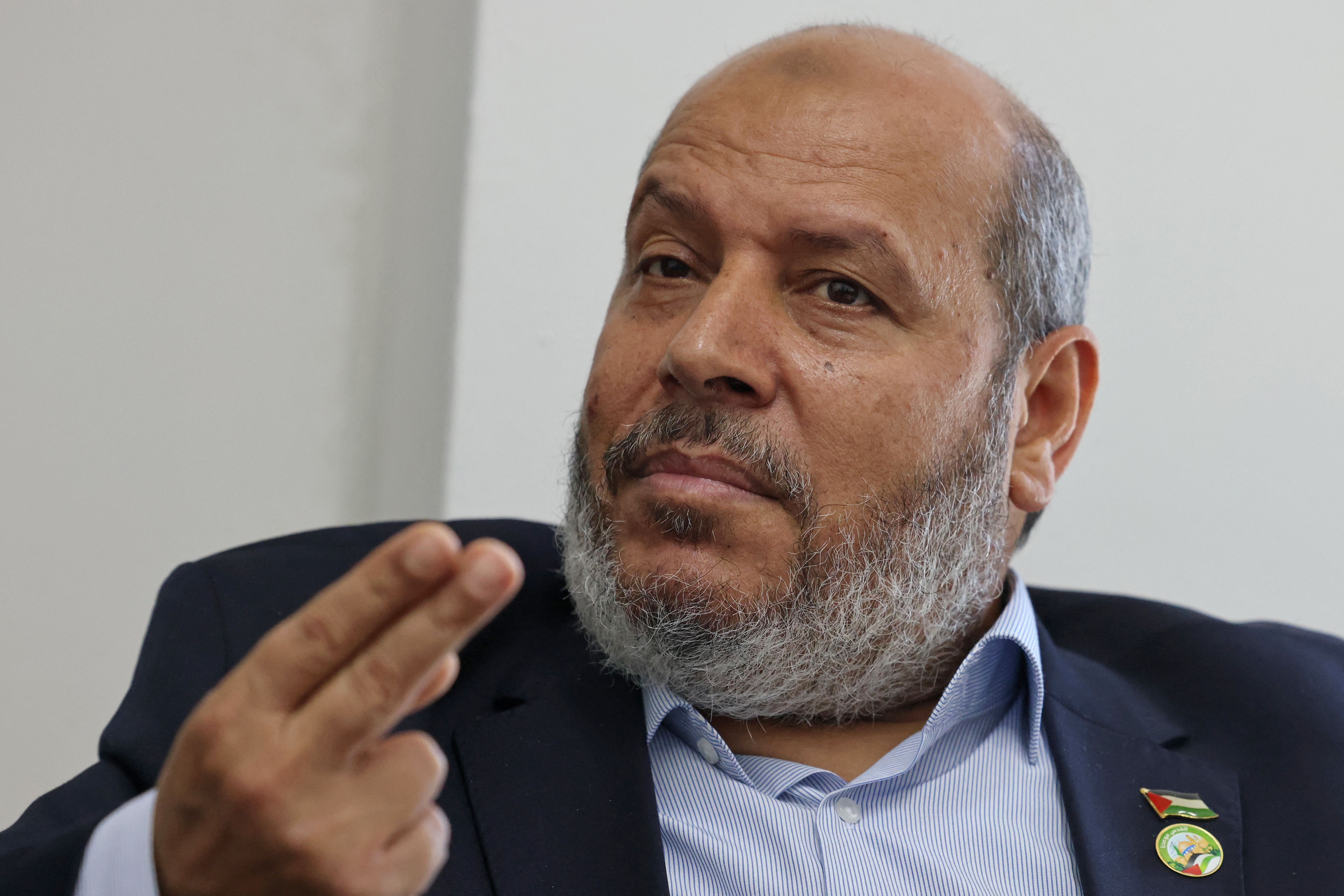
“Regarding the resistance factions, our jurisdiction is concerning matters of prisoner exchanges in return for halting the aggression, withdrawal, the entry of aid, and stopping the policy of displacement against our people,” said Mohammed Al-Hindi, the chief political negotiator for Palestinian Islamic Jihad, in an interview with Drop Site. “As for the national issues, the resistance factions are not authorized to speak on them alone, as these concern all factions and forces of the Palestinian people everywhere.”

The challenge before the negotiators was how to craft a response to Trump that would assert the Palestinian right to self-determination while persuading the erratic U.S. president to force Israel to cease its genocidal war.

The dominant pattern in previous ceasefire talks had been that Hamas’s proposals to amend Israeli-U.S. terms sparked false allegations that Hamas had rejected a deal, paving the way for more genocidal attacks. The Palestinian negotiators knew that proposing amendments or giving the impression they were rejecting any of Trump’s terms risked a return to that familiar and murderous cycle. But this time, there was a new constellation of interests.

Threading the Needle

When Trump announced his plan on Monday, he hailed it as “potentially one of the great days ever in civilization,” and boasted that his proposal would bring “eternal peace in the Middle East.” He claimed, repeatedly, that virtually every Arab and Muslim nation had endorsed his plan. This was not technically true, as the drafts provided to those countries prior to the White House announcement were substantially edited by Israel before the public roll-out.

Yet officials from these Muslim nations—most notably those from regional ceasefire mediators Qatar and Egypt—spoke of this Trump-enabled deception in only the most diplomatic of terms, opting to play along with his mythology in an effort to secure a deal. They all praised Trump for his initiative and emphasized that he was the key player to achieving peace.

Since Trump’s election, Hamas officials have said the only chance of halting Israel’s genocide resides with Trump. In the immediate aftermath of the release of the 20-point plan, Palestinian leaders from across the political landscape publicly denounced it as a surrender order and an attempt to use diplomacy to crush Palestinian resistance after Israel’s two year military assault had failed to achieve that goal.

A senior Hamas official told Drop Site that the group’s leadership understood that “this proposal was not put forward to find an end to the war. It is either total surrender or continue the war. Take it or leave it.” They viewed it as “catastrophic in the short and long term, for the resistance and for the whole Palestinian cause.” But on a strategic level, Hamas officials and other Palestinian leaders knew that formally rejecting Trump’s offer would be disastrous. The public narrative would almost certainly portray Hamas as rejecting peace even after a broad coalition of Muslim and Arab countries had endorsed it.

Over the course of the week, Hamas’s negotiators circulated proposed language among Palestinian factions and delivered it to the commanders from the Qassam Brigades and Hamas’s political leadership inside Gaza, according to two sources involved with the process. They also held lengthy meetings with officials from Egypt, Qatar, and Turkey.

Privately, some of these officials confirmed they had expressed support for a different version than the one Trump made public on Monday—and told Hamas negotiators they were appealing to Trump to roll back or discard some of the Israeli amendments. Trump allowed Netanyahu and his top adviser Ron Dermer to make significant changes to the terms, in some cases removing or substantively altering items that Trump’s Arab and Muslim “partners” had understood would be in the plan. While mediators from those nations pressed Hamas to accept the deal and cautioned against proposing any amendments or rejecting any specific terms, sources within the Palestinian negotiating team told Drop Site that, in the end, the mediators told Hamas negotiators it was ultimately a Palestinian decision.

Subscribe now

By the time Trump announced Friday that he was giving Hamas until 6 p.m. Sunday to deliver its response, the Palestinian negotiators had already finalized their answer. Soon after Trump posted his deadline, the text was in the hands of Qatari and Egyptian mediators who swiftly delivered it to the White House.

It was a strategic gamble; at its core, Hamas’s response was not an unequivocal acceptance of Trump’s demands, but the text was also void of any language that explicitly rejected any of his terms. It was aimed at threading a needle by crediting Trump, linking him more closely to a diplomatic alliance with Arab and other Muslim nations, and sending a message that Hamas was embracing the essence of Trump’s plan. But it also needed to preserve Palestinian rights and, most significantly, defer any answer on most of the terms laid out in the proposal. The key goal was to achieve an immediate Gaza ceasefire and to win Trump’s buy-in to restrain Netanyahu’s bloodlust and to start real negotiations.

Hamas officials knew that what Trump most wanted to hear was an unambiguous commitment to release all remaining Israeli captives and that Hamas would step down from power in Gaza. In principle, this was not difficult. Hamas had repeatedly offered to enter into an “all for all” deal throughout the genocide and to free all Israeli captives. It also repeatedly said it would relinquish governance of Gaza to an independent technocratic committee composed of Palestinians. Even though these overtures had been systematically rejected or ignored by the U.S. and Israel for months, Hamas negotiators leaned into the idea of centering them. The hope was that Trump would celebrate these commitments from Hamas as his personal victory and the product of his demands.

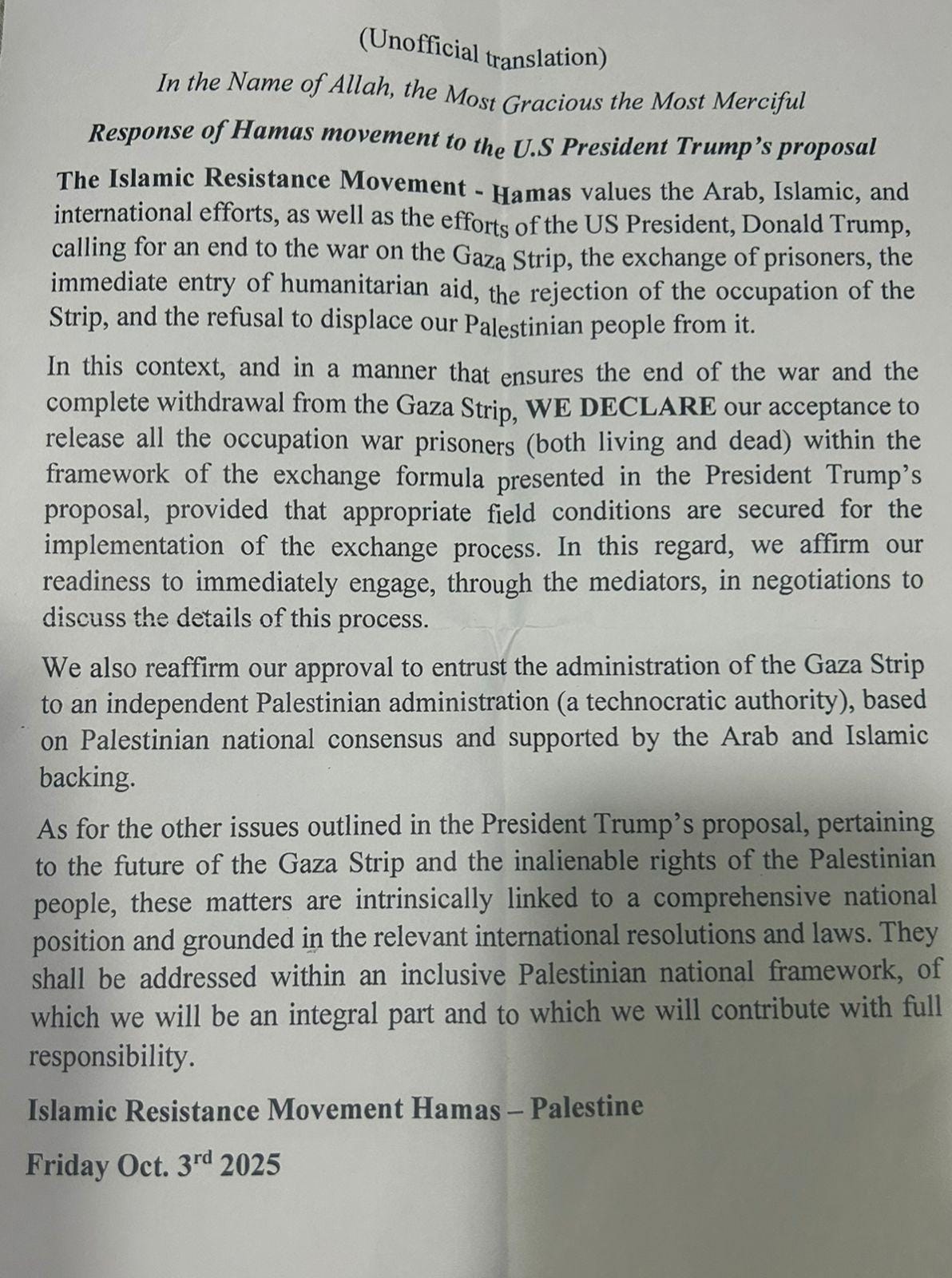
A translated copy of Hamas’s response to Trump’s proposal on October 3, 2025. Obtained by Drop Site.

“The Islamic Resistance Movement, Hamas, appreciates the Arab, Islamic, and international efforts, as well as the efforts of U.S. President Donald Trump, aimed at halting the war on the Gaza Strip, achieving a prisoner exchange, allowing immediate entry of humanitarian aid, rejecting the occupation of the Strip, and opposing the displacement of our Palestinian people from it,” Hamas’s official statement in Arabic read. “In this context, and in a manner that achieves an end to the war and the full withdrawal from the Gaza Strip, the movement announces its approval to release all prisoners of the occupation—both living and the bodies of the deceased—according to the exchange formula included in President Trump’s proposal, and with the provision of appropriate field conditions for carrying out the exchange process.”

The statement added that Hamas would “hand over the administration of the Gaza Strip to a Palestinian body composed of independents (technocrats), based on Palestinian national consensus and supported by Arab and Islamic backing.”

Less than an hour after Hamas announced it had delivered its response to Trump, the U.S. president surprised Palestinian negotiators with his first public comment, which came in the form of a post on Truth Social. “Based on the Statement just issued by Hamas, I believe they are ready for a lasting PEACE. Israel must immediately stop the bombing of Gaza, so that we can get the Hostages out safely and quickly! Right now, it’s far too dangerous to do that. We are already in discussions on details to be worked out. This is not about Gaza alone, this is about long sought PEACE in the Middle East,” Trump wrote.

The White House subsequently posted, in full and without comment, its own translation of Hamas’s response, including its characterization of Israel’s war as a “genocide.” The post was deleted soon after.

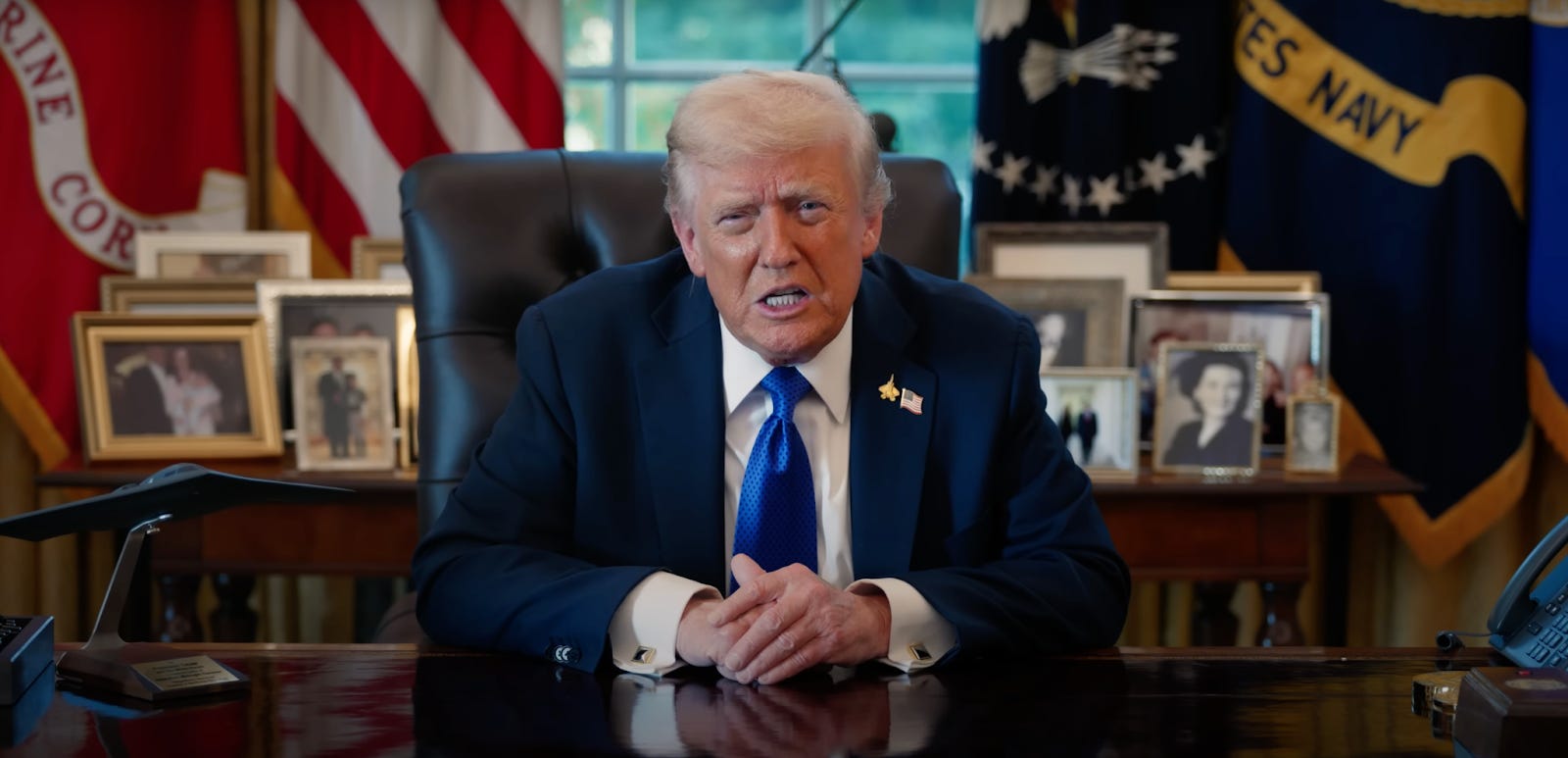
President Donald Trump spoke from the Oval Office in a video address following Hamas’s response to his 20-point Gaza plan.

The Trump Factor

There is little question that Hamas achieved the appearance of a diplomatic victory with its response to Trump. Israel’s initial response to Trump’s embrace of Hamas’s statement was muted. “We will continue to work in full cooperation with the President and his team to end the war in accordance with the principles set by Israel that align with President Trump’s vision,” read a statement from Netanyahu’s office. But, a senior Israeli political source told Israel’s Channel 12, Netanyahu spoke with Trump before the president released his statement welcoming Hamas’s response. “Everything is planned, there are no surprises here,” the source said. “Nothing came as a surprise.”

According to Axios, that Israeli spin is not accurate. Trump told the publication that when he spoke to Netanyahu, he said, “Bibi, this is your chance for victory.” A U.S. official with knowledge of the call said Netanyahu “told Trump this is nothing to celebrate, and that it doesn’t mean anything.” And Trump shot back, “I don’t know why you’re always so fucking negative. This is a win. Take it.” In the end, Trump told Axios, “He was fine with it. He’s got to be fine with it. He has no choice. With me, you got to be fine.”

Over the past seven months—even when there seems to be daylight between Trump’s and Netanyahu’s agendas, or stories are planted in the media about alleged disputes—the U.S. and Israel quickly return to a unified stance.

Hamas is now entering a minefield as technical negotiations begin in Cairo involving Israel, the U.S., Egypt, and Qatar. An Israeli delegation will be headed by Netanyahu attaché Dermer. Trump dispatched his son-in-law Jared Kushner and Special Envoy Steve Witkoff and warned Hamas to “move quickly, or else all bets will be off. I will not tolerate delay, which many think will happen, or any outcome where Gaza poses a threat again,” Trump wrote on Truth Social on Saturday. “Let’s get this done, FAST. Everyone will be treated fairly!”

A Hamas delegation, headed by its political leader Khalil Al-Hayya, will be in Cairo but the negotiations are slated to remain indirect, taking place through mediators. A statement from the Egyptian foreign ministry said the talks would be focused on “details of the exchange of all Israeli detainees and Palestinian prisoners, in accordance with US President Donald Trump’s proposal.”

While Hamas affirmed its commitment to release all Israeli captives, it did not do so unconditionally. The Palestinian side has always maintained that these releases must be tied to a clearly defined and guaranteed roadmap to the end of the genocide, the withdrawal of Israeli forces from Gaza, and the resumption of deliveries of food, medicine and other life essentials. While all of these are mentioned in Trump’s plan, the conditions are far from what the Palestinians had previously said they would accept.

If the U.S. allows substantive negotiations, there will be intense battles over the precise terms, redeployment and withdrawal maps, and the mechanism by which Israel will be prevented from resuming the war.

On August 18, Hamas formally agreed to an Egyptian and Qatari draft of a ceasefire framework, primarily written by Witkoff and Dermer. It involved meticulously negotiated terms for Israeli withdrawal, redeployment maps and conditions on aid. In its acceptance of the framework, Hamas offered substantial concessions. “Almost 98 percent of what has been agreed to by the Israelis was contained in this recent proposal,” Qatar’s foreign ministry spokesman said at the time.

Israel never formally responded, the U.S. ignored Hamas’s acceptance and then, on September 9, Israel tried—and failed—to assassinate Hamas’s negotiating team, including Al-Hayya, in a series of air strikes in Qatar. While some vestiges of that previous framework found their way into Trump’s new plan, many of the hard-negotiated specifics are gone, while provocative new terms Hamas long opposed were inserted.

Trump’s plan states that Israeli withdrawal will be “linked to demilitarization… with the objective of a secure Gaza that no longer poses a threat to Israel.” Hamas continues to maintain that demilitarization is a red line whose crossing would constitute a surrender of Palestinian rights to armed resistance against Israeli occupation.

“When a Palestinian state is established, it is only natural that the weapons of the resistance become the weapons of the state—a state that must be capable of protecting its people, its land, and its rights,” said Osama Hamdan, a senior Hamas leader, in an interview with Al Araby TV on Friday night explaining the movement’s response. “These are matters that must be addressed within a comprehensive national framework.”

Al-Hindi, the Palestinian Islamic Jihad official, concurred, saying that disarmament should not be linked to ending the genocide in Gaza, but requires the input of all Palestinian factions and voices. “We are still in a stage of national liberation and have not yet achieved our rights or the right to self-determination,” he told Drop Site.

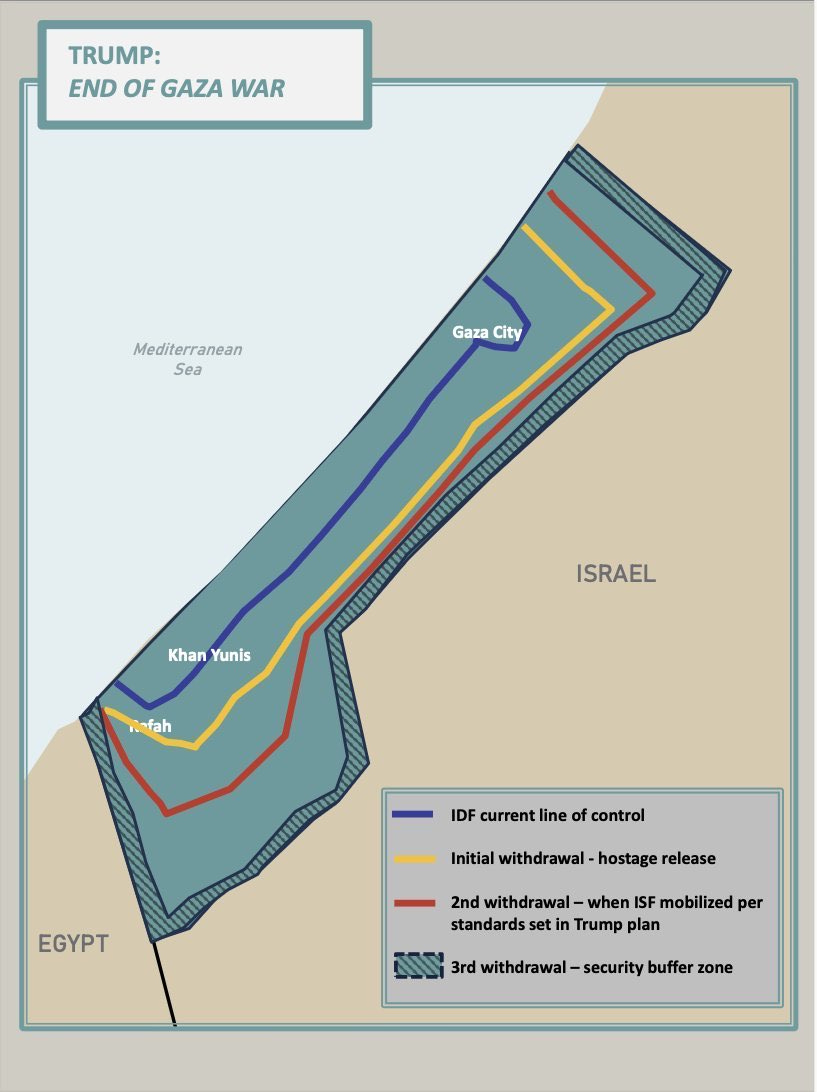
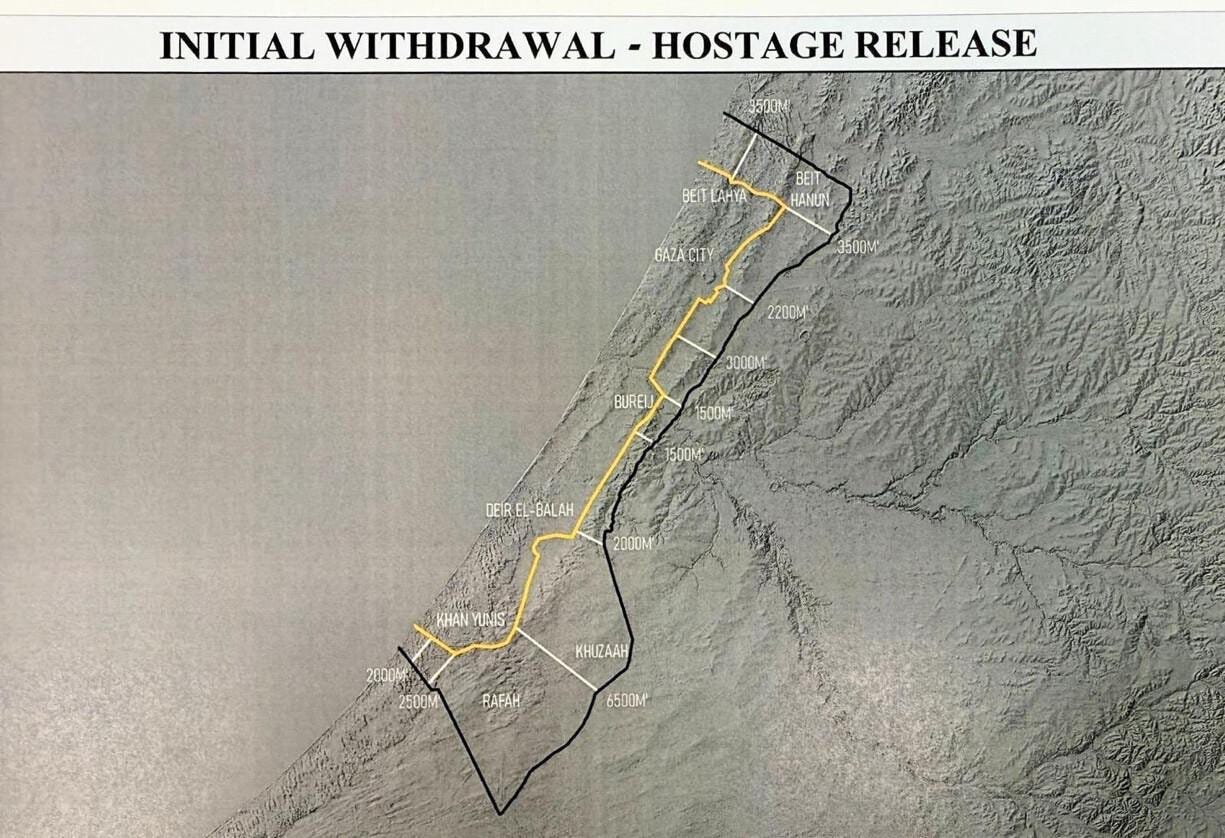
The Israel-drawn map that was distributed on Monday shows Israeli forces remaining deeply entrenched in Gaza, including the Philadelphi corridor along the southern border with Egypt indefinitely. An Israeli-imposed “security buffer zone” would “remain until Gaza is properly secure from any resurgent terror threat.” The plan offers no details on how a determination to dismantle the zone would be made.

The original withdrawal map according to President Trump’s 20-point Gaza plan.

On Saturday, Trump posted a new map on Truth Social, saying, “After negotiations, Israel has agreed to the initial withdrawal line, which we have shown to, and shared with, Hamas. When Hamas confirms, the Ceasefire will be IMMEDIATELY effective, the Hostages and Prisoner Exchange will begin.” The “negotiations” Trump referred to did not include any Palestinians. According to the map, Israel would remain even deeper inside Gaza territory than indicated in the map distributed on Monday with Trump’s 20-point plan.

The “hostage release” withdrawal map as published by President Trump on Truth Social on Saturday.

Hanging over all of this is the fact that the most significant, if not only, leverage that the Palestinian resistance holds is the Israeli captives that remain in its custody—20 living and 28 deceased. Trump’s plan requires they be released within 72 hours of the deal being accepted.

Hamas officials have warned that it may take time—perhaps as long as weeks—to locate the bodies of all of the deceased Israeli captives. They said some of them are buried under the rubble of buildings Israel has bombed or demolished, while others may be located inside territory currently occupied by Israeli forces.

The plan also states that Israel will release 250 Palestinians sentenced to life and 1,700 Palestinians from Gaza taken captive after October 7, 2023, including all women and children. The bodies of 15 Palestinians, according to the plan, would be returned for the remains of each deceased Israeli held in Gaza. The Palestinian captives, according to the plan, would be freed only after the Israelis are released.

The initial U.S. and Israeli moves following Hamas’s response to Trump’s plan have been aimed at sending a message that there won’t be real negotiations over the terms of an exchange of captives, but rather a set of directives given to the Palestinian side. The U.S. and Israel are taking the position that the only details to work out have to do with finding locations of Israeli bodies, assembling the list of Palestinian captives to be freed, and showing Hamas Israeli-approved troop redeployment maps. While Trump indicated the initial Israeli troop pull back will pave the way for “the next phase of withdrawal,” the Palestinian resistance will have handed over all the captives, effectively giving up its only leverage.

“We have negotiations that are more or less dictation. This is a coordination, or collaboration, between Trump and Netanyahu, or Netanyahu and Witkoff and Kushner, or probably more a dictation from Netanyahu to Kushner and Witkoff. And then what they say, this is the plan,” Sami Al-Arian, a prominent Palestinian academic and activist, told Drop Site. “The Americans, or Trump in particular, goes and puts forward an ultimatum, hoping that this is going to be adopted or followed by Hamas. Hamas has already said on the record that within the framework of Trump’s plan, they are willing to negotiate certain items and again underline the word negotiate, not to be dictated on.”

Throughout the ceasefire negotiations the past year, Hamas negotiators have demanded guarantees that after the Israeli captives captives are released, it would not immediately resume the genocide. Trump’s plan offers no such commitments and envisions a system of Israeli withdrawal from areas of Gaza only if an international force takes its place.

Even if the Palestinian side is able to secure formal pledges from the U.S. during the talks in Cairo that it will prohibit Israel from resuming the war, history is rife with examples of the U.S. supporting Israel in blowing up agreements. This is another major factor in why Hamas and Islamic Jihad have drawn a red line around the issue of disarmament.

“After two years of crimes, ethnic cleansing, and a policy of starvation, [Israel] has not achieved its objectives through bombing and aggression. Israel has also suffered damage on all internal and external levels and has nothing left to justify the continuation of aggression before the world,” said Al-Hindi. If Israel resumes the military assault on Gaza, “the Palestinian people will not be without means to resist the aggression.”

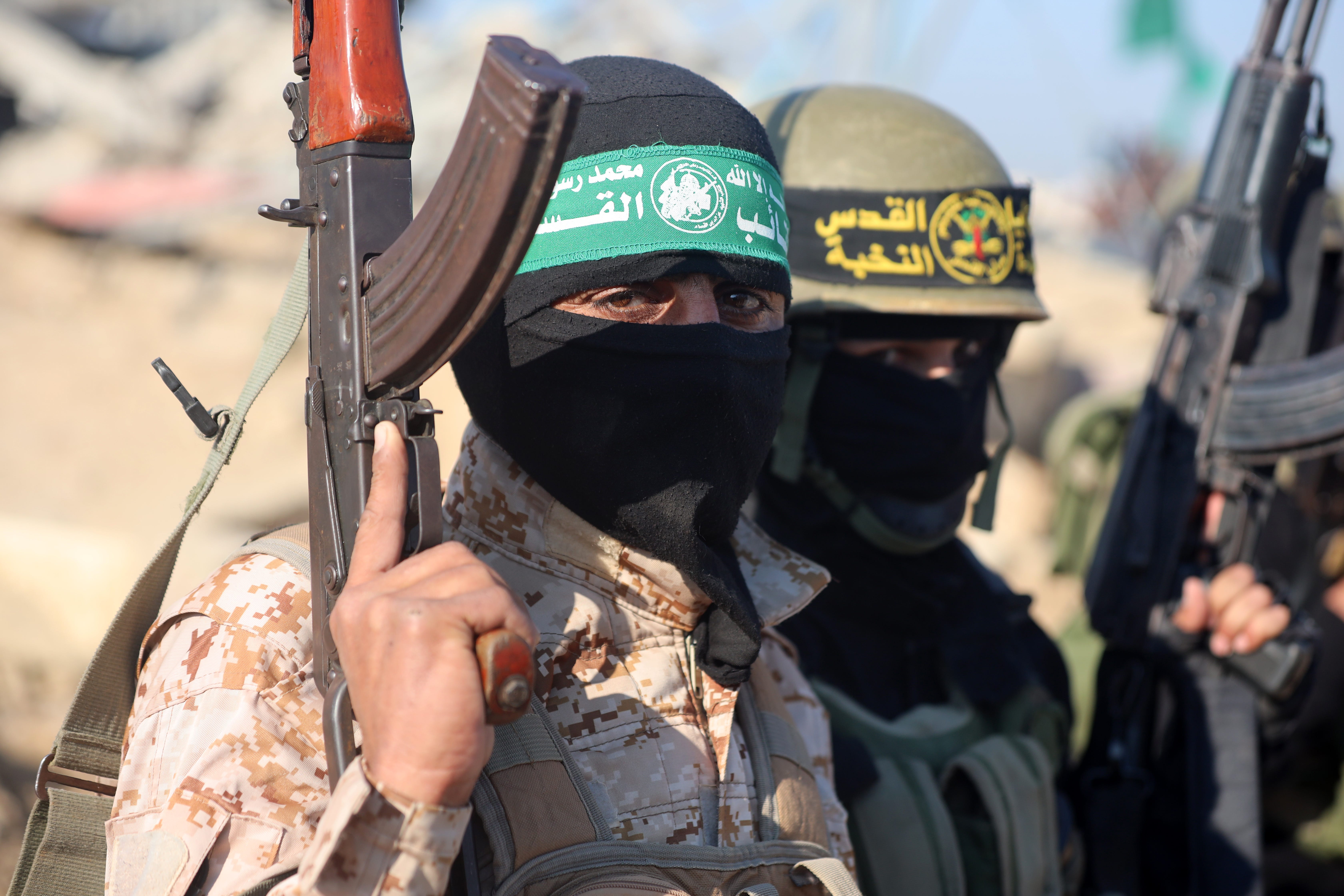
Palestinian Hamas and Islamic Jihad fighters prepare to hand over Israeli and Thai captives to a Red Cross team in Khan Younis, on January 30, 2025. Photo by Majdi Fathi/NurPhoto via Getty Images.

It All Boils Down to What Trump Will Accept

While Trump is heralding the dawn of a new era, one ripe for investment and profit, Israel will undoubtedly seek to use the technical negotiations over the terms of withdrawal and exchange of captives to its advantage. The Palestinian side is entering this stage of talks with the aim of linking withdrawal to the handing over of the captives. Israel wants any talk of withdrawal to be tied to Hamas’s surrender and total disarmament. “Israel will be responsible and involved in the demilitarization of weapons in the Strip,” Netanyahu said.

In a video address on Saturday, Netanyahu claimed Israel was “on the brink of a very big achievement,” saying that he hopes to soon secure “the return of all the hostages—the living and the slain, in one go, with the IDF still deployed deep in Gaza.” Israeli public broadcaster Kan reported that Israel intends to keep its troops in three primary areas of Gaza indefinitely: the “buffer zone” encircling Gaza, the Philadelphi corridor along the Egyptian border, and in strategic locations in northeastern Gaza.

Netanyahu also said that he sees the release of captives as separate from any Palestinian demands. “In the second stage, Hamas will be disarmed and Gaza will be demilitarized,” he declared. “It will happen either diplomatically, according to the Trump plan, or militarily, by us.”

The decisive factor will be whether the U.S. is willing to force Israel’s hand or if Trump will endorse Israeli claims that Hamas is reneging on the deal when its negotiators offer their position on the specific terms for the release of captives.

All this leaves a wide latitude for a breakdown in talks that Israel could exploit to blow up the deal, resume the assault on Gaza, and blame Hamas. That would come at the price of the Israeli captives remaining in Gaza indefinitely as the war continues, but Netanyahu has shown a willingness to keep their lives at risk in pursuit of his agenda. “If the hostages are not released by the deadline that President Donald Trump set, Israel will return to fighting with the full support of all the involved countries,” Netanyahu said Sunday.

At the same time, Trump’s plan does contain some nuance on the issue of disarmament, indicating the White House understands the Palestinian side is not going to accept a surrender order and will not lay down its weapons on demand. While the proposal states that, “All military, terror, and offensive infrastructure, including tunnels and weapon production facilities, will be destroyed and not rebuilt,” it adds: “There will be a process of demilitarization of Gaza under the supervision of independent monitors, which will include placing weapons permanently beyond use through an agreed process of decommissioning, and supported by an internationally funded buy back and reintegration program all verified by the independent monitor.”

The issue of disarmament is largely a red herring. The Palestinian resistance relies overwhelmingly on homemade weapons and ammunition, including repurposed Israeli ordnance used in Gaza. Much of its rocket infrastructure has been depleted or destroyed over the past two years. The October 7 operation was not successful because of advanced weaponry—it was conducted mostly with small arms. Netanyahu and other Israeli officials focus on the weapons issue as a proxy for their demand that Palestinians surrender to Israeli subjugation.

“That is not going to go anywhere because the resistance will be totally against any kind of disarmament in principle. So they’re not going to get into negotiations. And that could also be a breaking point between the parties,” said Al-Arian. “If Trump insists on this point—he should know by now that this is not subject to negotiations.”

Trump has spoken in vainglorious terms about the epic scope of what his plan will achieve and repeats the mantra that it extends beyond Gaza. He continues to emphasize the “magnificent” value of Gaza’s beachfront as a site for future private development. Hamas and other Palestinian factions are clear that they will not enter into any rushed agreements that carry far reaching implications for the future of Palestinian self-determination and statehood—seeking to strike a diplomatic tone and project an image of flexibility and reason by contrast.

“As long as the issue revolves around a willingness to release prisoners on both sides, cease the aggression, and withdraw, then what remains is simply to agree on the arrangements,” said Hamdan in the Al Araby interview. “We do not need lengthy negotiations. If the relevant parties are serious, and if the positive stance of Hamas is met with the same level of positivity, then a ceasefire could be announced,” he added. “The plan can’t have any real value without guarantees. This is a fundamental matter, and this is what the U.S. administration must work on and communicate to the mediators. Such guarantees are essential to achieving an agreement and building Palestinian trust that there is a real opportunity to reach a deal.”

It is also possible that Trump’s quick, affirmative response to Hamas on Friday was part of an elaborate set-up aimed at recovering the Israeli captives and then empowering Israel to continue the genocide.

“I’m afraid they are preparing a trap,” a Palestinian source close to the negotiators told Drop Site. Those fears are well founded. Earlier this year, Trump promised Israel would end the blockade and call for a permanent ceasefire if Hamas turned over U.S.-Israeli soldier Edan Alexander, but then reneged as soon as Alexander was in U.S. custody.

While that scenario is not out of the question, it would cause an earthquake in Trump’s relationship with Arab states with whom his family—most prominently his son-in-law, Jared Kushner—has extensive business ties. It would also derail Trump’s drive to privatize Gaza and strike massive financial deals.

Trump also indicated that he sees this moment as an opportunity to essentially rescue Israel in the face of its growing pariah status globally. “Bibi took it very far and Israel lost a lot of support in the world. Now I am gonna get all that support back,” Trump told Axios on Saturday.

In a statement Sunday, the foreign ministers of Qatar, Egypt, Turkey, Jordan, Saudi Arabia, the United Arab Emirates, Indonesia and Pakistan issued a joint statement that “reiterated their joint commitment to support efforts towards the implementation” of Trump’s proposal, but they also called for a range of terms that Netanyahu has already rejected, including “unifying Gaza and the West Bank.”

Al-Arian, director of the Center for Islam and Global Affairs at Istanbul Zaim University, said that the Palestinian negotiators are entering these talks over Trump’s plan fully aware that Israel’s aim is to eliminate all Palestinian resistance and to ensure that its broader agenda of ethnic cleansing remains intact. Whether or not a deal is reached, he told Drop Site, Palestinians will not surrender.

“If Israel was capable of finishing off the resistance, Hamas and Islamic Jihad and others, in the last two years, they would have done that. There is nothing that they spared short of a nuclear bomb. They tried everything in the book, including the policy of starvation, targeting the civilians to put pressure on the resistance more than the resistance itself,” Al-Arian said. “But I think the whole world now is fed up and they want to end this. And I think Trump is trying to get credit—and certainly he would get credit if this happens—and then he can go and boast that he wants or has won the Nobel Peace Prize. The real question right now is what details he would accept.”

Drop Site News Middle East Research Fellow Jawa Ahmad contributed to this report.

Leave a comment

Share


From Drop Site News via this RSS feed

6


The Michigan Senate race is a three-way contest between Rep. Haley Stevens, whose last campaign was boosted by millions of dollars from AIPAC; Abdul El-Sayed, a leading advocate of the “Uncommitted Movement” who’s known as Michigan’s Mamdani; and a third candidate, state legislator Mallory McMorrow, who sits between the two. Today’s story is based on leaked audio from a recent McMorrow campaign call.

As always, we’re grateful for reader support, which makes our journalism possible. If you can, make a tax-deductible donation today. If you are a free subscriber and you support our work, please consider upgrading to a paid subscription or gifting one to a friend or family member.

Subscribe now

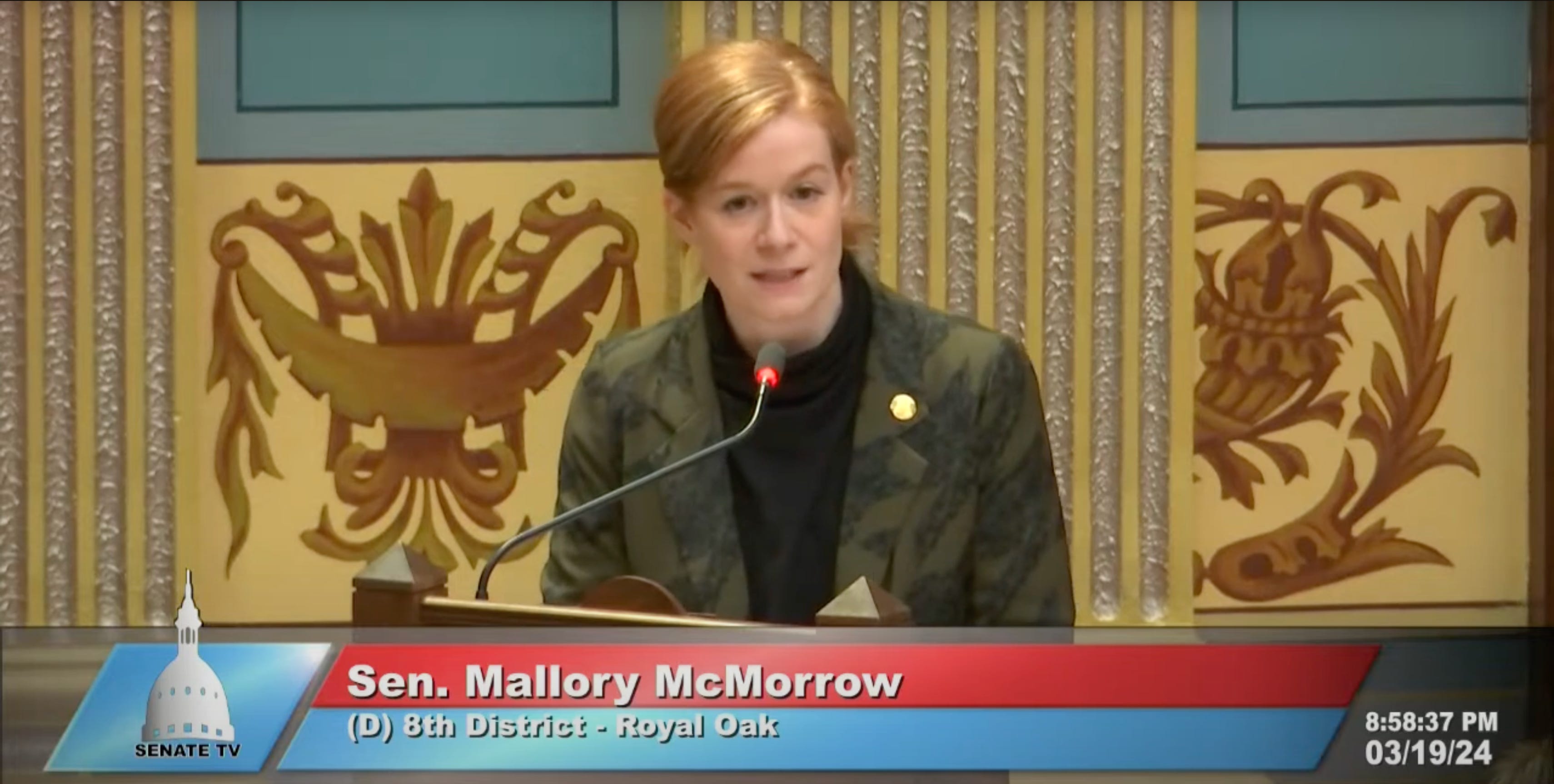
Mallory McMorrow speaks on the floor of the Michigan Senate in March, 2024.

Mallory McMorrow, a leading Michigan Senate candidate, has privately produced an “AIPAC position paper” that is “outstanding,” but has not made it public, according to her supporter Rob Kalman, who spoke on a recent McMorrow donor call. The position paper he describes has not been made public.

Kalman is former mayor and council member in Keego Harbor, Michigan, and said on the call he has been in close touch with local and national AIPAC leadership. A recording of the August 20 call was obtained by Drop Site.

AIPAC, or the American Israel Public Affairs Committee, asks candidates to privately share position papers before winning an endorsement. According to candidates and campaign managers who’ve gone through the process, the group has a series of litmus tests that candidates must meet, including support for the Taylor Force Act, a willingness to say that “all options are on the table” when it comes to Iran (which is code for a nuclear strike), support for laws against boycotting Israel, and opposition to any conditions on aid to Israel, among others.

McMorrow is running against Rep. Haley Stevens, who was AIPAC’s vehicle in 2022 for one of their more controversial power plays, when they organized against incumbent Rep. Andy Levin, a former synagogue president and self-described Zionist. Levin’s sin, from AIPAC’s perspective, was his willingness to defend his Michigan colleague Rep. Rashida Tlaib and to level criticism at the Israeli government.

Also running is Dr. Abdul El-Sayed, a critic of Israel who is running as a Michigan Mamdani. Stevens is presumed to be the favorite to win AIPAC support, but McMorrow has argued publicly that the organization should stay out of the race. In a call with high-level donors, her campaign and some of its key supporters divulged further details when it comes to their AIPAC strategy.

On the call, McMorrow campaign manager Wellesley Daniels is speaking with Rob Kalman, the supporter and former mayor of Neego Harbor. The wife of donor Scott Loney, Sarah Loney Marks, asked the campaign if they would be willing to talk to AIPAC, telling her that AIPAC tends to come in late with a large infusion of cash.

Daniels, the campaign manager, responds vaguely, saying that the campaign is aware of the dynamic and has been in discussion with relevant organizations. Pushed again, Daniels tells her, “We have been talking to every organization that wants to talk about this issue, and that's sort of our policy. So we've had conversations with them.”

It seems as if Daniels would have preferred to leave it there, but former Mayor Kalman then chimed in. “I can tell you that I've talked with them directly, because I know leadership locally and nationally. They know very clearly that I'm supporting Mallory and why I'm supporting her, and I have read her AIPAC position paper. It's outstanding. I don't know if it's public or not,” Kalman said.

A spokesperson for the McMorrow campaign, in a statement, said that no questionnaire has been filled out. “Rob Kalman is not a part of the Mallory campaign. Our campaign does not speak ‘through’ him,” the statement read. Kalman’s offer to take additional questions, however, gives the impression he was a lead part of the call, rather than a supporter asking the campaign manager questions. Indeed, he answered questions on the call rather than asked them.

“Mallory has not received nor filled out a questionnaire from AIPAC. Mallory has expressed her position on the war in Gaza publicly and to many groups representing Jewish and Muslim Michiganders, which is already publicly reported and on her website. She also answered two questions on the issue of weapons and meeting with Benjamin Netanyahu on MSNBC earlier this evening.” Asked in a follow-up if the campaign had produced a position paper, the campaign didn’t respond.

The news outlet Jewish Insider reported that McMorrow, according to a source familiar, had produced a position paper for “at least one Democratic pro-Israel group.” That is likely a reference to an AIPAC offshoot known as DMFI, or Democratic Majority for Israel.

Kalman, on the call, went on to argue that Mallory is well-positioned in the three-way race because El-Sayed will be aiming his criticism most loudly at AIPAC’s top candidate. El-Sayed, a former Michigan public health official, was an outspoken leader of Mighigan’s “uncommitted” movement. “Mallory will benefit, I believe, because Abdul's gonna hit Haley really hard over it, and so there might be that spend [by AIPAC], but Abdul's gonna provide some cover on that,” he said.

Kalman acknowledged that he has his own concerns with McMorrow’s record when it comes to Israel, citing her recent comments in a D.C. politics newsletter, which said McMorrow questioned a “reflexively pro-Israel stance.”

“I'll tell you that I was concerned with the Bernie vote and some of the public comments that were made – especially like a Punch Bowl article this morning – but Mallory gets it. She understands it. And this is somebody who supports Israel and understands reality on the ground in Gaza. I'm very comfortable with where she's at,” he said. In Punch Bowl, she had said she was urging AIPAC not to weigh in to the campaign, warning that voters are frustrated at the influence of outside money. (It’s unclear what he means about “the Bernie vote.” Sanders has endorsed El-Sayed in the race and Mallory endorsed Elizabeth Warren for president back in 2020.)

“And I think a lot of young people and some, quite frankly, some of the older people within the Jewish community will still vote for Haley, because that's what they've been doing in Oakland County,” he said. “I've told people it's gonna be split. I don't believe it's a monolith, but I think you're going to see a very large part of the Jewish community still support Mallory. It's not just the Andy Levin voters. There's plenty of people that really, really appreciate Mallory's approach. I'll leave it at that. And then a couple other questions, if anybody else has anything else.”

Kalman and a spokesperson for AIPAC did not respond to a request for comment.

Drop Site is reader-supported. Become a free or paid subscriber today:

Correction: Kalman is currently a council member in Keego Harbor, Michigan.


From Drop Site News via this RSS feed

7


Since dawn, Israeli forces have killed at least 17 people in Gaza, with the Ministry of Health reporting five more deaths from starvation. Israel announces plans to forcibly displace hundreds of thousands of Palestinians in Gaza southwards as part of its Gaza City invasion. Half a million Israelis protest for an end to the war in Tel Aviv. Far-right activist Laura Loomer prompts Trump administration to stop Palestinian children from receiving medical care in the United States. Las Vegas police release a senior Israeli official accused of attempting sexual contact with a child. Yemen and Israel exchange fire. Bolivia’s right wing wins in the first round of its presidential elections. U.S. President Donald Trump meets with Russia’s Vladimir Putin on Friday with no concrete resolution to the Russia-Ukraine war, set to meet with Ukraine’s Volodymyr Zelenskyy today.

This is Drop Site Daily, our new, free daily news recap. We’ll be sending it Monday through Friday. If you want to continue getting this newsletter, you don’t have to do anything. But if this is too much—we do try to be mindful of your inbox—you can unsubscribe from this newsletter while continuing to get the rest of our reporting. Just go into your account here at this link, scroll down, and toggle the button next to “Drop Site Daily” to the off setting. It looks like this:

Subscribe now

The Genocide in Gaza

Israeli forces killed at least 17 people across Gaza since dawn, eight of whom were seeking aid, according to Al Jazeera. The Ministry of Health recorded 60 people killed over the past 24 hours, including 27 while seeking aid. Five more people died due to starvation, including two children. In total, Israel has killed 62,004 people and injured 156,230 since October 7, 2023, according to the Ministry of Health.

Israel announced plans to forcibly displace hundreds of thousands of Palestinians toward southern Gaza as part of its operation to seize Gaza City. The army has already targeted the city’s Al-Zaytoun neighborhood with fighter jets, artillery, and explosive robots, systematically destroying hundreds of homes. Journalist Abdel Qader (@AbdSabbah91) is reporting the latest developments from the ground.

Israel said it will allow some tents and shelter supplies into Gaza via the Karam Abu Salem (Kerem Shalom) crossing starting Sunday, UN and aid groups confirmed. No shelter materials have been allowed to enter since March 2, despite dire need. Drop Site’s Murtaza Hussain and Meghnad Bose visualized the drop in food aid based on Israel’s internal COGAT data:

Some 500,000 Israelis rallied in Tel Aviv’s Hostages Square on Sunday, calling for an end to its war on Gaza and a sweeping captive-exchange deal. Demonstrations and strike actions also erupted in Jerusalem, Haifa, Beersheba, and more than 300 other locations nationwide in one of the largest protests in Israel since the beginning of the war. Prime Minister Benjamin Netanyahu has resisted the pressure, insisting there will be no ceasefire unless Hamas is “defeated.”

Newly circulating footage shows an Israeli airstrike killing a young girl carrying a water container. The child has been identified by Mosab Abu Toha as Amna al-Mufti, who was killed in December 2024 in Jabalia.

A severely malnourished Palestinian woman, Marah Abu Zuhri, who had been evacuated from Gaza to Italy for urgent treatment, died Friday at Pisa University Hospital. She arrived in a “profound state of organic wasting” and suffered a sudden respiratory crisis and cardiac arrest after initial treatment. She was 20 years old. In a new report, Amnesty International accuses Israel of “carrying out a deliberate campaign of starvation in the occupied Gaza Strip, systematically destroying the health, well-being and social fabric of Palestinian life.”

An Israeli strike hit Al-Ahli Arab Hospital’s courtyard yesterday, killing seven. Also known as Baptist Hospital, Al-Ahli Arab Hospital is in Gaza City’s Al-Zaytoun neighborhood, which has faced heavy Israeli bombardment over the past week. Dr. Hussam Hammouda, who has been working there after being displaced from northern Gaza, said the shelling has been constant: “We are living on the edge of death. Please pray for us.”

The Higher Presidential Committee for Church Affairs in Palestine has condemned Israel for what it calls a “systematic policy” to eliminate Christian presence and undermine historic religious institutions across historic Palestine. The Committee highlighted Israel’s August 6, 2025, decision to freeze the Greek Orthodox Patriarchate’s bank accounts in Jerusalem and impose new taxes on its properties, while blocking salaries for clergy, teachers, and staff. Head of the Committee Ramzi Khouri warned that these measures, along with settlement expansion near the Monastery of Saint Gerasimus, threaten the Church’s ability to provide services and constitute a violation of international law.

Former Israeli Military Intelligence chief Major General Aharon Haliva, who served until August 2024, stated in a recent clip: “As I said before the war.…For each one [killed on October 7th], 50 Palestinians should die.” He added, “It doesn't matter whether [they are] children.…They need to [experience] a Nakba every now and then to feel the price.”

Israel announced it would revoke diplomatic status for Australian representatives to the Palestinian Authority after Australia agreed to formally recognize a Palestinian state.

From UN Special Rapporteur Francesca Albanese: “For those who [say] ‘It can't be genocide as the Palestinian population is growing.' Gaza has had the largest drop in life expectancy of any place on earth in modern history.” The life expectancy in Gaza dropped over 30 years in the first 12 months of the war, according to a study in the Lancet earlier this year.

Gaza City, Gaza on August 14, 2025. Photo by Mahmoud Issa/Anadolu via Getty Images.

Laura Loomer and the War on Palestinian Children

The U.S. State Department suspended all visitor visas for individuals from Gaza after far-right influencer Laura Loomer said she “obtained video footage” of a few severely injured Palestinian children arriving in the U.S. for life-saving medical care. The department said no more children will be allowed entry “while it conducts a full and thorough review” of the temporary medical-humanitarian visa process.

Loomer had specifically criticized HEAL Palestine, a U.S. nonprofit that arranges critical treatment for children from Gaza who cannot be treated locally. “Why should Palestinians be treated in American hospitals for free while US Veterans are homeless on the street unable to get healthcare?” Loomer posted. “This is why everyone hates them.” The number of Palestinians from Gaza who are granted entry to the U.S. is very small: there were just 31 in the first year of the war, according to the State Department, under the Biden administration. Ryan Grim on this.

Key medical evacuation figures from Gaza (October 2023–July 2025):

Total patients evacuated: 7,507, including 5,201 children.

Top referral destinations (UN/WHO data, July 2025):

Egypt: 3,995 patients

UAE: 1,387 patients

Qatar: 970 patients

Turkey: 437 patients

EU countries: 244 patients

Current need: More than 14,800 patients on Gaza Ministry of Health list awaiting evacuation.

U.S. (approximate totals, outside UN data):

HEAL Palestine: 148 people, including 63 children

PCRF: Over 20 children

Secretary of State Marco Rubio defended the suspension of temporary humanitarian visas, citing alleged “evidence” that the organizations assisting the children have “strong links to terrorist groups like Hamas.”

HEAL Palestine responded, emphasizing that its program provides critically needed medical care unavailable in Gaza. The group clarified, “This is a medical treatment program, not a refugee resettlement program,” and highlighted that the care is not funded by U.S. taxpayer dollars.

Diplomatic Negotiations

Israeli Prime Minister Benjamin Netanyahu has claimed he would reject any partial “ceasefire” deal with Hamas, demanding that all remaining Israeli captives be released at once and that Netanyahu’s sweeping conditions for ending Israel’s war against Gaza be fully met. His terms include Hamas’s disarmament, Gaza demilitarization, Israeli control of the entire perimeter of the enclave, and installation of a non-Hamas, non-Palestinian Authority governance. A senior Hamas official, Basem Naim, told Drop Site last week Hamas was open to either a phased or comprehensive deal.

Palestinian factions, meeting in Cairo, called for an immediate ceasefire, lifting of the siege, and unhindered humanitarian access. Egypt presented a revised version of Special Envoy Steve Witkoff's 60-day plan based on the existing 13-point framework. Hamas is expected to offer its response tonight. More than 3 weeks ago, Hamas presented a handful of amendments to the proposal and Israel never offered a formal reply, instead withdrawing its negotiating team. While Hamas has said it is open to any proposals to end the genocide, officials told Drop Site that Hamas will not capitulate to Netanyahu’s demands, which the group says would be tantamount to surrendering the Palestinian liberation struggle.

Palestinian Authority PM Mohammad Mustafa met with Egyptian PM Mostafa Madbouly to discuss halting Israel’s war, increasing delivery of food, medicine and other life essentials, and preparing an International Conference on Gaza Reconstruction in the event a ceasefire is achieved. Mustafa said the PA wants a 15-member “Community Support Committee” to administer Gaza temporarily after a ceasefire, alongside ongoing training of up to 5,000 Palestinian security personnel in Egypt. Hamas has said repeatedly it supports a 15 member technocratic committee comprised of Palestinians and that it will relinquish governing authority in Gaza upon signing a deal. Israel and the US have repeatedly removed Hamas’s offer to step down from the ceasefire framework and then subsequently accused Hamas of insisting on remaining in power.

U.S. News

Las Vegas police arrested Tom Artiom Alexandrovich, a 38-year-old senior official in Israel’s National Cyber Directorate, during a sting targeting online child predators. He faces felony charges of attempting to lure a child with a computer but was released and has returned to Israel. Israeli officials confirmed he has been placed on leave but downplayed the case: it carries “no political implications.”

The Trump administration is pushing the U.S. immigrant detention system to unprecedented levels, with plans to expand capacity from about 50,000 beds to more than 107,000 by January, according to internal ICE planning documents obtained by the Washington Post. The strategy includes opening or enlarging 125 facilities, relying heavily on private prison contractors, military bases, and makeshift “soft-sided” tent structures. “This is the Trump administration’s endgame,” said Sarah Pierce, a policy analyst at the Migration Policy Institute, warning that the scale of expansion could overwhelm oversight and protections for migrants.

Three Republican-led states—West Virginia, South Carolina, and Ohio—will send National Guard troops to Washington, D.C., adding to the 800 already deployed under President Trump’s “public safety emergency.”

International News

Trump greeted Putin in Alaska with full pomp: a red carpet, military flyover, and handshake beneath an “Alaska 2025” banner. Despite Putin being under U.S. sanctions and ICC indictment for war crimes, the two rode together in “The Beast” limo, chatting without an interpreter before their private talks. The display drew criticism for its highly ceremonial treatment of a sanctioned and wanted leader.

Following this, U.S. special envoy Steve Witkoff said on Sunday that Trump and Putin agreed to “robust security guarantees” for Ukraine during their summit in Alaska last week. He told Fox News Sunday that Washington is prepared to offer Article 5–style protections “directly from the United States and other European countries,” though Ukraine is not a NATO member. The proposal will be discussed further Monday at the White House, where Trump is set to host Zelenskyy and top European leaders.

University of Chicago professor John Mearsheimer told Ryan Grim on Breaking Points that Putin “did a brilliant job” at the summit, rejecting a ceasefire and demanding a “peace agreement” on Moscow’s terms. He warned Ukraine risks losing “half the country” if it continues fighting, calling a negotiated settlement the “least bad alternative” while accusing the West of draining arms stockpiles and ignoring China.

Hillary Clinton praised Trump’s foreign policy, especially on NATO.

Israel struck a power station near Sana’a in Yemen on Sunday in response to recent Houthi missile and drone attacks on Israel. No casualties were reported, though the bombing damaged the facility and the full extent of the destruction is still unclear.

Bolivia’s presidential race is headed to a historic runoff on October 19, ending two decades of left-wing dominance after centrist Rodrigo Paz Pereira unexpectedly led the first round with 32.8% of the vote. Paz Pereira will face right-wing ex-President Jorge “Tuto” Quiroga, who placed second with 26.4%, while the ruling MAS party collapsed to single digits amid economic turmoil and infighting.

A paramilitary force in Sudan’s Darfur region shelled the Abu Shouk displacement camp outside el-Fasher on Saturday, killing at least 31 people—including seven children and a pregnant woman—and wounding 13 others, according to the Sudan Doctors Network. This marks the second attack on the camp in under a week, as the UAE-backed Rapid Support Forces (RSF) attempt to seize el-Fasher, the military’s last stronghold in North Darfur. The ongoing conflict, which erupted in April 2023 between the RSF and Sudan’s military, has displaced roughly 14 million people, driven famine in parts of the country, and prompted ICC investigations into atrocities including mass killings and sexual violence.

Trump said Thursday he would do “everything I can” to help free Hong Kong media tycoon Jimmy Lai, detained under China’s national security law for more than 1,500 days. Beijing’s embassy in Washington blasted Lai as a key “destabilizing” figure and warned against foreign interference. Trump indicated he plans to raise Lai’s case in upcoming trade talks with China’s leader, Xi Jinping, adding new friction to fragile U.S.-China negotiations.

France’s foreign ministry said Saturday it is pressing for the “immediate release” of a French embassy worker in Bamako, after Mali’s junta accused him of collaborating with foreign intelligence to destabilize the country. Paris rejected the charges as “unjustified” and a violation of the Vienna Convention on consular relations. The arrest comes amid heightened tensions, as Mali’s ruling junta—increasingly aligned with Russia—claims to have foiled a coup plot involving dozens of soldiers and foreign backing.

As Israel expands its operations across the region, Israeli forces announced plans to recruit roughly 600-700 additional soldiers each year from Jewish communities abroad, particularly from the U.S. and France.

More from Drop Site

Palestinian solidarity activists are confronting Israeli tourists to the Greek islands this summer, with the Israeli cruise ship Crown Iris repeatedly facing protests over the ongoing Gaza genocide. The escalating clash of tourism and activism have blended dramatic street actions, port blockades, and viral confrontations. Read more on Drop Site from Alexis Daloumis.

Columbia Journalism Review spoke to Drop Site’s Sharif Abdel Kouddous about what journalists and media workers can do to defend press freedom in Gaza. “Mass resignations by journalists and media workers in protest of the killing of their colleagues and the relative silence of their newsrooms on the subject of Israel’s genocide would go a long way toward not only highlighting the devastation, but also bringing down a media system that can no longer be reformed, but that needs to be dismantled and replaced,” Abdel Kouddous said.

Leave a comment

Share


From Drop Site News via this RSS feed

8


We have a commitment to ensuring that our journalism is not locked behind a paywall. But the only way we can sustain this is through the voluntary support of our community of readers. If you are a free subscriber and you support our work, please consider upgrading to a paid subscription or gifting one to a friend or family member. You can also make a 501(c)(3) tax-deductible donation to support our work. If you do not have the means to support our work financially, you can do your part by sharing our work on social media and by forwarding this email to your network of contacts.

Subscribe now

The CyberArk Software Ltd. logo ion a smartphone with Palo Alto Networks in the background (Photo Illustration by Pavlo Gonchar/SOPA Images/LightRocket via Getty Images).

In late July, the U.S. cybersecurity giant Palo Alto Networks (PANW) announced that it had acquired the Israeli identity management and information security firm CyberArk, paying a staggering $25 billion dollars worth of cash and stock to purchase the firm. In addition to potentially injecting billions of dollars into the Israeli economy, Palo Alto Networks’ acquisition of CyberArk further strengthens the relationship between Silicon Valley and Israel’s security-intelligence apparatus.

Palo Alto is one of the world’s largest cybersecurity firms, and provides infrastructure protection, firewalls, and cloud security services to tens of thousands of companies internationally. Udi Mokady, CyberArk’s founder and executive chairman, is an alum of Unit 8200, the Israeli Military Intelligence Directorate’s elite signals intelligence division. So are the four co-founders of Wiz: the Israeli cloud computing firm recently bought by Google for $32 billion. So, too, is Palo Alto’s Founder and Chief Technology Officer Nir Zuk.

Palo Alto has expanded through a spree of high-profile acquisitions over the past decade, paying sometimes up to billions of dollars for startups aimed at expanding its cybersecurity offerings. Nearly half of these have involved companies with origins in Israeli intelligence, raising concerns about access to the vast amounts of data around the world that the company is charged with protecting. Palo Alto Networks did not respond to Drop Site’s request for comment.

Subscribe to Drop Site News.

Some of these purchased firms—LightCyber, Dig Security, Talon Cybersecurity, Secdo, and Bridgecrew—were founded and led by publicly identified Unit 8200 veterans. Other major acquisitions include Cyvera, Twistlock, and Puresec, whose founders also come from the Israeli Defense Forces’s “cyber, intelligence, and commando units.”

“These acquisitions are a way to take people from Unit 8200 in Israel, and bring them into influential positions in the U.S. tech industry,” said Paul Biggar, founder of the tech startups CircleCI and Darklang and head of the activist group Tech for Palestine. “These companies handle their customers' customer data. If you are a bank, and you are using Palo Alto Networks, the data about all your customers, and their transactions, are passing through servers that are controlled by spies, or former spies.”

As of June 2025, over 1,400 veterans of Israeli intelligence are now working in U.S. tech—with 900 of those coming from Unit 8200 alone. That number comes from a database of people who publicly identify themselves as being both former Israeli intelligence officers and holding a job in U.S. tech on their LinkedIn profiles.

The database was assembled by an independent researcher, who is remaining anonymous for personal security and has dubbed the database the “Eagle Mission” influence network. The 1,400 people are self-identified veterans or active reserve members of Unit 8200, Israeli military intelligence, and the IDF Cyber Defense Directorate working in senior and mid-level engineering and security roles at major U.S. tech firms with offices in Israel, the U.S., and Europe. Drop Site crosschecked many of the records in the database for accuracy.

“This does not mean that every person who served in Unit 8200 is an Israeli spy looking to send classified data back to Tel Aviv,” the researcher emphasized. “But it does create a serious vulnerability. No other country has this kind of access to the American tech sector. We obsess over Chinese involvement in the tech industry and worry about corporate espionage, but Israeli penetration rarely gets mentioned.”

The global tech giant Microsoft is one of the most prominent employers of Unit 8200 alumni, employing roughly 250 veterans of the unit, alongside other major multinational companies including Nvidia, Meta, Google, Intel, and Apple, many of whom employ dozens of individuals drawn from the unit. Microsoft was recently revealed to have closely collaborated with Unit 8200 leadership on the creation of cloud services intended to store millions of private communications of Palestinians living under military occupation in the West Bank and Gaza. Microsoft declined to comment.

While the CyberArk acquisition deal drew criticism from some investment analysts due to the seemingly disproportionate price tag—with shares of Palo Alto Networks declining in the immediate aftermath—the intelligence ties were not mentioned in public statements about the acquisition.

A History of Spying

The presence of current or former intelligence agents from foreign countries in key industries in the U.S. is generally considered a source of concern due to counterintelligence and industrial espionage threats. For decades, Israel has been identified as a major counterintelligence threat in the U.S., particularly for the targeting of industrial and technical secrets.

In 2015, former American intelligence analyst Jonathan Pollard was released from prison after serving 30 years of a life sentence for spying and providing top-secret classified U.S. intelligence to Israel. After the end of his parole restrictions in 2020, Pollard, who was granted Israeli citizenship in prison, and whose cause had long been supported by pro-Israel groups and Israeli politicians, moved to Israel. Weeks after his arrival at Ben Gurion Airport, where Pollard was personally greeted by Israeli Prime Minister Benjamin Netanyahu, Trump gave a full pardon to Aviem Sella, the Israeli spy and military officer who had been charged with working as Pollard’s handler.

The Pollard case strained U.S.-Israeli relations. But accusations of spying and industrial espionage have continued. Last year, U.S. defense company Conflict Kinetics filed a lawsuit accusing an Israeli Ministry of Defense official of stealing trade secrets to create a shooting simulator tool for training of its soldiers. The Israeli official, Daniel Goldfus, was a fellow at the Harvard Kennedy School's Belfer Center for Science and International Affairs and allegedly promised the company that it could get contracts with the Israeli military. Goldfus has been serving as a commander in the Israel Defense Forces in Gaza.

“Its unlikely that we would let any country, even an ally, have this level of access to our most sensitive industries. It’s also important to remember that both the CIA and FBI openly rank Israel among our top counterintelligence threats, alongside Russia, China, and Iran,” said the researcher, who added that many individuals formerly affiliated with Unit 8200 or other Israeli security agencies had begun scrubbing information about their affiliation from their public social media profiles since October 7, 2023. “It’s remarkable how many people openly are willing to identify as having worked for a foreign intelligence agency, and that is only the ones who have shared information about their connections publicly.”

Instead, the connections between Israeli intelligence and American tech have largely been celebrated. A story in the Wall Street Journal from August 2024 lauded the fact of the unit’s expanding influence in Silicon Valley, stating that “there are at least five tech companies started by Unit 8200 alumni publicly traded in the U.S., together worth around $160 billion,” and praising veterans of the specialized unit for their “high-pressure culture and on-the-spot thinking.”

The article noted that major Silicon Valley venture capital firms like Greylock Partners and Sequoia Capital were hiring partners and buying companies built by founders with backgrounds in Unit 8200. Sequoia recently came under scrutiny for political statements made by a prominent partner, Shawn Maguire, regarding Israel and related subjects in U.S. domestic politics, including vociferous, public defenses of Israel’s war on Gaza and denunciations of its critics, including New York mayoral candidate, Zohran Mamdani, as “Islamists.”

Biggar characterized the actions of Sequoia, Greylock, Palo Alto Networks, and other Silicon Valley firms as part of a political shift driven by an influence network of closely connected individuals that have worked to reshape the ideological character of the industry.

“U.S. tech has gone political. Once upon a time they made great search engines and email, and now they sell AI to genocidal countries,” Biggar said. “There is a very tight network of people who believe the same things, and use their influence to import more people who share their views. It affects very much how these companies now behave.”

“Similar Values, Strong Cultures”

Unit 8200 has been an integral part of the Israeli military apparatus, including during the current genocide in the Gaza Strip. In addition to conducting electronic surveillance of communications, the unit has been involved in the creation of AI-generated targeting programs for use in Gaza, feeding targets to human operators to create what one former Israeli intelligence officer referred to as a “mass assassination factory,” sometimes approving the killing of hundreds of civilians in order to target a single individual alleged to be a Hamas commander.

In addition to its collaboration with tech giants to help carry out the current genocide in the Gaza Strip, Unit 8200 has also been developing surveillance technologies to monitor and control the population of the West Bank, including, most recently, the creation of AI-driven large language models trained on millions of conversations of Palestinians living under Israeli occupation in the territory.

In its press release announcing the acquisition, Palo Alto highlighted the expected role that CyberArk would play in developing its own AI-driven cybersecurity and identity-management platforms, stating the acquisition would, “unite two security leaders with similar values, strong cultures, and talented teams.”

Leave a comment


From Drop Site News via this RSS feed

9


We have a commitment to ensuring that our journalism is not locked behind a paywall. But the only way we can sustain this is through the voluntary support of our community of readers. If you are a free subscriber and you support our work, please consider upgrading to a paid subscription or gifting one to a friend or family member. You can also make a 501(c)(3) tax-deductible donation to support our work. If you do not have the means to support our work financially, you can do your part by sharing our work on social media and by forwarding this email to your network of contacts.

Subscribe now

The Free Press's “Honestly with Bari Weiss“ hosts Senator Ted Cruz presented by Uber and X on January 18, 2025 in Washington, DC. (Photo by Leigh Vogel/Getty Images for Uber, X and The Free Press)

In early June, The Free Press (FP), a publication started by former New York Times Opinion Columnist and Editor Bari Weiss, published an exclusive interview with Yasser Abu Shabab, a Bedouin who leads an Israeli-backed militia in the Gaza Strip. At the time of the interview, the Israeli military was said to be working with Shabab to undermine Hamas’s control of the territory by fomenting an insurgency to aid Israel's military offensive. Shabab is seen as highly unpopular among Palestinians, due to allegations of involvement in the narcotics trade, stealing and reselling humanitarian aid, and past ties to the extremist group the Islamic State.

The Free Press interview with Shabab offered him a chance to sell himself and his “anti-terror” militia, called the “Popular Forces,” while responding to the charges that he was tied to ISIS and had previously been jailed on drug trafficking charges. “All this talk is lies and slander against us,” Shabab told the Free Press in an audio message and video later posted online. “We categorically reject this extremist ideology. We believe in peace, and we believe in secular governance.” Last week, The Wall Street Journal also published an op-ed written by Shabab expressing his readiness to support Israel’s takeover of Gaza, notwithstanding previous Israeli news reports that the would-be militant leader is illiterate.

The FP interview was co-published with an organization called “The Center for Peace Communications” (CPC), but the nature of the organization that helped set up the interview with Shabab was left undisclosed. The CPC is a non-profit organization whose board of directors includes multiple senior figures drawn from pro-Israel think tanks in Washington, DC, including the Foundation for Defense of Democracies and The Washington Institute for Near East Policy. The CPC has helped the FP to produce reporting on the Middle East that is aligned with the shifting strategic goals and public relations needs of the Israeli government, with the organization cited as the source for FP content on the region in a steady stream of stories since 2023.

The most high-profile board member at the CPC is Dennis Ross, one of the most prominent supporters of Israel in DC who has served in multiple U.S. administrations, including as a former special assistant to President Barack Obama.

Subscribe to Drop Site News.

The founder and president of the organization, Joseph Braude, pled guilty to charges of smuggling stolen antiques out of Iraq following the 2003 U.S. invasion. In the FP video detailing Shabab’s plans to take over control of the Gaza Strip with Israeli support, Braude appears as a commentator, defending Shabab from allegations of extremist ties, stating that, “I am fairly confident that he is not ISIS,” though conceding that “one cannot preclude” that he may have had ties with the group in the past.

In addition to its profile of Shabab, the FP has published other high-profile video content sourced to the CPC. Other co-published projects include a video series called “Hezbollah’s Hostages,” featuring the anonymous voices of individuals who claimed to have witnessed or experienced the group’s involvement in crimes including drug and sex trafficking, as well as “Voices from Gaza,” another set of anonymously voiced testimonies of Palestinian civilians, this time claiming that they blame Hamas for the war and even support the Israeli military assault on the territory.

“We welcome any change that will save us from this indignation called Hamas,” one individual identified only as “Ashraf,” said in a video dated a few weeks after the Israeli military campaign began, “whether by Jews or non-Jews.”

The Fake Press

Since the October 7 attacks in Israel, and the escalating Israeli genocide in the Gaza Strip, the FP has emerged as perhaps the most unflinching supporter of the Israeli government and its policies in the U.S. media. While the publication first began with a focus on criticizing American progressive culture, since October 7 it has become essentially a mouthpiece for Israeli government positions. Even as the death toll in the Gaza Strip may have risen above six figures, according to some estimates, while Israeli leadership has made their plans for forcible ethnic cleansing explicit, the FP’s support has not wavered.

During this time the CPC appears to have served as a vehicle to help launder pro-Israel content of uncertain origins through the filter of a news organization. In addition to its prominent board members, the CPC’s staff members include many people whose careers have extensively focused on promoting Israel’s interests in the region and in Washington.

According to tax documents the center earned $1.5 million in grants in 2023. The Tina Snider Foundation, which gave $200,000 to the center in 2022 and $175,000 the following year is a major donor. The foundation headed by Tina Snider, also a board member of the center, was created from the estate of former Philadelphia Flyers owner Ed Snider, and gives to a range of ideological pro-Israel causes, including the Foundation for Defense of Democracies and The Lawfare Project. In recent years the center has also enjoyed financial support from a number of other pro-Israel philanthropic organizations, including the Adelson Family Foundation which gave $150,000 in 2023.

The Free Press and the Center for Peace Communications did not respond to request for comment for this story.

The FP's partnership with the center comes at a time when the news outlet, launched just three years ago with support from Silicon Valley venture capitalists, has been reportedly exploring a lucrative sale for up to $250 million—an amount that far exceeds the roughly $15 million a year that it is estimated to drive in subscription revenue. According to news reports in late July, Weiss has met with David Ellison, the son of Oracle founder Larry Ellison and soon-to-be owner of CBS News, about a possible acquisition of the publication. David Ellison, who recently pushed through a merger of his Hollywood studio Skydance with CBS’s parent company Paramount, was attracted to Weiss due to her “pro-Israel stance,” according to news reports about the talks.

The FP has had increasing difficulties making its pro-Israel narrative digestible enough for a general audience. A few months after running a story entitled, “The Gaza Famine Myth,” claiming that Israel was facing antisemitic slanders over its program of restricting aid to the territory, the publication has now been forced to pivot in the face of widespread starvation acknowledged even by far-right journalists aligned with the Netanyahu government, while still attempting to deflect responsibility from the Israeli government.

If it goes through, the deal could set Weiss up to help guide the “editorial sensibilities of CBS News,” according to reports on the potential acquisition.

Subscribe now

Leave a comment


From Drop Site News via this RSS feed