1


guy writes a lot of great tech articles tbh, have read quite a few now

Censorship

The part that bothers me isn’t the specific ban on LLM projects, or the specific ban on cryptocurrency projects. It’s that a hub built around “free software” is now telling its users which kinds of software are deemed good and which are not, and that is closer to censorship than it might seem. Once a platform writes into its terms that an entire category “harms its reputation” and can be removed on that basis, the deciding factor stops being whether the code is legal, or functional, or useful, and becomes whether it aligns with a position the platform has taken. I would argue that a significant share of the projects caught by a blanket ban of that kind are legitimate software rather than vibe-coded slop or sh.tcoin implementations.

2


This phenomenon applies especially to the spread of ideas and to the spread of infectious disease.

3


This is SBS publishing an article about a show which they broadcast, so this could be considered akin to 'sponsored content' (advertisement).

Nevertheless, I don't think that detracts from Anthony Morris's article. I also note that this overall message, of working class depiction in entertainment media, has been echoed by proponents in community theatre, such as the New Theatre.

"The ideas of the ruling class are in every epoch the ruling ideas, i.e. the class which is the ruling material force of society, is at the same time its ruling intellectual force."

4
5
Why British nuclear flopped (www.worksinprogress.news)
submitted 6 months ago by to c/RTFA@aussie.zone
6


Japan’s vast railway network is divided between dozens of companies, nearly all of them private. The largest of these, JR East, carries more passengers than the entire railway system of every country other than China and India. Each year, JR East carries four times as many passengers as the whole British railway system, even though it has fewer kilometers of track, serves about ten million fewer people, and competes with eight other companies. Japan’s railway system turns a large operating profit and receives far less public subsidy than European and American railways.

🤔

7
8


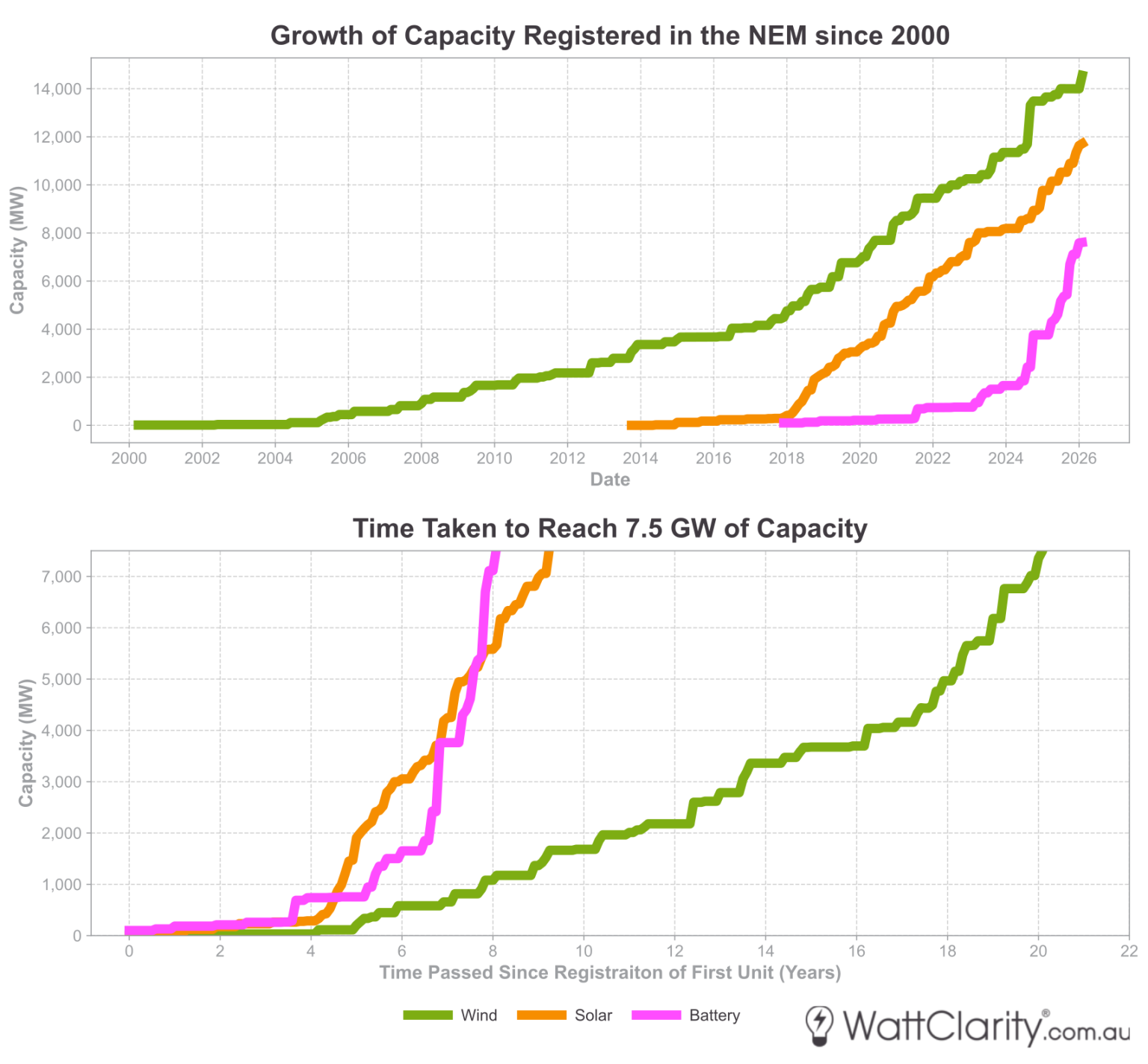
The battery fleet’s capacity has ramped up faster than the wind or solar fleet did at a comparable size. With at least 7.7 GW of additional batteries still coming, the growth of batteries will reach a much faster rate than at any stage of the solar buildout. Source: NEMreview.

To me, the more striking figure is behind-the-meter. In the first nine months of the federal government’s home battery subsidy scheme, somewhere in the vicinity of 4 to 5 GW of residential battery capacity has already been installed. Like rooftop solar before it, the vast majority of this capacity is effectively being dispatched before utility-scale storage assets — quietly shrinking the parts of the duck curve that grid-scale batteries target.

9


Just remembered this old article, still great

10
submitted 8 months ago by to c/RTFA@aussie.zone


https://archive.md/7SJqf

This article is long even by my standards but that might be because I'm not that deeply interested in the politics of silicon valley ... but this does feeeeel like it could come up in a few years for different reasons

11
12


Just putting this here

13
Why Arabs Lose Wars (www.meforum.org)
submitted 10 months ago by to c/RTFA@aussie.zone
14


Crossposting - it's worth a full read. Discusses actual extensions of the German Nazi Party operating in Australia in the 1930s, and what happened after the war had ended.

15


Solid

The Solid project "aims to radically change the way Web applications work today, resulting in true data ownership as well as improved privacy"[2] by developing a platform for linked-data applications that are completely decentralized and fully under users' control rather than controlled by other entities. The ultimate goal of Solid is to allow users to have full control of their own data, including access control and storage location. From Solid (web decentralization project)- wikipedia


Hi all who have a read of some or all of this, thanks for taking the time. I mean this post to be a conversation starter about possible avenues/roadmaps for an Aussie Zone/users option to implement SolidOS.

As i've read about this Tim Berners-Lee led project over the last few months i've become more convinced that the values of the Aussie Zone community match very well with the data sovereignty allowed by Solid. I first found out about Solid on The Man Who Invented the World Wide Web (Tim Berners-Lee) - Rest is Politics Leading.

I also believe this could provide a long-term durable answer for regulatory challenges like the social media ban. As of December 10th you need to be sixteen to hold an Aussie.Zone account.

I decided to put it in c/rtfa instead of c/meta because i suppose its not necessarily specifically about AZ at the moment. And theres a lot of links with lots of reading, i think it would all add up to more than 2000 words, so it seems suitable for this community.

Following are some links to explainers or implementations of the technology i've found:


Solid (web decentralization project)- wikipedia

I found a good explanation of the dssign on here,

In more detail, Solid consists of the following components:[16]

An organized collection of standards and data formats/vocabularies providing the same capabilities that centralized social media services offer, such as identity, authentication, login, permission lists, contact management, messaging, feed subscriptions, comments, discussions, and others. Specifications and design notes describing a REST API to extend existing standards, to guide developers building servers or applications. Servers that implement the Solid specification. A test suite for testing and validating Solid implementations. An ecosystem of social applications, identity providers, and helper libraries that run on the Solid platform. A community providing documentation, discussion, tutorials, and presentations

This next quote describes what I see as my place and reason for making this post,

...Berners-Lee advises that people without coding skills should instead advocate publicly for changing the Internet...

Intro to SolidOS - w3.org

The above link is a great illlustrated explanation of Solid by w3.org.

Solid project

Imagine having your own online storage, which you control. You store information once and decide who can access what, when you need services like mortgage applications or medical care.

This is what Solid can do. It’s a bit like carrying all your data in a rucksack (backpack) with lots of pockets. To access the data, different apps can only open the pocket you allow them to open, rather than taking the whole rucksack. The rest stays private.

Solid lets people take control of their data and combine it to achieve new results. It gives creators new collaborative tools while passing power back to users. It’s technology that returns the web to its original vision of serving people.

Standards for Agentic Commerce: Visa's Bold Move and What It Means

Inrupt is Tim Berners-Lee's commercial enterprise for Solid. They're really onto the agenticAI stuff now, so i'm jot sure if its a useful link beyond building a larger picture of the technology's use.

Activitypods

The above link is a project that is along the same lines as what I imagine AZ would be implementing if the community were to go down this road. It looks like users could even use Activitypods itself, maybe with some sort of bridging/onboarding of the existing accounts.

Here are some quotes from the page,

ActivityPub ActivityPub is a decentralized social networking protocol based upon the ActivityStreams 2.0 ontology. It provides a client-to-server and a server-to-server API for all common social features: following, liking, reposting... It became a W3C recommandation in 2018 and is used nowadays by dozens of softwares.

What is the main shortcoming of ActivityPub ?

ActivityPub wants to make it possible to create decentralized apps. But to post videos, you need an account on a PeerTube instance. And to post images, you need an account on a PixelFed instance. You must thus handle multiple accounts, with their profile, list of followers, etc.

How does ActivityPods solve this shortcoming ?

With ActivityPods, you have only one profile, one outbox, one inbox and one list of followers - all in a single place. Applications connect to your Pod to post activities, read the inbox and fetch data. And of course they can connect to any existing fediverse application !

...

ActivityPods The framework to create decentralized social apps ActivityPods brings together two game-changing technologies, ActivityPub and Solid Pods, and empowers developers to create truly decentralized applications

ActivityPub is a decentralized social networking protocol based upon the ActivityStreams 2.0 ontology. It provides a client-to-server and a server-to-server API for all common social features: following, liking, reposting... It became a W3C recommandation in 2018 and is used nowadays by dozens of softwares.

What is the main shortcoming of ActivityPub ?

ActivityPub wants to make it possible to create decentralized apps. But to post videos, you need an account on a PeerTube instance. And to post images, you need an account on a PixelFed instance. You must thus handle multiple accounts, with their profile, list of followers, etc.

How does ActivityPods solve this shortcoming ?

With ActivityPods, you have only one profile, one outbox, one inbox and one list of followers - all in a single place. Applications connect to your Pod to post activities, read the inbox and fetch data. And of course they can connect to any existing fediverse application


Thanks for reading, if you've made it this far sorry for the terrible way i've put this together, had a certain little people climbing all over me this morning!

I'm not really advocating any specific action, as i say, I mean to start a discussion and get this topic into the collective knowledge of the community on AZ, as well as Lemmy in general.

The way I see it, theres two pillars of issues with the internet today, one is driven by siloed and monopolised platforms which ActivityPub deals with quite well. While the other is the issue of data sovereignty, or control and agency over your online data, which Solid presents an answer for.

I'd love feedback, and comments, but i know theres a lot to wade through here, so i take it as a win if people are little more familiar today with this as an option than yesterday.

Cheers, Gorgritch_umie_killa.
16


Listened to Thursday's Politics Now episode who had Matthew Knott on, it was an interesting enough episode. After listening i's looking up something else, and stumbled on this article about an article he wrote up.

I've no idea who Abraham Edwards is; had a quick look but couldn't see anything really on what their story is. But the article is an interesting critique of the article and subsequent revisions that seem more like obfuscations by Matthew Knott.

I haven't really come across Matthew Knott as a journalist before yesterday, but i found both interesting, so thought i'd share them as a pair. Theres no link i'm trying to draw between his appearance on the podcast and the critique of his journalism by Abraham Edwards other than sharing my personal introduction to him as a journalist.

17
18
19


cross-posted from: https://slrpnk.net/post/23013381

As cities heat up, reflective roofs could lower energy bills and help the climate. But dark roofing manufacturers are waging a quiet campaign to block new rules

archived (Wayback Machine)

20


Fake Work provides a theoretically rich and often amusing picture of the banalities and absurdities of certain types of work. And those who have labored in such environments are likely to feel that she gets a lot right in her descriptions of those sorts of workplaces. Unfortunately, almost everything that Fake Work has to say about Y2K is either sorely lacking in historical and technical context, or is simply wrong.

In fairness, Fake Work isn’t really about Y2K. It’s about capitalism. But the book’s thoughtful and amusing critiques of capitalism are consistently undermined by the way this book misrepresents and oversimplifies Y2K. In talking not just about work but about Y2K, the book throws the term “fake” around a lot, and for those who are interested in a historically accurate consideration of Y2K that creates something of a very real problem.

21


The Coriolis Effect is definitely real. It drives ocean currents and weather patterns. But does it make toilets flush and tubs drain the opposite direction when you cross the equator? No.

Let me lay some science on you. And if that doesn't convince you, I'm the Toilet Guru and I have experienced toilet flushes in both the Northern and Southern Hemispheres. I can report that flush direction is a random mix everywhere. Keep reading for the details and pictures.

22


Teasing the public with fraudulent or self-deluded promises of aliens used to mean something. It took work. It meant slapping together ropes and planks of wood and trampling miles of barley in the dead of night, hundreds of times, over 13 years. It meant riveting 1/8th sheet steel into a 3 m-high monolith and depositing it in the Utah desert. Even theoretical works used to require huge leaps of logic and real effort: to turn 1I/’Oumuamua — a building-sized chunk of nitrogen ice — into a defunct solar sail from a network of interstellar buoys emplaced by a Galaxy-spanning civilization, or to misinterpret common seafloor iron-rich spherules as “steel-titanium alloys” likely from an “alien gadget”. In contrast, the latest release from Avi Loeb and collaborators — that maybe the interstellar comet 3I/ATLAS is alien technology — feels phoned in, like they’re just going through the motions. Where, I ask, is the dedication to the craft?

23


cross-posted from: https://quokk.au/post/128459

Myalgic encephalomyelitis/chronic fatigue syndrome (ME/CFS) and long COVID affect large numbers of people, and constitute a substantial burden to the U.S. and global economies. The article by Eckey et al., in this issue of PNAS (1), adds to the growing evidence that the two illnesses have much in common. Moreover, the illnesses may represent just two examples of an even larger, recently recognized class of illness: post-acute infection syndromes (PAIS) (2).

24
 
 
25
view more: next ›