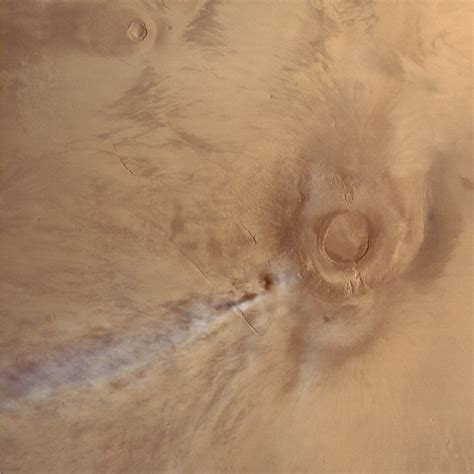
Since it was first recorded by a probe in 2018, scientists have been unable to find a plausible explanation for the existence of this cloud, often referred to as the Arsia Mons Elongated Cloud (AMEC). Until now. Recently, researchers successfully modeled the cloud’s formation for the first time, their results suggesting that it may be driven by a physical process that has never been directly observed in any planet’s atmosphere.
“We found that we needed to include some exotic physics… physics that, while included in textbooks, is treated as theoretical and usually thought not to happen in nature. It certainly hasn’t been seen in action before,” Jorge Hernández-Bernal, a planetary scientist at Paris’ Sorbonne Université and lead author of the study, said in a press release. “Once we included this physics in our simulations, the AMEC emerged just as we hoped.”
On Earth, clouds usually form when water vapor creates droplets or ice crystals in the presence of tiny particles, such as dust or salt. The new study, published in Nature Geoscience, instead suggests AMEC could be forming through so-called homogeneous nucleation, where vapor changes directly into ice crystals on its own without any help from debris.
“It’s akin to droplets of condensation appearing in the middle of a room, rather than on a window,” Hernández-Bernal explained. “It’s wholly unexpected.”