Commuter Trains, Ewing (West Trenton), NJ, 2010.All the pixels, but limited service on weekends and holidays, at flickr.com/photos/mattblaze/43#photography
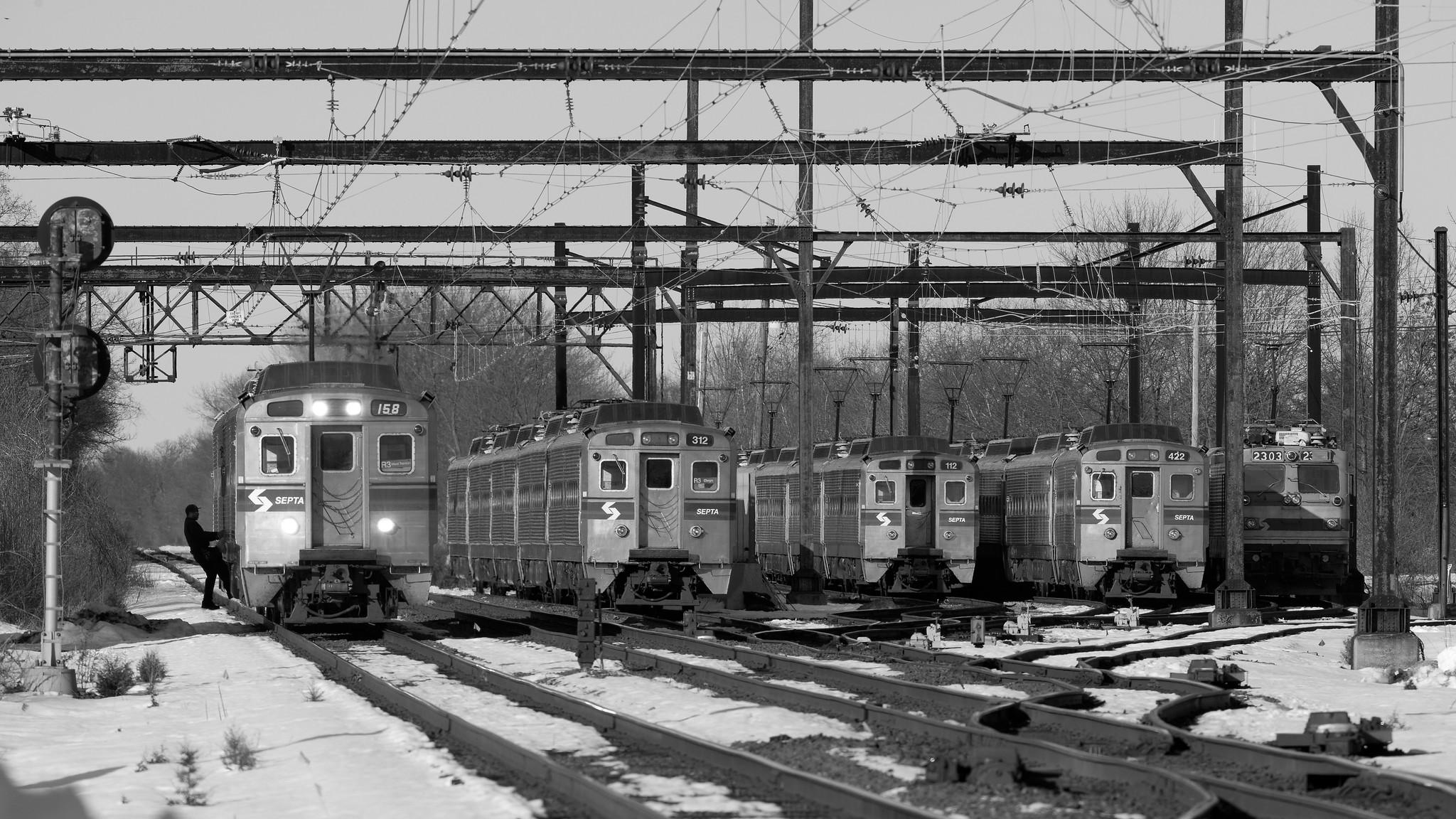
Five electric commuter trains in a rail yard, under overhead wires. A conductor boards the leftmost train. It is winter, with snow on the ground.
you are viewing a single comment's thread
view the rest of the comments
[–] [S] 1 point 1 year ago (19 children)

Very long lenses like the 400mm (and up), with their narrow field of view, are essential for some compositions (such as this one), but I find I only rarely actually use them. In fact, the longest lens I have for my main medium format camera system is 180mm (which yields the 35mm equivalent view of about a 120mm), and I hardly ever use even that for the most of the photography I do.For wildlife photographers, on the other hand, 400mm is practically a wide angle.

  • source
  • parent
  • hideshow 19 child comments
  • [–] 1 point 1 year ago (2 children)

    @mattblaze on my way out of town the other day I wished I had my 300mm on me, the 150mm wasn't nearly tight on the planes I was watching take off from the lounge. That said, the XF and four lenses is already more than heavy enough that I'd have been regretting it the entire trip.

  • source
  • parent
  • hideshow 2 child comments
  • [–] [S] 1 point 1 year ago (1 child)

    @LapTop006 I've never been happy with any of the long lens options for the Phase One (XT or XF). I've got a 300mm for my XF, but it most collects dust. I've pretty much given up and just grab the Sony if I need to use something really long.

  • source
  • parent
  • hideshow 1 child comment
  • [–] [S] 1 point 1 year ago (15 children)

    One of the challenges of very long lenses is that they tempt you to compose images of subjects that are very far away. But the farther away something is, the more the atmosphere can distort the image. The effects of heat distortion, pollution, humidity, and weather are amplified across longer distances, no matter how sharp the lens is or how high resolution the sensor.

  • source
  • parent
  • hideshow 15 child comments
  • [–] [S] 1 point 1 year ago (14 children)

    A quick and very pedantic note on long lens nomenclature:Lenses with a narrow field of view and a long focal length (> ~90mm or so on 35mm cameras) are called, appropriately enough, "long" lenses.Many, but not all, long lenses employ an optical design where their physical length is shorter than their optical focal length. These are called "telephoto" lenses. Most, but not all, telephoto lenses are long, and most, but not all, long lenses are telephoto. The terms aren't interchangeable.

  • source
  • parent
  • hideshow 14 child comments
  • [–] 1 point 1 year ago

    @mattblaze I guess it's still incorrect re: telephoto, but I ain't gonna redo the meme third time

    ![The "Don't make me tap the sign" meme template. The sign being tapped says '"oom"doesn't mean long reach or high magnification. That's called "telephoto". "Zoom" means variable focal length.

    Your phone doesn't have "optical zoom", it just has multiple lenses with different fixed focal lengths that it can switch between.'](https://static.glitch.social/media_attachments/files/115/332/746/363/143/758/original/c3c5893cd7e325d1.png)

  • source
  • parent
  • [–] 1 point 1 year ago

    @mattblaze Interesting. I've never heard of this differentiation. I always thought tele(photo) meant the same as long. Most interesting to me about this is that I at the same time can't understand why somebody would call long lenses zoom when they aren't zoom lenses as you suggest some people do sometimes.

  • source
  • parent
  • [–] 1 point 1 year ago (1 child)

    @mattblaze what do you mean by “their physical length is shorter than their optical focal length”?

  • source
  • parent
  • hideshow 1 child comment
  • [–] [S] 1 point 1 year ago

    @ross The physical length is the distance between the front of the lens and the sensor/film plane (as you'd measure with a ruler), with the lens focused at infinity. The optical focal length length is (roughly) the distance from the sensor/film plane to the plane at which the field of view of the lens is "framed".With a simple, single-element lens, these will be the same.

  • source
  • parent
  • [–] 1 point 1 year ago

    @mattblaze I've been shooting for many years including on a semi-professional level for the past decade and I never knew that's what telephoto meant!I learned the hard way that even moderately long focal lengths are enough to produce very significant atmospheric distortion. I've shot parades regularly. Crowds are a constant problem for parade photographers so I learned to bring a step ladder and a long lens to get around the people.This worked great until I had to shoot a parade someplace with humidity. All of my distance shots lacked sharpness. I thought I had a camera problem. It wasn't until I had to do the same shoot the following year that I realized the air was imperceptibly hazy to the naked eye.

  • source
  • parent
  • [–] 1 point 1 year ago (2 children)

    @mattblaze pedantic but interesting. The Venn diagram lunes of the exceptions must be interesting.

  • source
  • parent
  • hideshow 2 child comments
  • [–] [S] 1 point 1 year ago (1 child)

    @n1vux The interesting exceptions for telephoto=long are "pancake" lenses (usually designed for rangefinders), which are normal-wide but barely protrude from the camera body.

  • source
  • parent
  • hideshow 1 child comment
  • [–] 1 point 1 year ago

    @mattblaze so OM XA "reverse retro focus" was precusor of pancakes, neat.(I read that pedantically the folded cat-mirror lenses classify as tele as well. Numerically accurate.)(I do like a pancake lens for EDC.)

  • source
  • parent
  • [–] [S] 1 point 1 year ago (2 children)

    And none of this has anything to do with whether a lens is a "zoom", which refers to lenses with a focal length that can be varied across a range to achieve different angles of view without changing lenses. Many people casually use "zoom", "telephoto", and "long" interchangeably (usually when they just mean "long"), but that just confuses people who understand the technical meaning of those terms.

  • source
  • parent
  • hideshow 2 child comments
  • [–] [S] 1 point 1 year ago

    Also, fun fact, while zoom lenses today are very commonly used as a convenient alternative to multiple lenses in still photography, they were mostly developed for cinema, where "zooming" during a shot is an effect that can't be achieved without the ability to vary the focal length on the fly.

  • source
  • parent