A calculator you would approve of @SmartmanApps ! This might be one of my favourite algebraic #calculators, but then I was always a fan of Sharps. @calculators
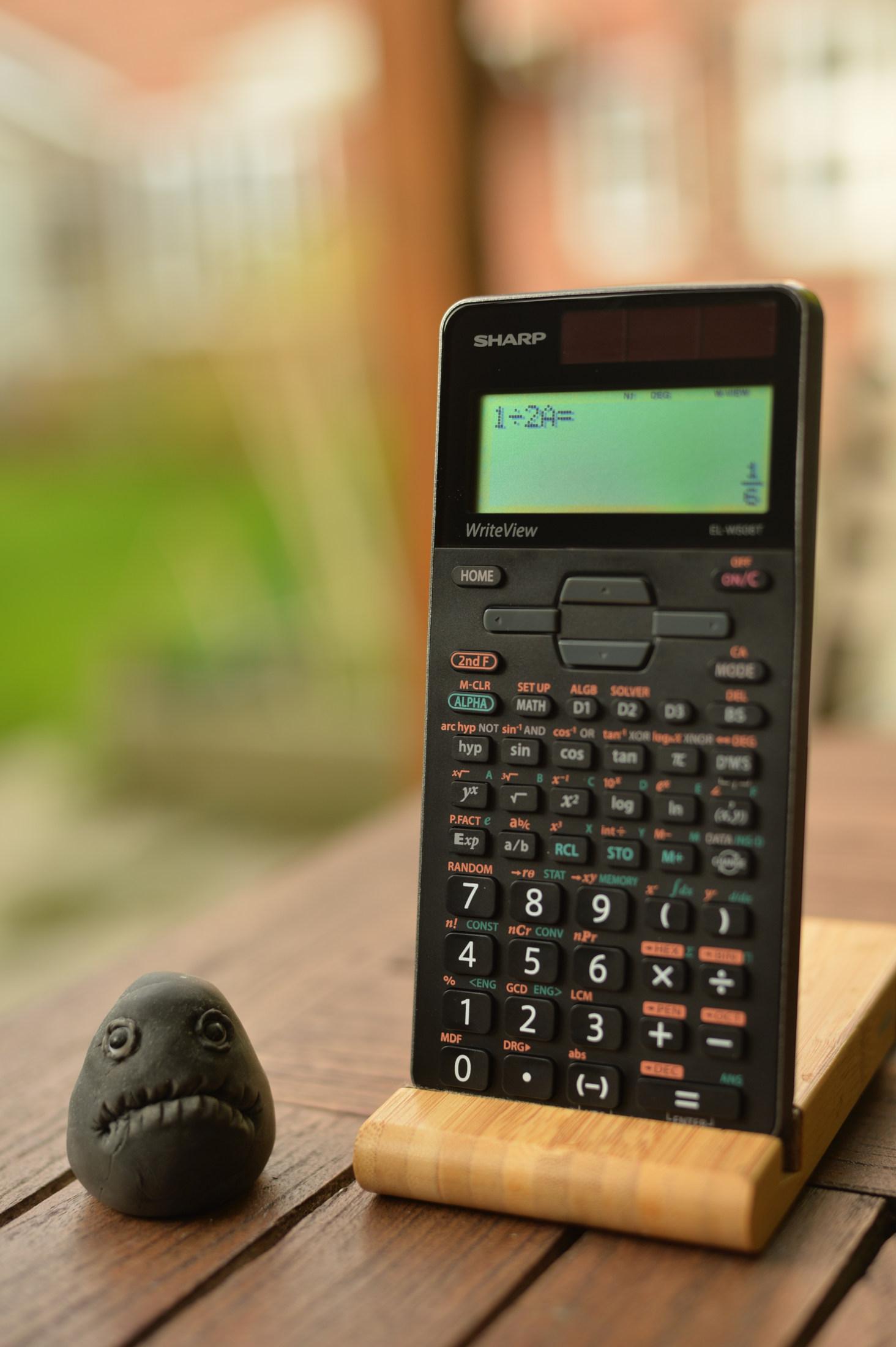
Sharp EL-W506T calculator next to a grumpy lump.
you are viewing a single comment's thread
view the rest of the comments
[–] [S] 3 points 1 year ago (5 children)

@JakeSparkleChicken Thanks! I like the UI so far, lots of features seem implemented well. Have heard about issues with trickier integration, but not about trig - do you have any examples?

  • source
  • parent
  • hideshow 5 child comments
  • [–] 2 points 1 year ago (3 children)

    Sorry about that! I spoke from memory instead of checking my data first. The Trig functions are pretty middle of the pack, it's the integration and the processor speed that are not that great. sum((e^sin(atan(x)))^(1/3), 1, 1000) takes six minutes to run, but at least it completes. The Casio fx-991CW takes just over on minute, and even the TI-36X Pro only takes four minutes.

  • source
  • parent
  • hideshow 3 child comments
  • [–] 2 points 1 year ago (2 children)

    Yes, I think the processor must be slower, and as a result, the integration is more limited. They also have different methods of differentiation, and maybe the Casio one is superior.

    I don't have a 991-CW, but do you know what it can do with the complex functions? My experience of older Casio 991s is that complex is limited to arithmetic operations only. This seems to be the case on the W506T - i.e. it won't do Log or Sin of a complex number. But then many 'scientific/non-graphing' calculators (except for HP) don't.

  • source
  • parent
  • hideshow 2 child comments
  • [–] 2 points 1 year ago

    Just to follow up, there's a great thread on integration on the W506T here: https://www.hpmuseum.org/forum/thread-13968.html. The upshot is that is that the 506 uses Simpson's, which will falls down in some use cases, especially ones with asymptotic curves, and needs the user to select more iterations manually.

    In terms of trigs I tried these two: cos(1.57079632 rad) = 6.79491584e-9, which is correct to 4 decimal places. Not bad, better than older Casios, not as good as the latest Casio platforms which get at least 9 digits correct. arcsin(arccos(arctan(tan(cos(sin(9 deg)))))) = 9.0000001 which is reasonable.

  • source
  • parent