1
2
3


cross-posted from: https://leminal.space/post/35929945

Does anyone know a Nostr client that supports bulk adding relays?

Many clients let you export all relays as a text file or zip, but there’s no import feature. This makes switching clients or sharing relay lists tedious.

Is there a way to bulk import relay lists efficiently? If you’ve found a trick or client that does this, please share!

#Nostr #Decentralization #Relay #Crypto #CryptoCommunity #Web3 #OpenWeb #Privacy #PeerToPeer #Federated #DecentralizedNetwork #PrivacyTools #DigitalFreedom #NostrRelay #SocialMedia #Tech #Innovation #Blockchain #Distributed #Networking #OpenSource #Software #TechCommunity #Coding #Programming #Developers #TechNews #OpenTech #DigitalPrivacy #DataOwnership #InternetFreedom #SocialNetworking #P2P #TechTrends #NostrClient #NostrApp #NostrNetwork #RelayManagement #TechSolutions #DigitalRights #TechDiscussion #FOSS #FreeSoftware #Cryptography #DigitalSecurity #OpenInternet #DecentralizedApps #PrivacyFirst #Web3Community #TechSupport #TechTips #NetworkingTools #TechTalk #DigitalInnovation

4
5


Hi. I've been researching alternative Internet protocols and decentralized systems for a while, and I'd like to ask for guidance because I feel like I'm mixing a number of ideas and I still don't see a really viable architecture.

I'm interested in simple protocols like Gemini, Spartan, Gopher and especially Nex for their simplicity. I have also looked at other things like IPFS, Freenet, torrent, Reticulum and Yggdrasil. Nostr leaves me rather sceptical: I have read things about him, but his ecosystem seems to me to be very linked to the critical world and, in general, I do not see him as minimalist as I expected. Secure Scuttlebutt and Earthstar also draw my attention, but I honestly don't understand how they work or whether they could serve what I'm looking for.

What I'm trying to imagine is a modular, decentralized and censorship-resistant network, but it can also work on limited and old hardware, such as:

Nokia with Symbian,

devices with KaiOS,

Old PCs with Windows XP or light Linux,

and even, in some cases, consoles that can run Linux, such as Wii or PS2.

The idea is not to make a "perfect" system, but something realistic, useful and quite autonomous for people who do not have access to a modern or powerful machine.

What I'm trying to figure out

Transport layer

What interests me most is that the data can move over the Internet, but I would also like the system to be compatible with something like Reticulum, because the more options you have the better. I've also heard a lot about Yggdrasil, but I don't just see clearly what role I could play in this case.

  1. Content distribution layer

The most meaningful option here is torrent, but I have several problems with it.

When there are few seeders, the content becomes fragile and can easily disappear. In addition, publishing in a really anonymous way is complicated, because you usually end up exposing your IP if you want to share something directly.

Hypercore also interests me, especially for the idea of being able to add new content without deleting the above, something like a feed or a history only of additions. The problem is that he's very close to Node.js and Rust, and for what I have in mind that doesn't help me too much. IPFS seems slow and heavy to me, and Freenet doesn't even talk. My idea is about situations where there is no access to another more powerful machine, so depending on a proxy or an intermediate node is not what I'm looking for. I would like these limited devices to be as autonomous and independent as possible.

  1. Cryptography and anonymity layer

If you can, I'd like to include anonymity in some safe way. Not necessarily for everyone or for all uses, but it is a real option for those who publish content.

  1. Interface layer

The part visible to the end user I would like it to be very simple: a light browser type Nex, Gopher or Gemini that only download, decipher if necessary, cache and render text.

If there is multimedia, I would like it to be optional and separate, so that the system remains usable on very limited machines.

What worries me

Here are my main doubts:

How can a decentralized network be combined with extremely limited customers without forcing them to use proxies or intermediate machines?

What real options are there for the author to publish content anonymously without losing compatibility with old customers?

Can you design a system where the same content is accessible in various ways: anonymous, pseudonym and public?

What alternative to torrent would make sense if I wanted updates and not just fully static content?

Can Reticulum and Yggdrasil serve as transport, discovery or bridge between nodes, or do they not fit this goal?

Would Hypercore be better than torrent for updated content, or is it too heavy for this case?

What part of the problem is solved with hashes, signatures, DHT, webseeds, myrors or mutable pointers, and what part is not?

My background idea

The philosophy I have in mind is something like: if a team still works, it should still be able to access information and leisure without being forced to buy new hardware. I'm interested in a kind of modular and minimalist internet, designed to ensure that an old device is not excluded because of the ecosystem.

I'm not looking for something ideal in abstract, but an architecture that can really exist. If there are similar, experimental or partially useful projects, I would also like to know them.

Thank you in advance to anyone who can guide you on this.

6


cross-posted from: https://lemmy.ml/post/45604769

TL;DR: I'm not a programmer. I'm a sysadmin with a dream: a distributed forum database with no owner, no single point of failure, client-side filtering (like VLANs for content), and optional Nostr/ZeroNet/Atlas transport.

What exists: database replicated across nodes, each node chooses what to store and what filters to apply. Moderation = subscribing to trusted filters. No crypto required.

What I need: reality check, technical feasibility analysis, database schema advice, prototype devs (PHP/Go/Rust), testers.

What I offer: small budget ($100-200/mo for specific tasks), domain/hosting funding, endless gratitude.

Full article (detailed, 8000+ words, includes philosophy and use cases): https://write.as/zyhlc76pi2op3.md

Please be brutal. I can take it.

7
8


What is Tyr?

We're taught that email must go through servers. Why? Because the Internet was built around centralized infrastructure. Every email you send travels through multiple servers - your provider's server, maybe a few relay servers, and finally your recipient's provider's server. Each hop is a potential point of surveillance, censorship, or failure.

Even "encrypted" email solutions still rely on these centralized servers. They encrypt the message content but the metadata - who you're talking to, when, how often - is visible to anyone watching the servers.

But there is a network, called Yggdrasil, that gives everyone a free IPv6 and doesn't need a blessing from your ISP. We finally have this possibility to use true P2P email. And moreover, this network has strong encryption to protect all data that flows from one IP to another.

Tyr brings true peer-to-peer email to your Android device using these unusual conditions. Unlike traditional email clients, Tyr doesn't need:

❌ Centralized mail servers (the connections are straight P2P)
❌ Message encryption layers (the network takes care of that)
❌ Port forwarding or STUN/TURN servers (Yggdrasil handles NAT traversal)
9


When Cloudflare went dark, half of the internet staggered with it. People kept calling it an “outage.” Let’s be honest: it was a structural failure baked into how today’s web works.

A centralized DNS stack is incredibly efficient right up to the moment it collapses. And when that single point of failure snaps, nothing downstream matters. Millions of websites freeze because one company sneezes.

We’ve normalized this fragility for way too long.

If yesterday proved anything, it’s this: the modern internet still depends on chokepoints that have no business existing in 2025.

Centralization wasn’t a mistake. It was a shortcut. And shortcuts always invoice us later.

The alternative isn’t theoretical. Decentralized naming systems are finally maturing, and they don’t break just because a single provider does. Not because they’re magical or perfect, but because mathematically they can’t collapse the same way centralized DNS does.

Several experimental architectures have been exploring this direction for years, including ledger-based distributed name systems that remove the root-layer bottleneck entirely. The point is: the path forward exists — we just haven’t committed to it as an internet community.

Yesterday wasn’t a warning. It was a preview.

The next outage won’t be a wake-up call. It’ll be a consequence.

It’s time to rethink the root layer of the internet, not patch it.

Resilient systems aren’t optional anymore. They’re overdue.

10


Eugen Rochko: "After nearly 10 years, I am stepping down as the CEO of Mastodon and transferring my ownership of the trademark and other assets to the Mastodon non-profit."

11


How could a robust decentralised file system be useful?

Would you use one if one was available?

If so, to what use (storing, sharing, building apps on top of it, ...)?

If not, are there some specific reasons like difficulty to set up, legal, you already use one, or other?

I'm making one and it is fully functional but adoption is not here yet so I'm trying to figure out why.

Cheers

Edit: I'm referring to a decentralised online storage, accessible from anywhere.

12


This page provides a measurement of Bluesky PBC's control over various components of the AT Protocol social network infrastructure. It tracks the distribution of power across key protocol elements, helping to assess the current state of decentralization and identify areas where centralized control may need to be reduced to achieve the protocol's long-term vision of a truly distributed social network.

13
14
15
16
17
18
19
20
21
22


This post is a blogpost version of a recent talk that Daniel Holmgren gave at AtmosphereConf (March 2025).

AT Protocol (or atproto) is a protocol for creating decentralized social applications.

It's not the first protocol with that aim to exist. In the history of decentralized social media protocols, atproto takes a unique approach which is still deeply influenced by technologies and movements that came before it.

The phrase “atproto ethos” often comes up during our protocol design discussions. It's a fuzzy term, but we use it to refer to the philosophical and aesthetic principles that underlie the design of the network.

In this post, we'll distill that ethos. First, we look at the movements in technology that have most directly influenced atproto.Then, we pull out the core innovations that atproto brought to the table. Finally, we highlight some opinionated ways of thinking that influenced the design.

23
 
 
  • Added a Mastodon importer to move your Mastodon posts to your WordPress site.
  • User setting to enable/disable Likes and Reblogs
  • + a ton of fixes
24


Mar 13, 2025

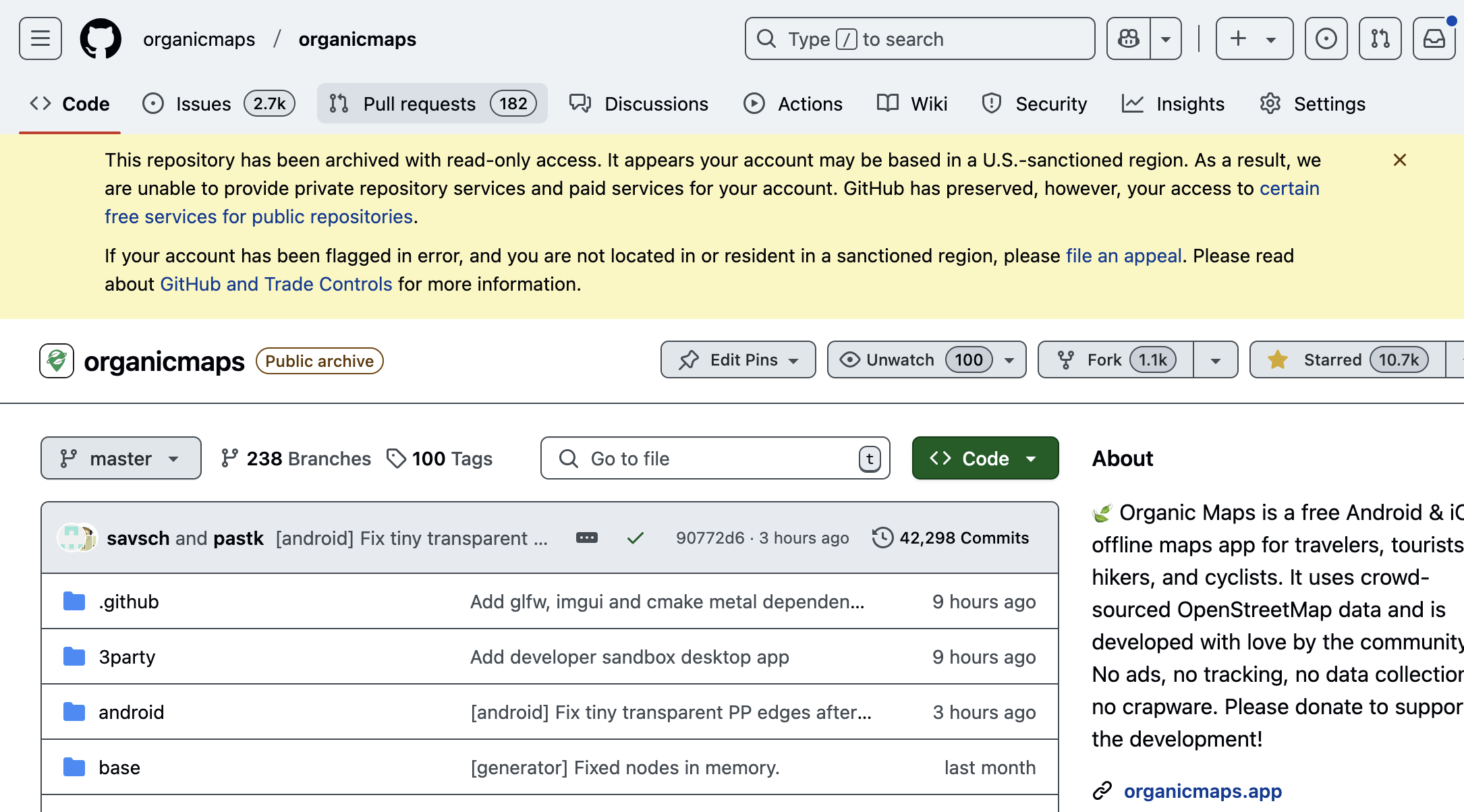
We have a temporary glitch with GitHub—probably some contributor was geolocated in a sanctioned region (no details yet). All required documents to unlock the account have been uploaded. Don't blame Microsoft/GitHub - it is just U.S. law. Please be patient. It should be unblocked soon.

GitHub read-only

Mar 27, 2025

GitHub has gone - long live Forgejo (@forgejo).

Fully migrated out of Microsoft’s walled garden after they blocked us:

  • 54k commits
  • 9.5k issues
  • 4.3k pull requests
  • 100k comments

Everything moved. Nothing left behind.

https://git.omaps.dev/organicmaps/organicmaps

25
view more: next ›